AUD/USD analysis: bearish ahead of RBA monetary policy meeting

AUD/USD Current price: 0.7209
- Australian dollar has little chances of recovering ground, even in a weak-dollar environment.
- RBA monetary policy expected to bring no surprises, keep rates at record lows.
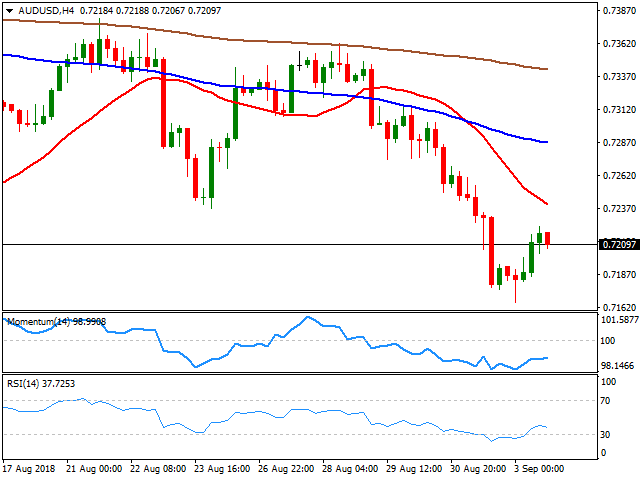
Commodity-related currencies were under selling pressure at the beginning of the day, with the AUD/USD pair hitting its lowest since January 2017 before bouncing some. The pair traded as low as 0.7165 amid global trade concerns, following the failed negotiations between the US and Canada and headlines indicating that the US will be hitting China with tariffs on up to $200B worth on goods. Data coming from Australia was mixed, as Retail Sales was flat monthly basis in July, missing expectations of a 0.3% advance. The AIG Performance of Manufacturing Index, however, rose to 56.7 in August, while the TD Securities inflation was up 2.1% YoY. The Chinese Caixin Manufacturing PMI in August came as expected at 50.6, down from July's reading of 50.8.
The Reserve Bank of Australia is having a monetary policy meeting during the upcoming Asian session, largely anticipated keeping rates at record lows of 1.5%. The accompanying statement will be scrutinized in search for clues about any change in the outlook of future monetary policy decisions, with changes of such occurring being quite limited.
The intraday recovery seems a correction due to the extreme oversold conditions of the pair, although the bearish potential remains intact. In the 4 hours chart, the price remains below a bearish 20 SMA, which extends its decline below the 100 and 200 SMA, while technical indicators remain well into negative territory, having already lost upward strength. Even in a dollar-weak environment, the Aussie has little chances of recovering ground.
Support levels: 0.7165 0.7130 0.7100
Resistance levels: 0.7225 0.7260 0.7300
Author

Valeria Bednarik
FXStreet
Valeria Bednarik was born and lives in Buenos Aires, Argentina. Her passion for math and numbers pushed her into studying economics in her younger years.