Asia wrap: The US Dollar wrecking ball
- The King Dollar is no longer just firming; it is starting to behave like a wrecking ball across Asian FX, equities and Gold.
- Korea is becoming the clearest pressure point, with foreign equity outflows meeting a won already trading near its weakest levels since 2009.
- USD/JPY at 162.75 keeps Tokyo’s intervention risk alive, but the wider market is still trading the rate differential rather than the Ministry of Finance.
- Kevin Warsh’s speech and Thursday’s US payrolls report now matter more than the latest AI dip. The Fed is no longer the market’s friendly bartender.
The wrecking ball
The King Dollar is back in the driver’s seat, and the ride is getting rougher for the parts of Asia that had grown accustomed to the old market assumption that the Federal Reserve would always keep one hand near the punch bowl.
That assumption is now the market’s most obvious Achilles’ heel.
With traders waiting for Federal Reserve Chairman Kevin Warsh’s remarks in Europe on Wednesday, the DXY has gained a touch, extending a 0.6% advance over the previous quarter. Treasuries remained on the defensive, with the 10-year yield edging another basis point higher to 4.46%, while gold slipped 0.6% to around $3,975 an ounce as the prospect of higher US rates once again diluted the appeal of holding a non-interest-bearing asset.
The shift is subtle in rate terms but increasingly violent in cross-asset terms. Markets no longer treat the Fed as a friendly bartender quietly topping up the liquidity bowl whenever risk assets wobble. The possibility that Warsh’s Fed could deliver one or two “servicing hikes” next year, rather than a dramatic tightening cycle, is enough to keep the front end firm, keep the USD well bid and likley rally further.
Asia FX is starting to feel the wrath of that wrecking-ball dynamic.
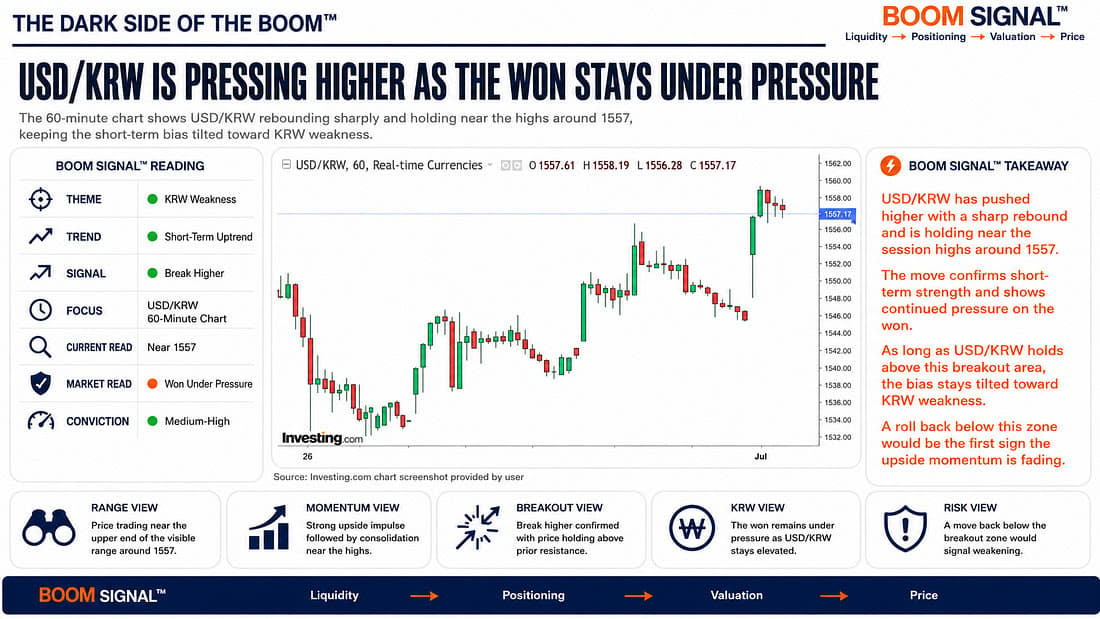
South Korea’s won slid as much as 0.6% to 1,559.10, moving back toward last month’s 1,562.20 low, a level not seen since March 2009. The move came alongside another wave of foreign selling in Korean equities, with overseas investors unloading a net 1.46 trillion won, or roughly $938 million, of Kospi stocks on Wednesday. That would mark an eighth consecutive day of outflows.
The concern is not simply that the won is weak. It is that the currency is weakening as foreign participation in the equity market is being pulled back. This is real, not speculative, flow dynamics. The Kospi fell as much as 3.9%, with Samsung Electronics and SK Hynix both down at least 3%, as global investors continue to reassess AI exposure after the broader market suffered a record $58 billion in foreign selling last quarter.
That selling was partly driven by global funds hitting exposure limits to Samsung and SK Hynix, but the broader message is more uncomfortable. Korea has become one of the clearest examples of how quickly an AI-heavy market can shift from a leadership trade to a funding leg when global investors need to reduce risk, thanks to the massive leverage backdrop.
The key problem is that investing in the assets of a foreign economy becomes far less attractive once its currency is added to the risk equation. A local equity market may still offer a respectable return, but a falling currency can erase that gain quickly. What appeared to be a straightforward equity allocation suddenly becomes a more volatile cross-currency position.
For large US foreign capital allocators, the comparison is increasingly straightforward. They can keep capital at home in an economy that is still growing, earn a decent return in cash or Treasuries, and avoid the additional uncertainty of foreign-exchange losses. More so if they belive the dollar rally has more legs. Overseas markets, therefore, have to work much harder in this environment to secure the allocation. They need to offer sufficient upside to compensate for local equity risk, policy risk and the possibility that the currency moves sharply against them.
That is why the stronger dollar is such a powerful force and can turn into a global wrecking ball. It does not simply weaken Asian currencies; it changes the global capital-allocation equation. Once FX risk starts to dominate the expected local equity return, the natural response is to reduce exposure, repatriate capital, and stay closer to home. Korea is now carrying both sides of that trade: a weaker won and equity outflows that reinforce currency pressure.
Asia FX traders are beginning to talk openly about USD/WON 1,600, a level that would be more psychological than technical. Once a currency nears a crisis-era extreme, the market stops pretending that neat chart levels offer much comfort. The next move hinges on whether policymakers can alter the narrative before investors decide to test the round number.
The pressure was not confined to Korea. The Indonesian rupiah, Philippine peso and Thai baht all weakened, while USD/JPY rose to 162.70, leaving the yen at its weakest level since 1986. Tokyo is now firmly inside intervention territory, but the market continues to trade the yield differential rather than the threat of official action.
That makes USD/JPY a dangerous market rather than an easy one. The intervention risk is obvious, but so is the carry appeal. Traders may be standing closer to the exit, but nobody has fully left the party yet.
Meanwhile, the two-day recovery in global equities began to lose momentum after a blistering quarter led by chipmakers and technology stocks. The market had spent much of the previous quarter looking through geopolitical risk and buying the AI growth story with both hands. Now it faces a different test: whether that growth narrative can coexist with a Fed that is no longer willing to promise a painless path lower for rates.
Front-running Warsh’s Sintra speech may be the immediate catalyst, but Thursday’s US June payrolls report is the true pressure gauge. A strong report will reinforce the case for higher-for-longer rates and give the $ another leg higher. A softer number may offer temporary relief, but unless it materially alters the Fed’s inflation calculus, it is unlikely to reverse the broader shift in market psychology.
Bottom line: The dollar is becoming the market’s most closely watched pressure valve. Watch USD/JPY, USD/KRW and US yields closely. As long as the 10-year yield holds near 4.47% and the Fed continues to talk about hikes rather than cuts, Asian currencies and AI-heavy equity markets remain exposed to another round of forced de-risking.
Author

Stephen Innes
SPI Asset Management
With more than 25 years of experience, Stephen has a deep-seated knowledge of G10 and Asian currency markets as well as precious metal and oil markets.