Asia open: The thin line between a new dawn and déjà vu

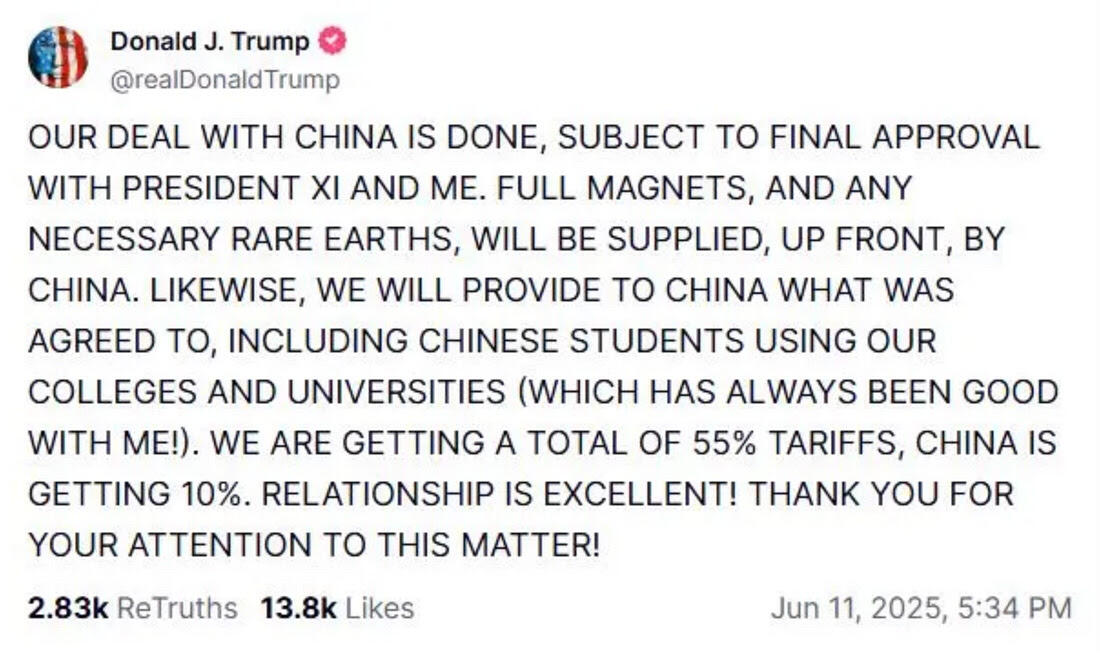
Asia wakes to another sunrise that feels both promising and familiar — a blend of optimism and that faint ache of déjà vu. Once again, the U.S. and China seem to have reached “framework harmony,” a phrase traders now treat like an old song they know too well. You hum along because you’ve heard it before, even if you don’t quite believe the ending. A Trump–Xi trade truce might be taking shape, but in trading rooms from Sydney to Singapore, it feels more like cautious déjà vu than a new dawn today — as traders remain cautious about a replay of June 11, the day the “ done deal” with China wasn’t quite done.
Still, no one’s willing to fight the tape. Hope, even recycled hope, trades well. Futures open mixed — Australia drags a little — and tech is in the spotlight, and not the good one, after Amazon announced plans to cut 30,000 jobs. In another era, that would’ve been cause for panic. But now, in the age of AI, job cuts are almost read as progress. Machines are taking over the assembly line of productivity, and the Fed, for all its power, has no rate tool for that kind of shift.
Meanwhile, Tokyo is the stage this morning — regal, deliberate, and heavy with symbolism. Trump’s meeting with Emperor Naruhito carried all the expected ceremony, but the real story sits beneath the surface: defence, money, and the kind of political choreography that moves markets. Prime Minister Sanae Takaichi — Abe’s protégé and Japan’s new conservative voice — brings both continuity and risk. Her rapport with Trump could deepen defence ties, which Washington will love, but JGB traders are already twitching. Her warmth toward Trump plays well in Washington but makes Japan’s bond market nervous. Talk of expanded defence spending could weigh heavily on Japan’s fiscal outlook, especially given that long-end JGB yields remain sensitive after her election victory sent them to multi-year highs. And that is where the balance of this morning's Tokyo market angst resides.
And yet, markets have a funny way of smiling through the noise. Trump’s visit has, perhaps whimsically, aligned with a symbolic milestone — the Nikkei 225 breaking above the 50,000 mark for the first time yesterday. That’s no small feat. Even as the index trades a touch softer this morning on the back of a firmer yen, the psychological lift remains.
U.S. Treasury Secretary Bessent, in his meeting with Japan’s Finance Minister Satsuki Katayama, politely tiptoed around the currency issue — praising the resilience of Japan’s economy without mentioning the yen’s weakness that has quietly fueled the recent equity surge. Diplomacy, after all, thrives on selective hearing — but FX traders catch the undertones. They read enough “Treasury Police” nuance to buy yen, which is trading stronger this morning. But if truth be told, it’s actually tracking the firmer Yuan.
Tokyo remains highly sensitive to regional cues. With the PBoC now strengthening the yuan and Trump arriving in Japan, likely pressing for a firmer yen, Tokyo must tread a careful diplomatic line. As one of Asia’s export powerhouses, Japan can’t risk being seen as playing for a currency advantage just as Washington lands at its doorstep.
Takaichi herself is an intriguing mix — nationalist in tone but pragmatic in action. She understands markets even as she courts ideology. Every handshake, every pause beside Trump’s podium will be studied for signals — not of diplomacy, but of direction. The U.S. wants Japan to do more on defense; Japan wants to protect its balance sheet. It’s a waltz of shared interests and quiet tension, each trying not to step on the other’s yield curve.
Later today, Trump will travel to Yokosuka — the joint U.S.–Japan naval hub that visually defines the alliance: steel, precision, and proximity. From there, he’ll meet with Japanese business leaders and repeat the familiar pitch — invest in America, bring jobs home, strengthen the partnership. It’s part politics, part salesmanship, and entirely on brand.
So Asia opens not with fireworks, but with an uneasy calm — a market breath half held. Traders aren’t chasing the rumor this time; they’re watching, weighing, waiting for something real to sign. Because beneath the warm glow of diplomacy lies a truth the market knows too well: global trade no longer moves in straight lines. It circles back on itself — deal, delay, détente, repeat. The dawn is beautiful, but you can’t shake the feeling you’ve seen this sunrise before.
Author
Stephen Innes
SPI Asset Management
With more than 25 years of experience, Stephen has a deep-seated knowledge of G10 and Asian currency markets as well as precious metal and oil markets.