Are we prepared? Military families face financial strain

Summary
In a report we wrote last November in commemoration of Veterans & Military Families Month, we found that household income among active-duty military families has lagged behind household income in the civilian sector for more than a decade. Elevated rates of joblessness and under-employment among military spouses is a major reason for the widening income gap.
We focus on indicators of financial stress among military families in this year's report. More than 30% of military families indicated in 2023 that they were either "finding it difficult to get by" or "just getting by." Unreimbursed expenses related to permanent-change-of-station moves have led to financial hardship for many military families.
According to the DoD, 65% of active-duty service members could cover at most three months of emergency expenses in 2022, while 12% had no emergency savings at all. Military families are less likely than their civilian counterparts to fully pay off their credit card debt every month. Compared to civilian families, a lower proportion of military families are food secure, with 10% of military families reporting their food security as being "very low."
High levels of financial stress among military families may pose a risk to the readiness of the U.S. armed forces. Survey data show that only one-third of military family members are likely to recommend military service, down significantly from 55% as recently as 2016. If the armed forces are not able to adequately recruit and retain service members, military preparedness could be negatively affected in coming years.
The Department of Defense and Congress have created a variety of resources in an effort to reduce financial strain experienced by military families. Service members received a 5% pay increase in 2024, the largest boost in more than 20 years, and the housing allowance was also increased.
One year of outsized pay increases will do little to narrow the income gap on a sustained basis. Until steps are taken to address the chronic joblessness and under-employment of many military spouses, some of the families that honorably serve the country likely will continue to feel financial stress.
Does lagging income growth lead to financial stress among Military Households?
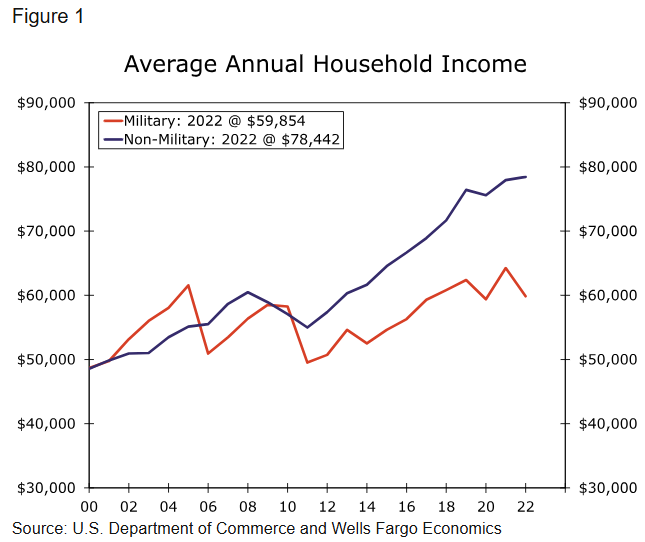
Over the past three years, we have published annual reports in recognition of Veterans & Military Families Month, which is commemorated in November. We have focused on issues faced by current service members and their families, as well as by those who have honorably served in the past. In 2023, we analyzed the income differences between active-duty military households and their civilian counterparts. As shown in Figure 1, average annual household income between the two cohorts was more or less similar in the 2000s. However, a gap has opened up in recent years, and the annual income earned by the average active-duty household currently lags behind the comparable amount for the average civilian household by nearly $19K (24%).
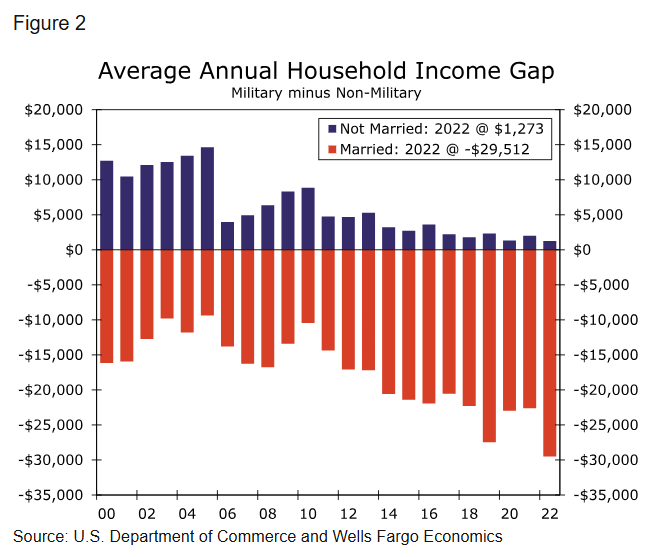
When we drilled down further, we learned that the widening gap in household income was due largely to spousal income. Active-duty military personnel who are single earned roughly the same, on average, as their civilian counterparts in 2022 (Figure 2). However, household income among married service members is considerably lower than married civilian households. Not only is the incidence of part-time employment among military spouses higher than among civilian spouses, but the unemployment rate among the former is astronomical. According to Blue Star Families, a non-profit organization that advocates for military families, the jobless rate among military spouses stood at 22% in 2022.
If average income among active-duty military households has lagged behind average civilian household income in recent years, are there more signs of financial stress among the former relative to the latter? Is there a financial "penalty" associated with military service and, if so, are there any consequences associated with that "penalty"? In a follow-up to last year's report, we evaluate financial stress among the nation's active-duty military families.
Author

Wells Fargo Research Team
Wells Fargo