Freight costs may reach US shelves after the Fed plans to stop hiking

The Federal Reserve (Fed) has forecast its main reference rate unchanged through 2027, a year when higher shipping costs are likely still reaching US store prices. Shipping a container from Asia to the US costs more than four times what it did before the war with Iran began in late February. International Monetary Fund (IMF) research puts the peak effect on shop prices roughly a year out, in 2027.
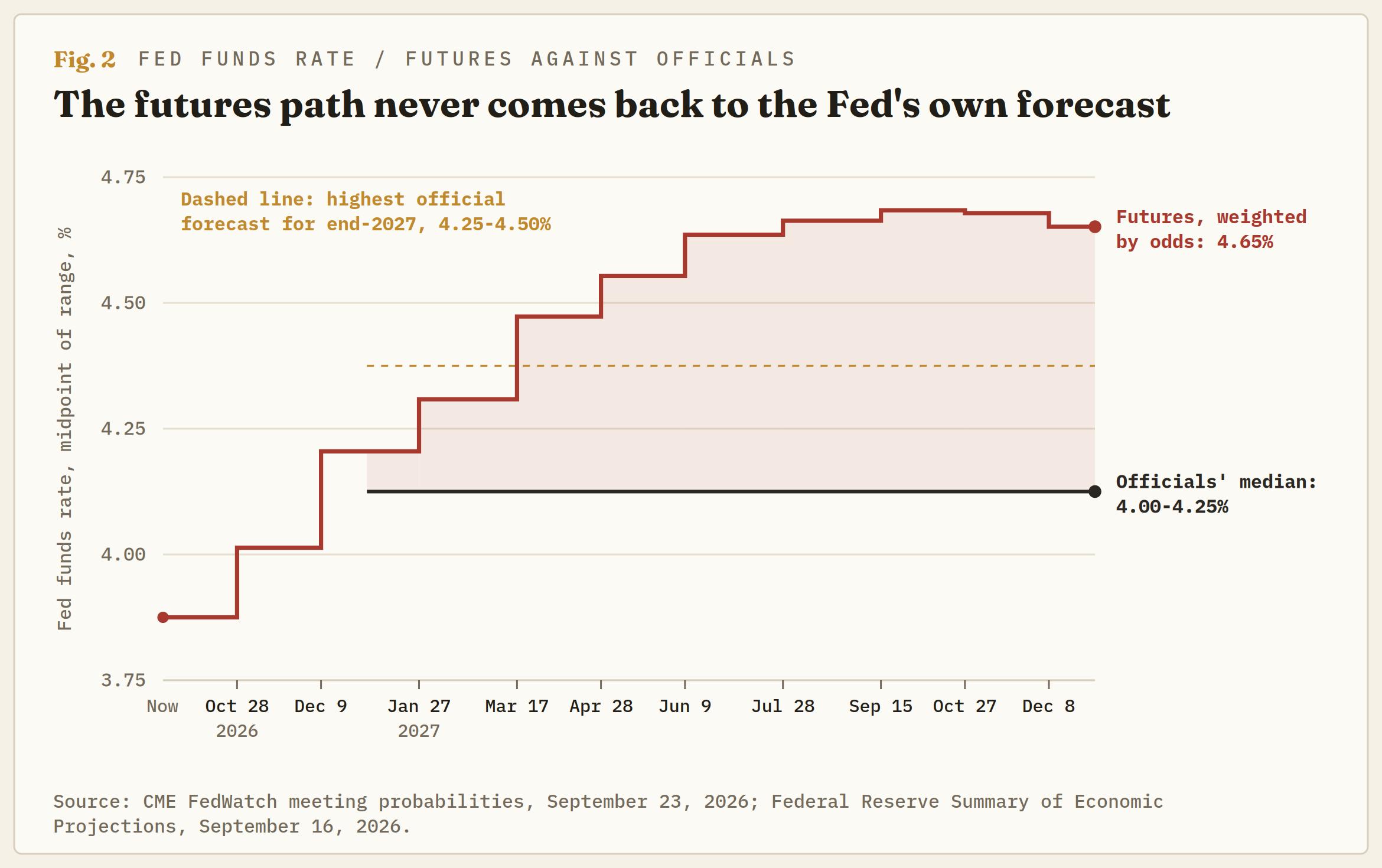
The CME’s FedWatch, which turns futures prices into odds for each Fed meeting, puts the rate at 4.50-4.75% by June 2027, three quarter-point increases above the current 3.75-4.00%. That is above the highest 2027 forecast submitted by any of the 18 officials who sent one in. Traders had odds on a cut at the end of 2027 as late as September 21 and have since taken it out. That leaves the officials' forecast as the one most likely to fail.
Imports cost more at the port and not yet in the shops
Prices of imported goods other than fuel rose 5.5% in the year to August, the most since May 2022, according to the Bureau of Labor Statistics (BLS). The BLS index mixes prices quoted with and without shipping, and tariffs and the Dollar push it too, so not all of that is freight.
Shop prices haven't followed yet. In the Consumer Price Index (CPI), goods outside food and energy rose 0.7% over the same year. The Fed's flat 2027 forecast depends on those prices staying quiet, and the goods in question are still at sea.
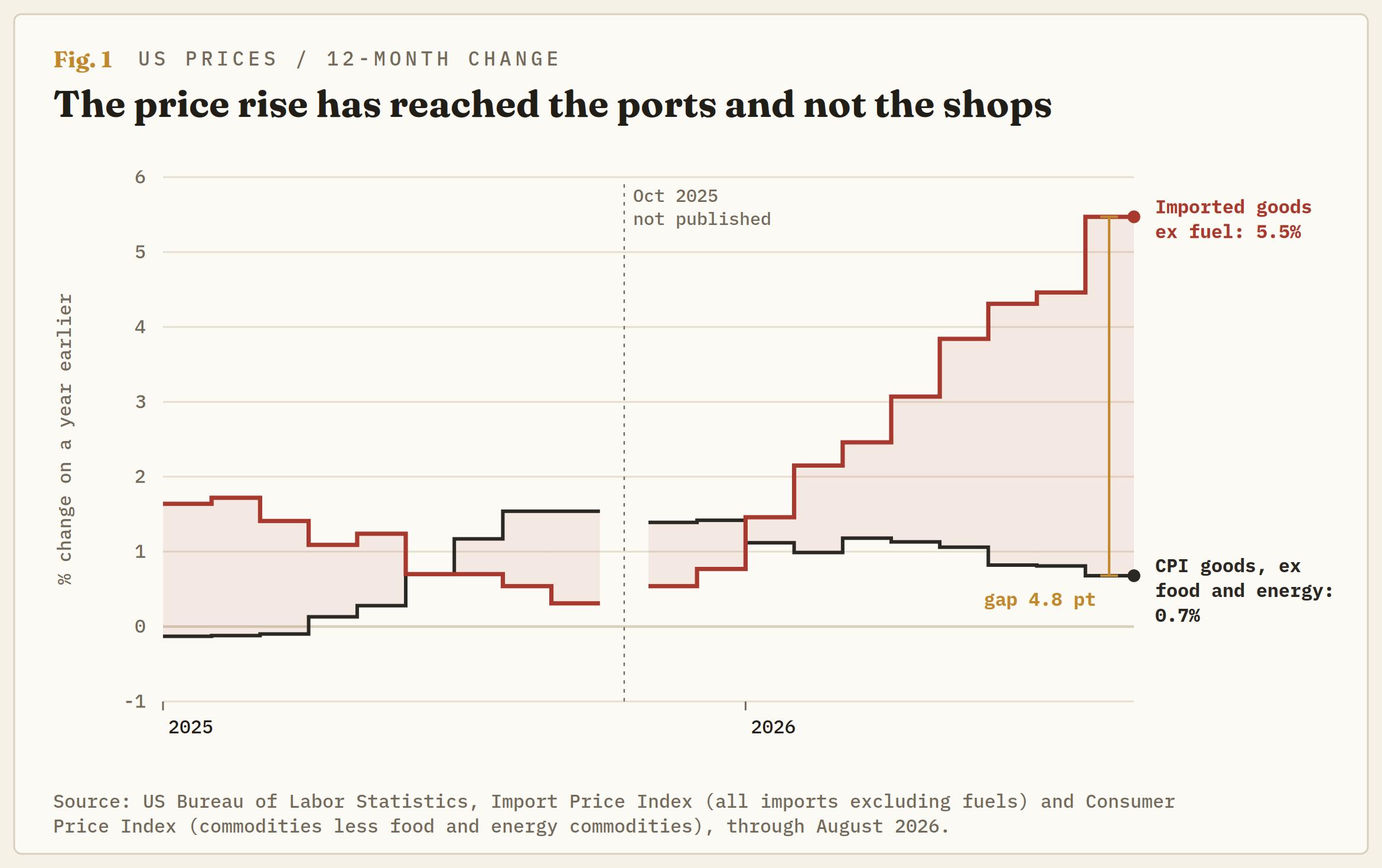
That is the order the IMF found in 30 years of data from 143 countries. Shipping costs reach import prices within two months and shop prices over about a year, with the effect peaking at 12 months and lasting up to 18. Fuel is faster, and gasoline is already up 27.4% over the year to August. Crude has since fallen back, after Saudi Arabia restarted the pipeline that carries its crude to the Red Sea on September 22.
Four times the freight and a rate held flat through 2027
On September 17, freight-rate tracker Xeneta had shipping a 40-foot container from Asia to the US East Coast up 325% since late February. The East Coast rate was 11% below its record, set on January 1, 2022. Drewry's broader index across eight East-West routes has held near $4.5K a container for three weeks.
The IMF measured shipping costs with the Baltic Dry Index (BDI), which prices ships carrying coal, grain and iron ore. The BDI is up about 70% since late February. On the IMF's rule of thumb, where a doubling adds about 0.7 of a point to inflation, that is worth about half a point across the countries it studied.
Big economies that make more of their own goods see less of it, so the US effect is likely a few tenths. A few tenths won't justify two more rate increases. With the IMF's timing keeping it in shop prices through 2027, it does argue against the Fed's forecast that inflation falls away. The half-point comes from a study of what it costs to ship coal and grain, and the goods on American shelves arrive in containers, whose rates rose far more.
Futures now price no cut at all in 2027
The Fed raised its rate a quarter-point to 3.75-4.00% on September 16, its first increase since July 2023. Officials' own forecasts, published the same day, put the rate at 4.00-4.25% at the end of 2026 and leave it there through 2027. They have the Personal Consumption Expenditures Price Index (PCE), the Fed's preferred inflation gauge, falling to 2.3% in 2027.
FedWatch gives 55.36% odds of another increase on October 28 and prices at least one by December 9 as certain, which matches the officials' median for 2026. Seventeen of the 18 said the risks to their inflation forecasts are tilted higher, and four of the 18 still pencilled in a cut during 2027. They also lifted their estimate of the rate that neither slows nor speeds the economy, to 3.25% from 3.06%.
Fed Chair Kevin Warsh said on September 16 that the Fed can't stop an Oil shock but does have a job stopping one from spreading. Shipping costs are one of the ways the war reaches prices outside energy.
Three October releases will show which forecast is right
The first test is China's early-October holiday, before which Xeneta expects one more rise in container rates and after which it expects them to soften. Soften means from within 11% of the record, not back to February. The BLS then publishes the CPI on October 14, producer prices on October 15 and import prices on October 16, and the Fed meets on October 27-28.
If CPI goods start rising from 0.7% over the winter, the odds of a fourth increase should climb from the 23.65% FedWatch gives for September 2027. If a cut returns to 2027 pricing while container rates stay near their record, traders are betting the shipping costs never reach the shelves.
Two-year Treasury yields move with traders' expectations for the Fed's rate, so anyone buying two-year Treasuries on the Fed's own forecast is betting container rates come down first. The freight case is wrong if CPI goods are still rising less than 1% a year by the March 2027 meeting, with container rates near their record.
Author

Joshua Gibson
FXStreet
Joshua joins the FXStreet team as an Economics and Finance double major from Vancouver Island University with twelve years' experience as an independent trader focusing on technical analysis.