April US Purchasing Managers’ Indexes suggest hiring limits
- Employment indexes fall sharply, the service sector slips into contraction.
- Unfilled jobs rise to an all-time record in March.
- Nonfarm Productivity drops the most in 75 years in the first quarter.
- Payrolls are expected to rise 381,000 in April, the smallest gain in a year.

As recession worries in the US rise, the job market has been a fount of optimism. Over the last six months, American firms have hired an average 600,000 workers, the best performance since the initial recovery from the pandemic lockdowns of March and April 2020.
But a combination of rapidly increasing labor costs and worker scarcity has seriously damaged the outlook of personnel managers and presents a warning for Friday’s Nonfarm Payrolls.
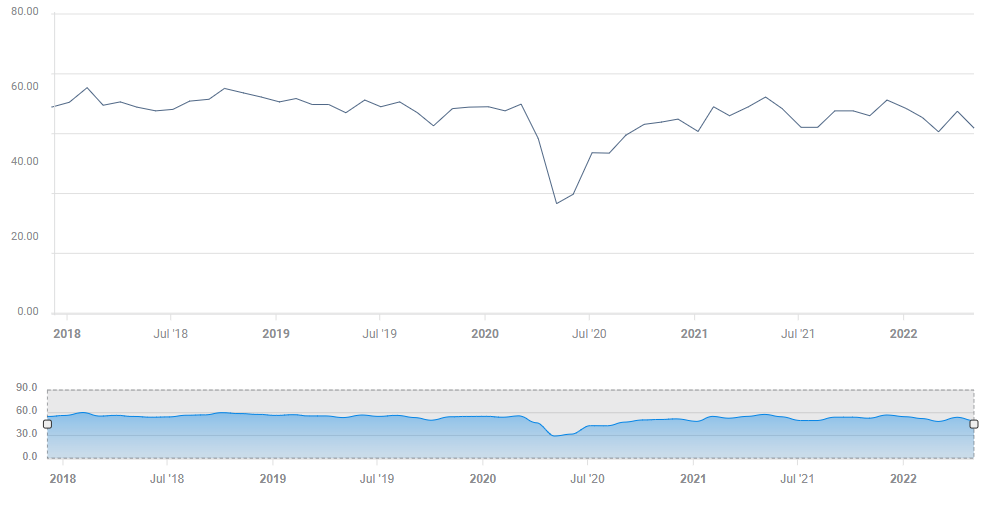
Purchasing managers’ indexes (PMI) for employment, a well-known forward indicator for the labor market, fell precipitously in April. The manufacturing index dropped 5.4 points to 50.9, the largest single month fall in over 20 years. It was the lowest reading since September and far less than the 54.7 forecast. Employment in the much larger service sector slipped into outright contraction at 49.5 from 54.0 in March. It was the second negative month in the last four, February registered 48.5.
Services Employment PMI
Managers in both sectors noted that the difficulty in finding and hiring workers continued to hamper production and that rising wages are a major factor in price hikes.
Overall, the performances of the indexes from the Institute for Supply Management were disappointing. The manufacturing PMI faded to 55.4 from 57.1 and the service poll dropped to 57.1 from 58.3. Each had been expected to rise.
New business was the most telling failure. The manufacturing index for new orders fell to 53.5 from 53.8, missing the forecast of 57.7. While the index remained positive above the 50 demarcation between expansion and contraction, it was the weakest level in 23 months.
Manufacturing New Orders PMI
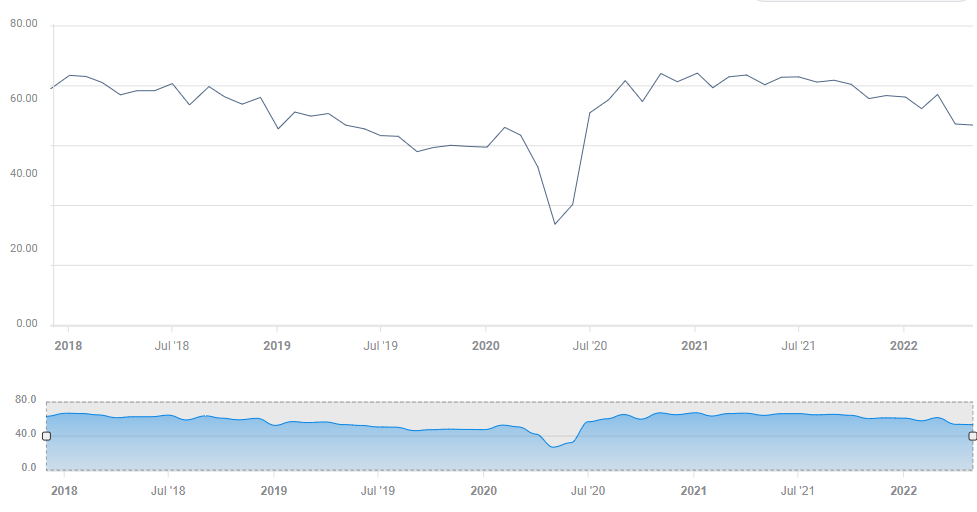
Orders in the service sector fell even more, dropping to 54.6 from 60.1, and were nearly 10 points below the 64.3 consensus estimate. This measure of incoming business was the lowest in 14 months.
Prices continued their ascent. The Prices Paid Index for services climbed to 84.6 in April, its highest level on record. Prices for the manufacturing index ebbed to 84.6 from 87.1.
Productivity, JOLTS and Initial Jobless Claims
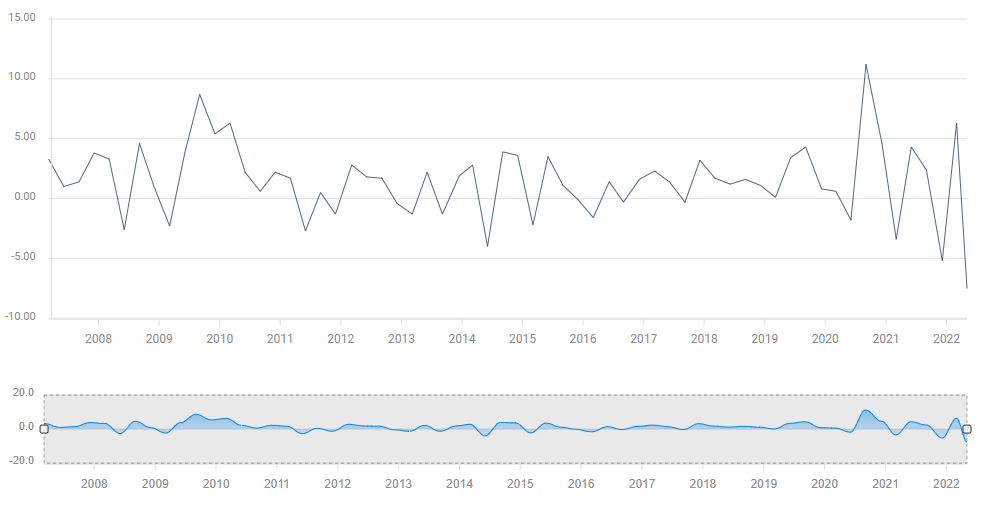
In a sign that soaring labor costs are biting into business profitability, Nonfarm Productivity in the first quarter plunged 7.5%, the biggest drop since 1947, and far more than the 5.2% forecast. Unit labor costs jumped 11.6%, making 7.2% over the past year, the largest increase since the the third quarter of 1982.
Nonfarm Productivity
Hiring problems have sent the number of unfilled positions in American industry and retail to another monthly record. The Job Openings and Labor Turnover Survey (JOLTS) listed 11.549 million open jobs in March up from 11.344 in February. Over the last four months, the number of empty positions has averaged 11.401 million.
Finally, Initial Jobless Claims rose 19,000 in the week of April 29 to 200,000, its highest total in seven weeks.
Concluding thoughts
Soaring inflation, plunging equity prices and the most aggressive Federal Reserve rate increases in two decades are different views of the same economic picture. It is probably naive to expect that payrolls can remain aloof from the burgeoning market turmoil. If job production turns south, one of the last supports of the economy will be gone.
Personnel managers have issued their warning.
Author

Joseph Trevisani
FXStreet
Joseph Trevisani began his thirty-year career in the financial markets at Credit Suisse in New York and Singapore where he worked for 12 years as an interbank currency trader and trading desk manager.