All sorts of stuff

Issuance anomaly
Before we get started, please complete this 70-second survey on Fed and USD. Results in Friday’s am/FX because I am off tomorrow.
Now moving right along. A super quick follow-up to my discussion yesterday about Google and their capital raise. I mentioned the research from 2006 and 2008 that identifies the share issuance anomaly. To check on how it played out after that (i.e., out of sample), I looked at equity returns vs. shares outstanding for the S&P 500 from 2015 to now. Here is the result.
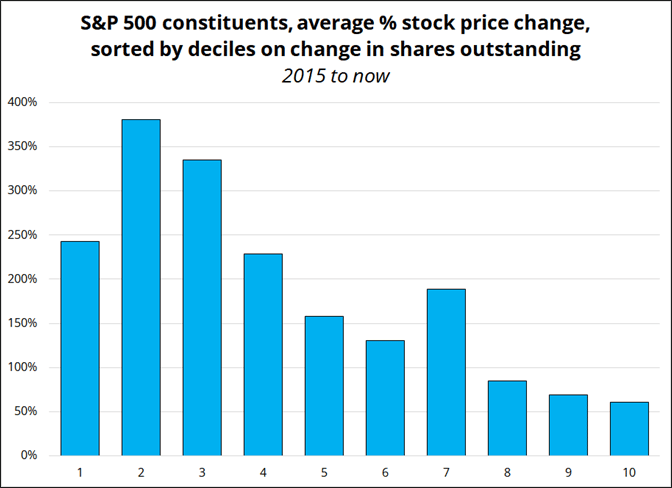
Does not include dividends, but they would not change results much
Obviously one key here is knowing ex-ante who is going to have higher or lower share counts over time. But Google just told you and other megatech is likely to follow now that they’ve opened the floodgates. This is good empirical evidence from a different period showing that share counts matter. There are simple reasons share counts matter (supply and demand) and more nuanced ones (issuance leads to higher capital spending, which lowers returns). Anyhoo, I thought that was interesting.
If you want the bear case on the financials around AI, Brandon Carl does an excellent job here. Brandon is an even-keeled and super smart guy. I worked with him at one point.
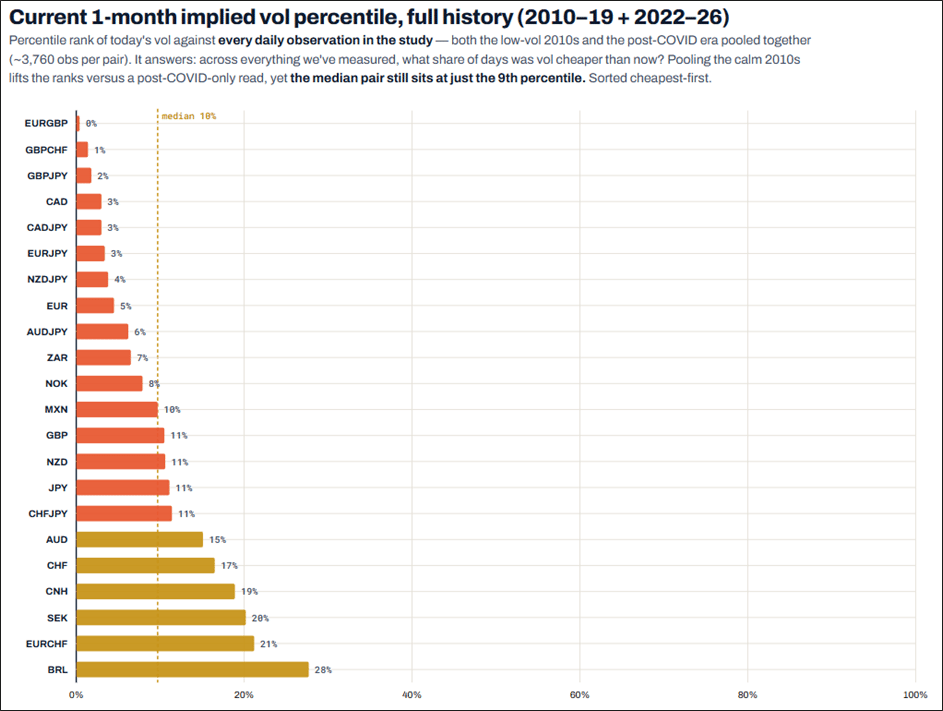
Buying vol because it’s low is not a viable strategy. Selectively buying vol on a very low base when you expected realized is about to pick up can be good. We have June FOMC on June 17 as the centerpiece event of the month, but NFP could also create some zip. Imagine a very strong NFP figure with a lower Unemployment Rate. That puts the MOF in an extremely awkward position if it takes USDJPY up through 161.00 as they would be intervening directly against fundamentals on the day of an economic release. They could do that, but it’s not very kosher in G7 communiqué terms.
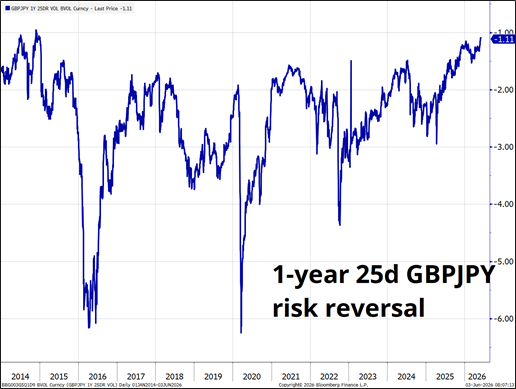
Look at GBP vol there. Mamma Mia. Not only is GBPJPY vol in the second percentile, 1-year 25-delta GBPJPY riskies are least bid for puts in >10 years.
If you spelunk awhile inside the caves of FX volatility, you will see all sorts of similar formations. The takeaway is not necessarily to buy vol with both hands, the takeaways are as follows:
1. If you have a directional view, it has rarely been cheaper to express it via options.
2. If you have a view on when things might move, you can express that cheaply, too. Even with event premiums around FOMC, etc., the baseline vol is so low that if things move, you’ll make money long options through those events.
3. If you’re bearish GBPJPY or have natural exposure to GBPJPY, it’s time to get busy buying puts.
4. Brazil and CNH vol are not nearly as cheap as most other pairs, relative to history.
The complacency you see in credit and ebullience you see in stocks is matched by the complacency in FX vol.
All things to keep in mind when structuring trades from here.
Jobs
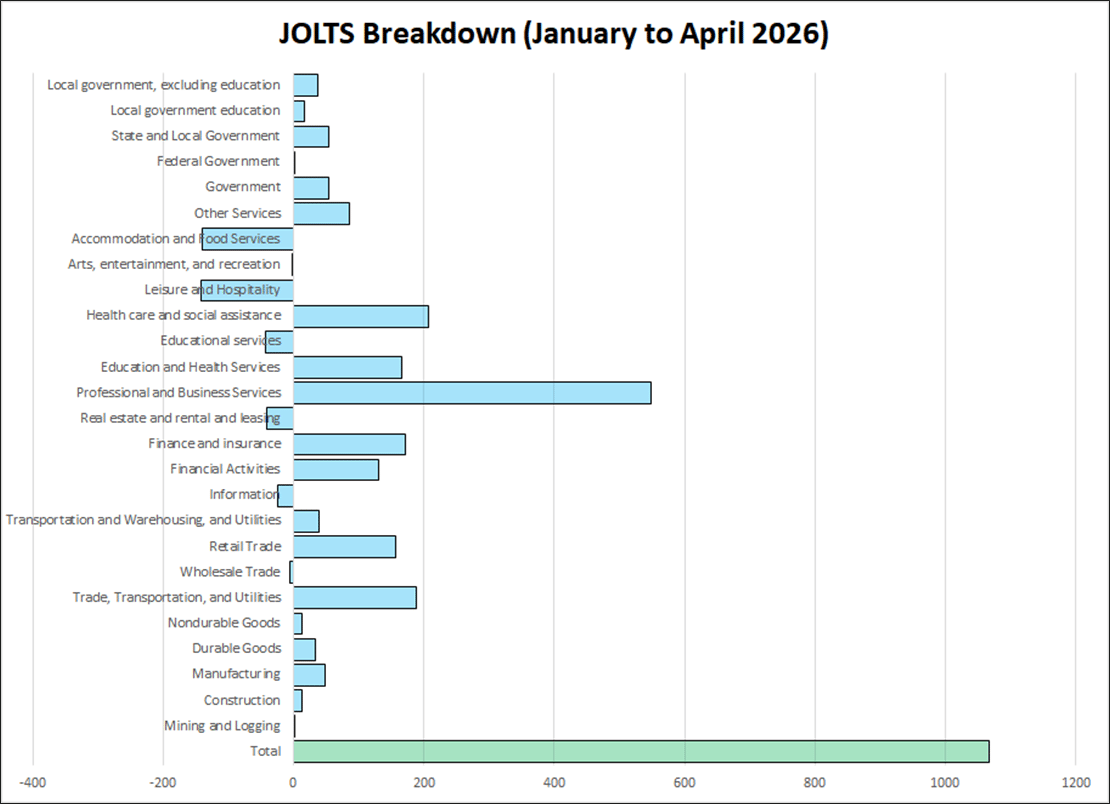
In case you are curious, here’s the industry breakdown for JOLTS this year. We are moving away from the “AI is going to destroy jobs” narrative towards “AI boom will create jobs and inflation today and may lead to fewer jobs and disinflation later.”
Korea Korea, she remind me of a West Side Story
Yesterday I wrote about the great KRW conundrum, and I received a stunning amount of feedback, all from KRW bulls. The basic idea is that the large rally in KOSPI triggers forced rebalancing (selling KRW) and that flow will end once KOSPI stops skyrocketing. I find this line of argument unconvincing simply because this is an idiosyncratic explanation for KRW and yet USDJPY and USDKRW have been the exact same trade for more than a year. There is no equity outflow story in Japan.
The common theme in 2025 was that Korean and Japanese investors were buying NVDA and U.S. tech hand over fist and that created mega inflows into the USD. Sure, U.S. investors also bought Korean and Japanese equities, but those flows were smaller because U.S. markets are so much bigger. Note how USDKRW is mostly a USD trade, but it decoupled from the DXY around Liberation Day. And more importantly, note that USDJPY did the same thing at the same time.
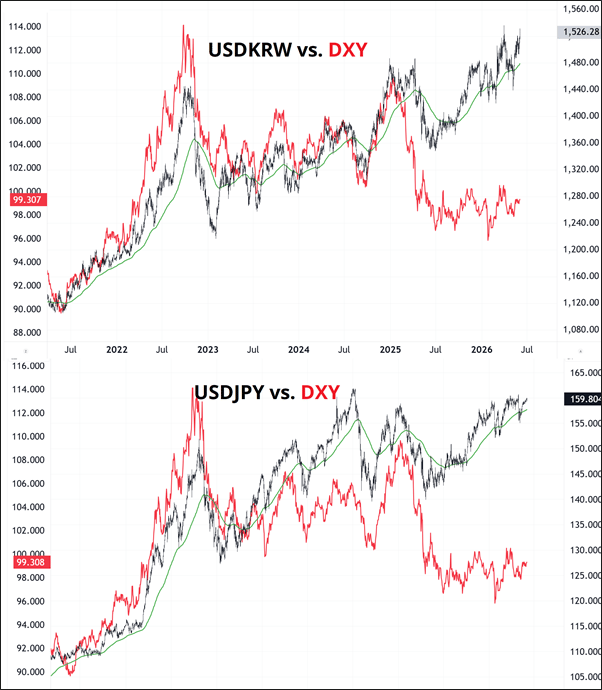
The similarity between the charts should give one pause when studying Korean balance of payments and such. If you plot Korean basic balance against KRW, it’s extremely hard to find any relationship. Occam’s Razor would suggest that KRW and JPY are more similar than different, and they tell a story of dollar beta and reliance on imported oil.
The last thing I will note is that I received a surprising number of responses considering KRW is fairly niche. All the responses were similar, saying that KOSPI rebalancing is hurting KRW, but it will eventually dissipate and KRW will mean revert back towards 1400/1450. The passion of the KRW bulls is strong. I would mark this as a bearish KRW observation from a behavioral perspective. Multitudinous animated responses to a comment I make about a niche currency leads me to believe that the allocation to the long KRW trade is medium/large.
Trades
I hate the long gold trade. Even though the 200-day is still holding, it feels like a matter of time now before it breaks. So, I am taking the L and cutting long gold at 4486. The idea is stale. I expected it to rally back in sympathy with other risky assets, and it has not. It’s trading like Michael Saylor sold gold, too.
The USDCAD is working okay so far, with NFP and Canadian jobs on deck Friday.
Final thoughts
1. Check out my new article on Panoptica: I want it. But I don't like it.
This isn’t another ‘smartphones are bad’ article … I mean, they are and it is … but living in the world-as-it-is means minimizing our smartphone ‘dark flow states’, not eliminating them. This is my reckoning with the relationship, and practical strategies for managing it.
This is part of a new series run by Ben Hunt featuring human writers writing about human things in a less human time.
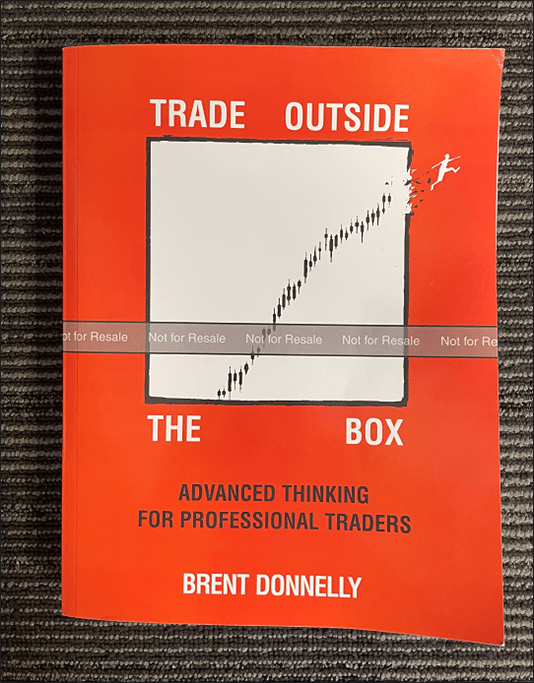
1. I have received a proof of my new book!
The finish line is near; I hope to release it June 29.
2. After Ueda’s speech last night, the June hike is fully priced. BOJ is irrelevant for USDJPY, as usual.
3. Please note I am out of office tomorrow, back Friday.
4. The funding trade for SpaceX should start soon. It is hard to overstate how big this batch of IPOs will be. I would guess money comes out of TSLA and VCX specifically as some TSLA holders will want to convert to SPCX and there is no reason to hold VCX (stock price $200, NAV $20) when you can buy the real thing.
Hope you end the day in the jet black.
Author

Brent Donnelly
Spectra Markets
Brent Donnelly is the President of Spectra Markets. He has been trading currencies since 1995 and writing about macro since 2004. Brent is the author of “Alpha Trader” (2021) and “The Art of Currency Trading” (Wiley, 2019).















