All eyes are on Fed chief Powell

Outlook:
Did we cancel the recession? The 2/10 year spread has normalized to a positive number (1.613-1.521 = 9.2 points). Similarly, the Bund yield got less bad at-0.65% from -0.70% on Friday. All eyes are on Fed chief Powell, who gives the keynote speech at Jackson Hole this Friday. Before then, the Fed releases the minutes of the last FOMC (Wednesday). The ECB also releases its minutes (Thursday). In the absence of much economic news this week, focus will turn by default to the institutional factors.
It's odd that Jackson Hole finishes and then G7 starts right up with no breathing space in-between. As noted above, Boris Johnson is expected to grab the spotlight at G7, but he is going to have to wrestle it away from the other publicity hound, Trump. Also attending are Macron as president (it goes to the US in January, eek), Merkel, Conte, Abe, and Trudeau.
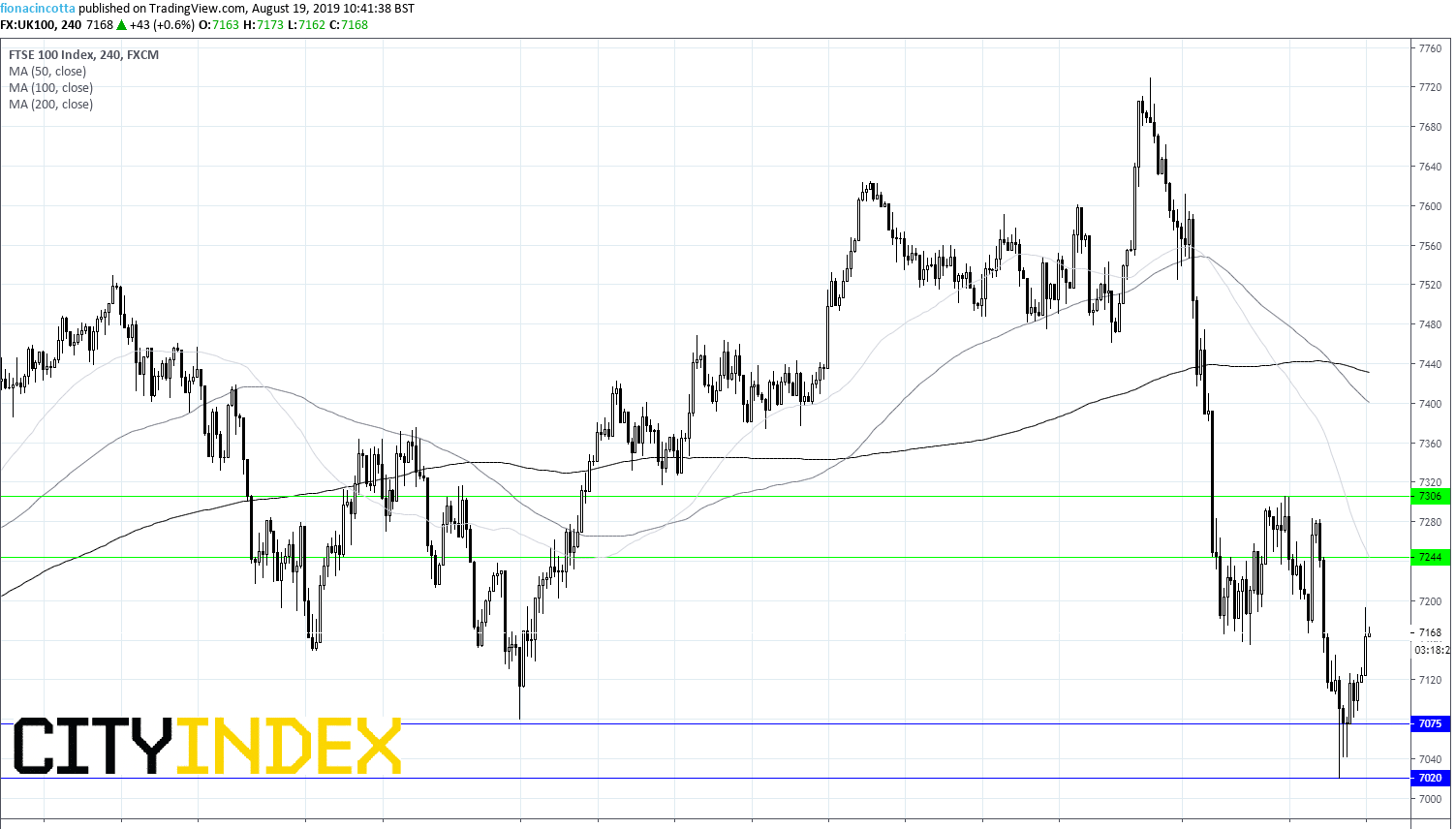
The Kudlow denial of any recession depends on consumer robustness, both the low unemployment number and retail sales last week. Kudlow pointed out that capital investment is lower mostly because of the oil industry, which retreated in the fracking field. This is true but we are not sure it's useful. As for the consumer, we get more evidence on consumer spending from the earnings reports of major retailers--Home Depot, Lowe's, Target, Kohl's and TJX. We should not ignore the University of Michigan consumer confidence report last week—a giant drop. See the chart. It's interesting that the last big drop came in January, right after the first giant stock market rout. Conventional wisdom says that most consumers don't have skin in the stock market game and don't follow it, but this chart might be used to argue that consumers are influenced by the stock market anyway, believing it is a proxy for the overall economy. Since most consumers are not better off than before Trump, this has a smell of probability.
We may or may not be headed for recession, but the drop in long-term rates is a clear signal that some smart guys think the probability is rising. Whether it's the fund managers and their economists informing the bond traders or the bond traders spreading the word, these two camps can easily make a self-reinforcing feedback loop. Long rates are falling low because the economy is weakening, making the economy weaker. That means everyone from former importers to your pension fund is sitting on a giant pile of cash. That cash ends up on short-term paper, mostly Treasuries, and sometimes outright cash per se, meaning bank deposits. Since banks copy the bond boys and worry about the risk of lending, it just sits there.
One solution is to incentivize banks to lend and borrowers to borrow is some tax advantage for specific types of projects. But the Trump administration has no strategic plan other than blaming the Fed, and the Fed in turn is blaming the world economy, and the world economy is blaming Trump the Tariff Man. As Krugman explained a week ago, protectionism harms economies by harming supply, whereas the Really Big Recessions are caused by demand falling off the cliff. We don't have that now, not with unemployment so low and retail sales so boomy. Krugman deduces that the presumption of recession arises from the sheer unpredictability of Trump's behavior.
The sad fact is that Trump wants incompatible outcomes—a weaker dollar (while boasting about capital inflows) and a strong stock market without new sugar to drive it up, all the while threatening more and higher tariffs that damage the entire supply chain as well as frighten all the markets. To some extent, China's low-key wait-and-see response is retaliation enough—Trump is getting blamed for bad US outcomes while China keeps on trucking. This is not to say China doesn't suffer, but with exports to the US at only 19.1% of total world exports, China is in a stronger position. And has the chops to make people suffer. After the Long March and Cultural Revolution, Trump is a mere fly buzzing around the room.
Still, the next round of tariffs is due September 1. China can't let that pass without some kind of response, if not a full-throated one. We already know the options—devaluation, dumping Treasuries, teaming up with US enemies, etc. Just about all of these options are negative for the stock market in the short-run. As we wrote last week, Xi now owns the S&P.
Much of this is going to take a back seat until Jackson Hole and the G7 are done and over with. That doesn't mean pressure is not building. Some amount of angst depends on the stock market's behavior. We can't expect the S&P to respond much to tariffs on Mexican tomatoes, but you never know. Wars have started on less.
As long as Trump and Co. keep promising a good outcome on the trade war with China, conditions are okay, but Xi can upset that at any time. The question is whether Trump knows it. He is perfectly capable of pretending to rejoin the human race at G7 and make magnanimous concessions to China, purportedly out of pity or at the request of the other members. Crocodile tears, of course. If that were to happen, we can indeed see the dollar retreat. This would be the logical outcome if Trump's first priority is to get the stock market to recover and keep rising. But Trump is not logical, so don't count on it.
This is an excerpt from “The Rockefeller Morning Briefing,” which is far larger (about 10 pages). The Briefing has been published every day for over 25 years and represents experienced analysis and insight. The report offers deep background and is not intended to guide FX trading. Rockefeller produces other reports (in spot and futures) for trading purposes.
To get a free trial, please write to [email protected] and you will be added to the mailing list..
This is an excerpt from “The Rockefeller Morning Briefing,” which is far larger (about 10 pages). The Briefing has been published every day for over 25 years and represents experienced analysis and insight. The report offers deep background and is not intended to guide FX trading. Rockefeller produces other reports (in spot and futures) for trading purposes.
To get a two-week trial of the full reports plus traders advice for only $3.95. Click here!
Author
Barbara Rockefeller
Rockefeller Treasury Services, Inc.
Experience Before founding Rockefeller Treasury, Barbara worked at Citibank and other banks as a risk manager, new product developer (Cititrend), FX trader, advisor and loan officer. Miss Rockefeller is engaged to perform FX-relat

















