AI is consuming plenty of energy

Due to electricity shortages, several US states have imposed restrictions on the construction of large data centers.
Artificial intelligence (AI) has been making headlines in the global media. But few people know what AI really is. Sometimes it is considered to be something immaterial, the way that a human mind is immaterial. But a human being, the bearer of intelligence, is material; has flesh and bones. And so AI cannot exist without a material base in the form of computers, servers, data centers, the internet, and other communications.
AI technologies are rapidly developing. Here are just several figures that prove that. For example, it was estimated that total global spending on AI development amounted to $1.75 trillion in 2025. This year, it is expected to total $2.52 trillion (a rise of 44%). The US is the global AI leader even though China is actively catching up. In 2026, the American AI industry’s spending is estimated to be $765 billion. As forecasted by several US investment banks, American corporate spending on AI will exceed $1 trillion in 2027. Bank of America expects AI total capital expenditures in the US to total about $7.6 trillion over the period between 2026 and 2031.
Some analysts have noted that the AI development spending growth in the US almost matches the recent US GDP growth. It seems to them that the development of the AI industry is the main (and perhaps the only) driver of the American economy. However, some estimates are more conservative. For example, economists at the Federal Reserve Bank of St. Louis estimate that AI investment has contributed 39% to America’s GDP growth in the third quarter of 2025. Even if we assume that this figure is accurate, the role of AI investment is still high in today's American economy.
AI spending includes investments in the creation of AI infrastructure, research and development, infrastructure maintenance, workers’ wages, electricity, advertising, and other expenses. Investments are accountable for most of AI industry spending. This year, according to forecasts, they are expected to reach $1.37 trillion globally.
To compare, global oil production investments for the whole of 2025 amounted to $420 billion. Meanwhile, over the same time period it cost approximately $580 billion to construct new data centers. But what would the AI revolution really lead to in practical terms? Well, to start with, the AI sector creates substantial demand for precious metals, namely gold, silver, platinum, and other platinum group metals and also many industrial metals, including but not limited to ruthenium, copper, aluminum, nickel, tin, lithium, and cobalt. However, also very rare metals are needed, namely yttrium, gadolinium, scandium, europium, lanthanum, neodymium, dysprosium, terbium, and erbium. Moreover, AI also requires nonmetallic substances such as silicon—the basis of chips, circuit boards, and processors; quartz—used in crucibles for melting silicon and growing crystals for semiconductors; and gallium—a key semiconductor in high-power, high-frequency data processing devices, quantum computing devices, and optoelectronic devices.
The problem is that some of these materials are in very short supply. Therefore, there is a growing concern about who would get access to these production resources first. That is why due to the rapid development of AI, prices for these materials have risen sharply in recent years. For example, global copper market reports note that demand for this metal is growing fast thanks to the AI industry. Last year, it amounted to 28 million tons. According to S&P Global estimates, by 2040, the demand will increase by 50% to 42 million tons due to new data center projects. That is why copper prices have risen by 44% in 2025 alone, from $8,670 to $12,453 per ton. In January 2026, the metal reached its peak of $13,335.
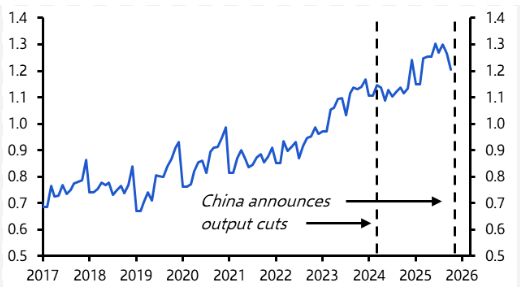
Some market analysts believe that copper prices could break $15,000 by the end of 2026.
Obviously, certain countries have many more natural resources necessary to facilitate AI development, and they are taking advantage of this or planning to do so in the future. For example, China controls almost the entire global output of refined silicon, a substantial share of refined copper, and virtually all of the recycled gallium—materials necessary to produce electronics and to develop the AI industry.
But, as many experts acknowledge, the most important resource for the AI industry is electrical energy. It is essential to power the entire AI infrastructure. Otherwise, this entire infrastructure is nothing more than useless garbage. In the past, coal used to be the energy driver for the global economy. Then, it was oil, while today and tomorrow, it will be electricity.
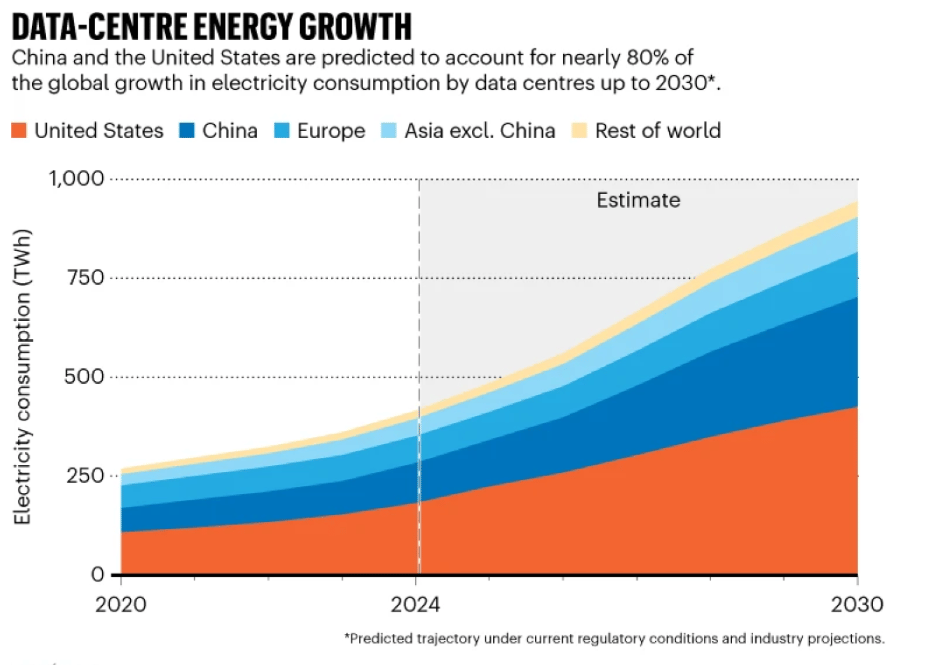
According to the IEA’s estimates, computing and data storage accounted for 1.5% of global electricity demand in 2024. This electricity consumption volume has come close to the share of electricity consumed by the total transportation (1.9%) or the total electricity consumed by countries such as Mexico or Turkey. As reported by the IEA, data center electricity consumption will more than double by 2030, accounting for approximately 3% of global electricity demand. In absolute terms, this represents 945 TWh, comparable to Japan's annual electricity consumption.
The electricity consumption of cryptocurrency mining farms was once a hotly debated topic. Indeed, in some countries and regions of some countries, crypto mining consumed substantial amounts of electricity. Restrictions on mining businesses have been (and continue to be) imposed. According to analysts’ estimates, globally, crypto mining's share of electricity consumption was almost 0.5%. This figure is expected to rise by 50% by 2030. However, this is still substantially less than the amounts of electricity consumed by the AI industry.
In some countries, restrictions have been imposed on AI electricity consumption. The most notable example seems to be Ireland. Interestingly, this country has the highest share of AI electricity consumption—it was 21% last year. In 2022, the Dublin grid operator halted new data center projects, making an exception to only those that can generate their own electricity. Then, a total moratorium was approved on the construction of new data centers until 2028.
But now the energy problem is gaining even more importance, given the war in the Middle East. That is why some European countries, including the Netherlands and Germany, have banned AI companies from connecting to the power grid until 2030. Even in the US, several states, namely Oregon, North Carolina, Virginia, and Iowa, imposed moratoriums on the construction of new data centers with a capacity greater than 25 MW this year. This is due to the fact that AI infrastructure consumes power unevenly, which overloads local grids. Power shortages have also been reported, canceling plans to expand AI infrastructure.
Even without the AI industry, the US electricity market has been facing pressure for a while. Power plant costs are rising, and electricity producers are eager to charge their customers even higher costs. The AI industry's share of US electricity consumption is significantly higher than the global average. In 2023, it was 4.4%. According to forecasts by Lawrence Berkeley National Laboratory, by 2028, the AI industry's share of US energy consumption could grow to 6.7-12%. Given these trends, the AI industry is becoming a significant factor in exacerbating the electricity shortage in the US market.
That is why in February 2026, US President Donald Trump held talks with major IT companies to reach an agreement, dubbed the Ratepayer Protection Pledge, under which the corporations would cover the electricity costs of AI services. According to the agreement, AI companies must meet their own energy needs, also by building their own power plants near AI infrastructure facilities. Trump believes this will help to avoid higher energy costs for households and, in some cases, even reduce electricity costs for local communities. Signatories to the agreement include Amazon (AMZN), Alphabet (GOOG), Meta (META), Microsoft (MSFT), OpenAI (OPAI.PVT), Oracle (ORCL), and XAI.
However, some experts are critical of this initiative. Even though AI corporations will have their own power plants, they will create additional demand for oil, natural gas, coal, and shale, thus contributing to higher energy prices.
So, the AI sector is consuming more and more resources. But is there any opportunity that all these costs would pay off? Apart from electricity and natural resources, there are enormous financial costs associated with AI. Loans, corporate bonds, and stocks are all used to finance AI development. It seems highly likely to me that creditors’ and especially investors’ expectations of buying many AI companies’ bonds and stocks may not be met.
The whole situation with AI looks like a big speculative bubble. Many investors have rushed to stockpile AI companies’ shares. This reminds me of the Dot.com bubble in the 1990s when speculators actively bought shares of Internet companies and lost their fortunes when the bubble burst at the beginning of the 2000s. Here is why I think the AI companies’ shares are in a speculative bubble. The S&P 500 index gained about $7.5 trillion in value from the beginning of 2024 to the beginning of 2026. Of these 500 companies, 17 companies work in the AI sector. These 17 companies’ market capitalizations have appreciated by $4.9 trillion. This small group of AI corporations must somehow justify investors’ excessive enthusiasm, which it has not done so far. Moreover, it is possible that a severe power shortage in the US could trigger a collapse simply because the amount of data suitable for training models is finite, while computing power is limited by power shortages and grid capacity. It is expected that these physical limits could be reached by 2028.
Author

Anna Sokolidou
Independent Analyst
A research analyst, a freelance finance writer and an economics teacher looking for interesting investment opportunities. I have been investing for years. I am mostly interested in writing about commodities, precious metals and large corporations.