A wild ride for markets as dizzying market U-turns dominate
What a difference a day makes. On Monday we saw the largest daily price swing for Brent and WTI crude oil since the depths of the Covid pandemic. After hitting $119.50 per barrel on a supply crunch in the Gulf, the Brent crude oil price is currently trading just below $91 per barrel. The oil price is down 8% today, after Donald Trump eased concerns that the conflict in the Middle East would be prolonged, and there are signs that governments and policy makers will work together to buffer the near-term energy price squeeze. The UAE also confirmed a slowdown in the barrage of Iranian missile attacks, which is also easing near term concerns about the conflict.
Are Trump’s words enough to contain the Oil price?
The Brent price dropped as low at $88 at one stage on Tuesday morning, however, we think that comments from President Trump that the war is ‘very complete’, may not be enough to permanently erase a risk premium that has been built into the oil price in recent days, especially since the Strait of Hormuz remains closed. Thus, we expect commodity prices to remain volatile for the duration of this war.
Dysfunctional markets trigger unexpected price reversals
Interestingly, in the past when the price of oil has jumped above $100 per barrel it tends to be sticky around this level. For example, the oil price spike in 2022, after Russia invaded Ukraine, saw the oil price remain above $100 for 87 days. The fact that the oil price has swung more than $31 in 24 hours shows how dysfunctional the market is right now, and how there is no playbook for what we are currently witnessing in financial markets.
Oil price determining direction in stocks and bonds
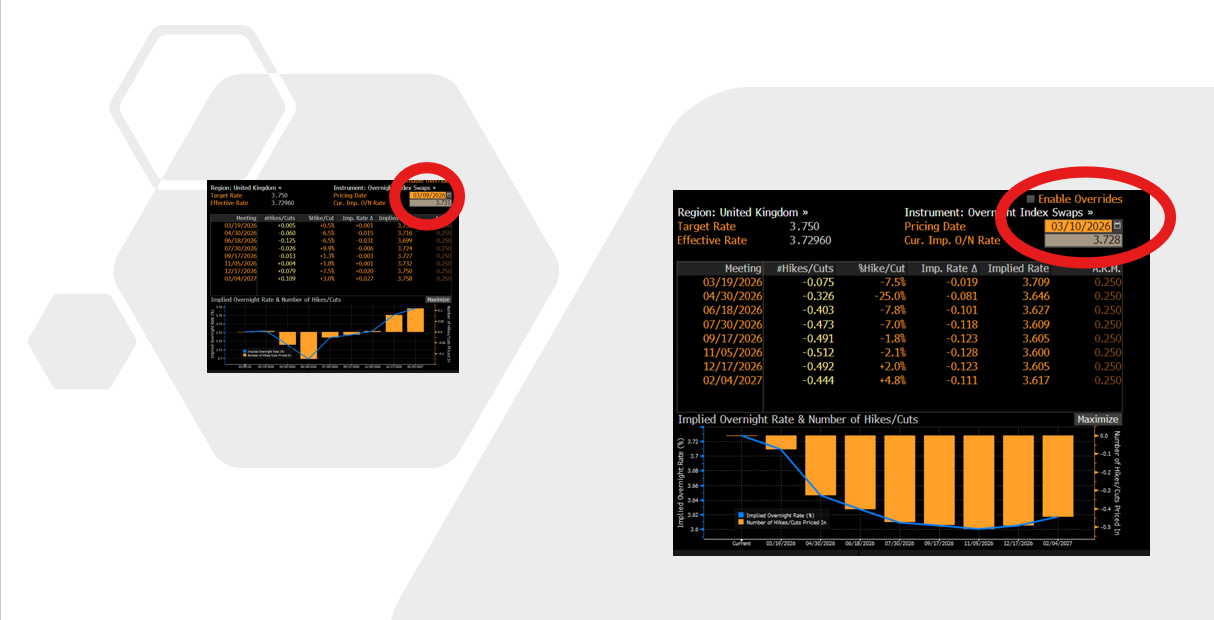
Stocks are rising as the oil price is falling, the Eurostoxx index is higher by more than 2% today, led by ASML and Hermes, suggesting that tech and consumer stocks will lead markets higher. The Bonds are also recovering, the UK 10-year Gilt yield is down 8bps today, as UK Gilts erase some of the losses of the past week. The interest rate futures market is now back to pricing in a rate cut for the UK this year. The volatility in the interest rate futures market is rarely this high, and it is extremely unusual for rate cuts to be priced in and out in a matter of hours, but this is what happens when there is a damaging oil price spike.
BoE meeting still relevant as we live through unprecedented interest rate volatility
There is currently 0.4 rate cuts priced in for this year, and UK rates are expected to end the year at 3.65%, down from the current level of 3.75%. There is a 7.2% chance of a rate cut priced in for the BOE’s meeting next week. While we doubt that a rate cut is on the cards, the Bank of England will need to use next week’s meeting to signal their future intentions. Will they look through the crisis in the Middle East as a temporary spike in commodity prices and focus on the weakening economy? Or will the situation have died down enough for them to signal that further rate cuts are coming, albeit with a small delay? Either way, next week’s meeting is still important for sterling and UK bond markets.
Futures prices are pointing to a higher open in the US, later today, as risk sentiment improves. This is still a fluid market, and if the headlines deteriorate, or the war escalates, then we could see prices reverse once again.
Chart 1: The shift in UK rate cut expectations between Monday and Tuesday
Author

Kathleen Brooks
XTB UK
Kathleen has nearly 15 years’ experience working with some of the leading retail trading and investment companies in the City of London.