3 things you need to know about Preference Shares


As you progress on your investing journey, many new words and anagrams will appear. Having a complete understanding of these words can help minimise misunderstandings and misinterpretations, and consequently, costly investing mistakes.
In this article, I have ventured to explain what constitutes a Preference Share, hoping to help round out your investing knowledge.
1.What exactly are Preference Shares?
Preference Shares, otherwise known as Preferred Stock, can be thought of like a Corporate Bond. Preference Shares are 'fixed income' or ‘dividend shares’ that are prioritised over Common Shares when it comes to dividend payments. In addition to priority dividend payments, Preference Shareholders also hold priority over Common Shareholders when it comes to recouping the value of their investment if the company is liquidated. One downside of Preference Shares is that their voting rights are typically restricted or non-existent.
2.Cumulative vs. Non-Cumulative Preference Shares
Several kinds of Preference Shares exist, but the most common are Cumulative Preference Shares and Non-Cumulative Preference Shares. For any dividends that a company cancels or fails to pay, a Cumulative Preference Shareholder will retain the right to be paid this dividend in the future. Moreover, the Cumulative Preference Shareholder will have to be paid any missed dividends before any future dividends can be paid to any other shareholder. Non-Cumulative Shares do not have this same right.
3.Do Preference Shares exist in perpetuity?
While the majority of Preference Shares do not have a maturity date, there are means by which these Shares can be discontinued. Preference Shares can be converted to Common Shares or removed from circulation altogether. To do so, the issuing company may have to pay a premium over the Preference Shares' face value to recall them. Alternatively, Preference Shares can be issued with the condition that gives the issuer the right to redeem or convert the shares at some specific price, some specific date, or when some other condition is meet.
What is an example of a Preference Share?
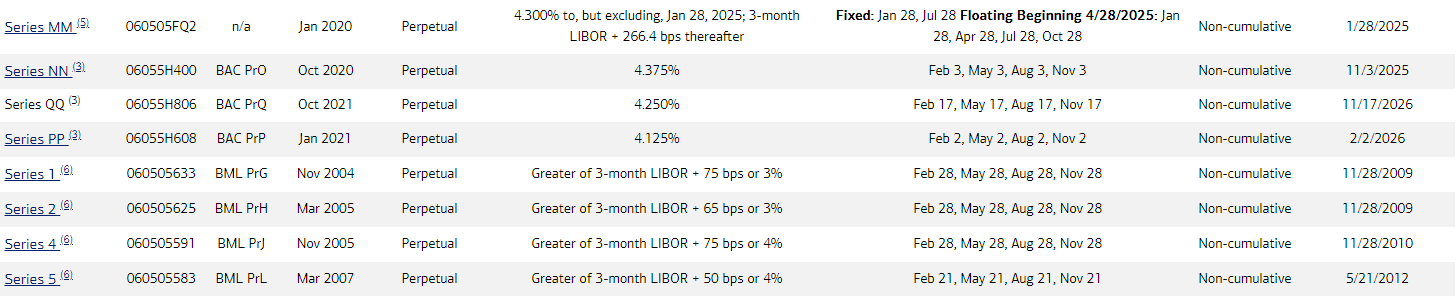
The Bank of America (NYSE:BAC) has several Cumulative and Non-Cumulative Preference Shares on its books, some dating back to 1997. From July to September 2021, the Bank of America issued 8 new series of Preference Shares. As illustrated in the table below, each series was issued with different conditions related to the dividend amount, the frequency of payment, and its redeemability.
Author
Mark O’Donnell
Blackbull Markets Limited
Mark O’Donnell is a Research Analyst with BlackBull Markets in Auckland, New Zealand.

















