3 Forecasts for the Euro: Two see a drop, one is buying right here

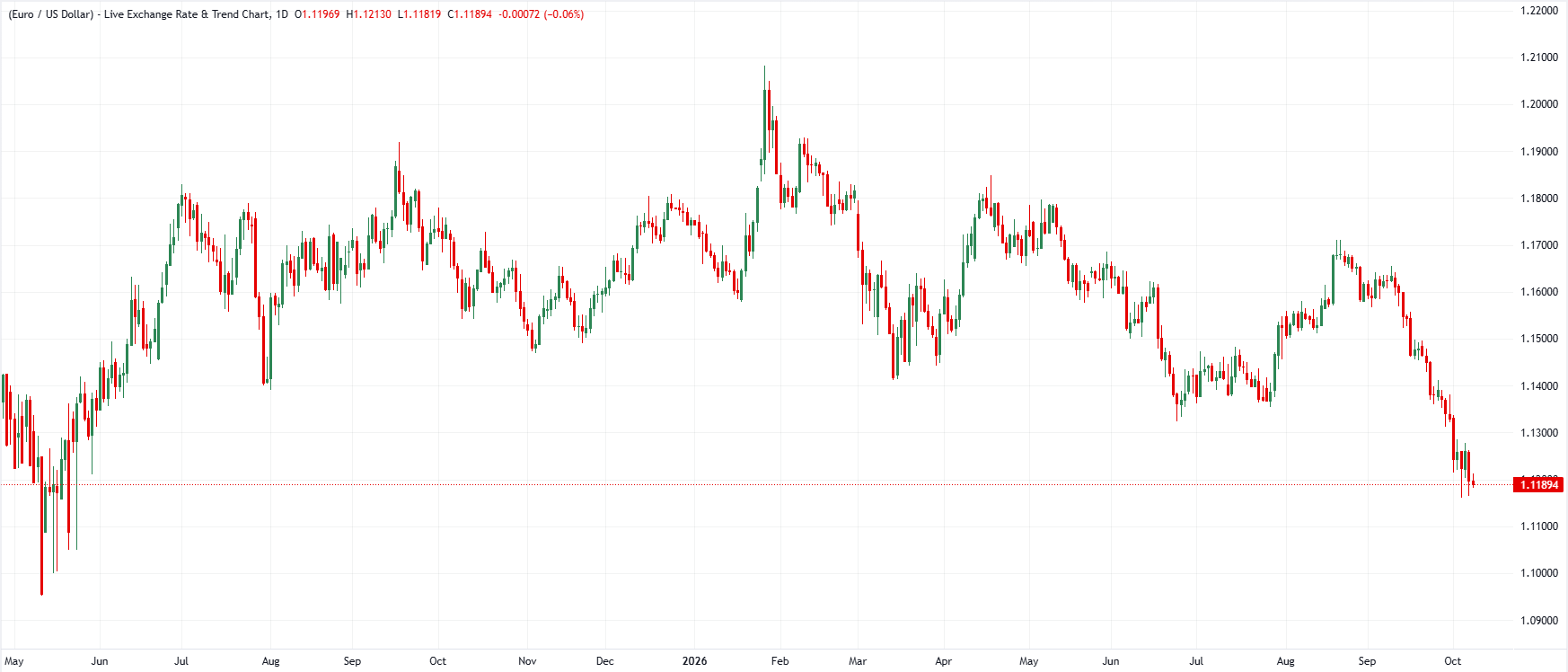
The Euro (EUR) is trading at 1.1190 at the time of writing against the US Dollar (USD), and three fresh analyses published this morning split cleanly down the middle: two see further downside — one on fundamentals, one on the charts — while a quantitative desk is calling the short trade itself a mistake and has activated a long position at current levels. The disagreement is not about the direction of the news, but about whether the Euro has already fallen enough to price it.
Ebury's Matthew Ryan: The dovish ECB keeps the pressure on
Ryan delivers the fundamental bear case, and the surprise is who's supplying it. After the September inflation beat, ECB President Christine Lagarde last week "struck a surprisingly dovish note," and Ryan doesn't think the data changes anything: "we don't think that the September inflation beat will be enough to sway the Governing Council just yet — though a hike in December still remains on the cards." His core argument goes beyond the ECB: policymakers everywhere are realizing that the bond sell-off is doing their tightening for them, pushing up mortgage rates and corporate borrowing costs — "a big reason why we think rate hike expectations remain overly aggressive across the board." Firmer-for-longer divergence between a hawkish Fed and a patient ECB leaves the Euro exposed. — Read the full report
KCL Consult's Kim Cramer Larsson: The charts say 1.1065
Larsson's daily technical read is blunt: "EUR/USD at key support - down to 1.1065?" In his daily video update, the Euro sits at a decisive support zone with room to break lower, alongside a broader US Dollar-strength picture — the US Dollar Index DXY "to 103?" and USD/JPY, USD/CAD and AUD/USD all testing decisive levels. Larsson's framing puts 1.1065 in play if the current support gives way, a target more than 100 pips below current price. — Read the full report
SMAS Quantum Research's Andrey Shvedov: The short squeeze is coming
Shvedov is the aggressive outlier — and he thinks the bearish consensus is the trade that fails. While retail media is "gripped by aggressive bearish momentum" after the plunge from 1.1600, his quantitative audit finds price colliding with "a Titanium Plate of Institutional Capital: a massive 7th-Order Confluence Slab (7TF) anchored by Daily and Weekly accumulation baselines" spanning 1.11945 down to 1.10345 — with 95.45% of directional displacement already exhausted at the lower two-sigma rail. His conclusion: "late short positions present catastrophic risk-to-reward." He has formally activated a long mean-reversion trade: entry 1.1170–1.1195, stop at 1.1120, first target 1.1265, second target 1.1345–1.1370, at a calculated risk-to-reward of 1:2.5 to 1:3.2. — Read the full report
The takeaway
The split is genuine: Ryan's dovish ECB read and Larsson's 1.1065 technical target both point lower, while Shvedov is buying the same price zone the bears want to break, arguing the selling is mechanically exhausted. Watch ECB speakers after Lagarde's dovish turn — and the 1.1120 line: Shvedov's own stop. If it breaks, his long is invalidated and Larsson's 1.1065 target comes alive; if it holds, the squeeze he predicts starts with a run at 1.1265.
(This article was created with the help of an Artificial Intelligence tool and reviewed by an editor. Know more.)
Author

FXStreet Insights Team
FXStreet
The FXStreet Insights Team is a group of journalists that handpicks selected market observations published by renowned experts. The content includes notes by commercial as well as additional insights by internal and external analysts.