Silver demand is quietly growing outside solar

Late September's tech headlines added well under 0.1 million ounces of measurable silver demand, while electronics outside solar are forecast to need 9 million more this year, growth that works for silver holders.
The headlines are not where the ounces are. A satellite carries somewhere between 50 and 200 grams of silver on the estimate in Silver Rising. There is no standard published figure for the silver in a 5G mast or a grid battery. The larger number sits in the forecast from Metals Focus and the Silver Institute. Silver used in electrical and electronic goods other than solar panels is set to grow about 3.4% this year, on our subtraction from the survey's figures. For silver holders, that is good news over several years, because it is demand spread across many products rather than one industry. It does little for 2026, when the fall in solar's silver use outweighs it.
Silver's price has been under pressure from rising interest rates. It traded at $60.68 an ounce on October 7, on USAGOLD's daily report. Gold stood at $4,121.26. Silver is about half its January high. The Federal Reserve raised rates on September 16 for the first time since 2023. A weak September jobs report has since cut the odds of another rise in October to about 20%, on futures-market pricing. At Golden Meadow®, we treat interest rates as pressure on the price over the next few months, separate from the longer-term case built on a shortfall in supply. Electronics demand sits on the demand side of that case.
What the tech headlines showed
Much of the technology news in the second half of September pointed in silver's favour. China's 5G base stations passed 5.1 million at the end of August, on government data. China's sales of batteries for grid storage more than doubled in August from a year earlier. On September 28, SpaceX's Starship put the first 26 of its newest Starlink satellites into orbit, a step toward much larger Starlink launches.
Not every story went one way. Amazon's satellite network has not launched since July 2. On September 21, Texas ordered its environmental regulator to pause permits for data-centre projects until an audit of the state's power grid finishes in mid-December. Oracle issued a force majeure notice on a New Mexico data-centre project over potential delays in securing power, Reuters reported, citing a person familiar with the matter. Force majeure is a contract clause that excuses delays outside a company's control. Oracle said the project remains on its planned schedule.
Why the ounces are small
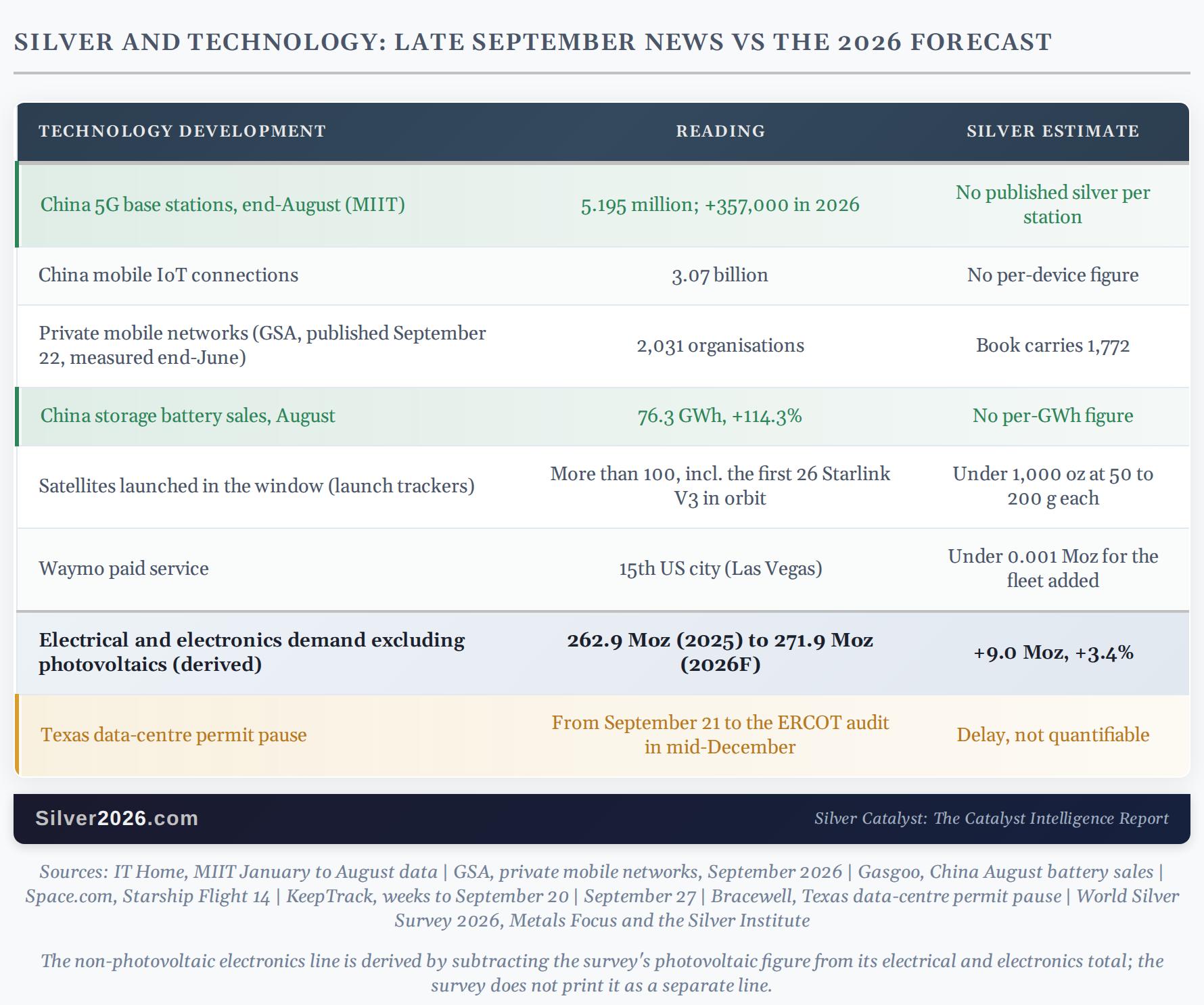
Launch trackers listed nearly 80 satellites reaching orbit in the two weeks before September 28. The Starship flight that day took the total past 100. At the book's estimate per satellite, those carry at most a few hundred ounces of silver. There is no standard published figure for the silver in a 5G base station or in a gigawatt-hour of battery storage, so neither turns reliably into ounces.
Added together, every item from those two weeks of technology news that can be measured comes to well under 0.1 million ounces. That counts only new demand traceable to the news itself. It is a different and much smaller number than the full-year forecast for the same kinds of products.
Where the ounces are
The survey from Metals Focus and the Silver Institute puts electrical and electronics demand, including solar, at 449.5 million ounces in 2025. It forecasts a 6% fall this year, to 422.9 million. Solar panels explain the fall. Their silver use is forecast to drop from 186.6 million ounces to 151.0 million.
Take solar out and the picture changes. Everything else in the category rises from 262.9 million ounces to 271.9 million. That is about 9 million ounces more. The survey does not print that figure; it is our subtraction from its two published numbers. The same figure was roughly flat in 2025, so this is a forecast return to growth rather than a long trend. The survey itself names AI infrastructure, cars and power-grid investment among the sources of growth. It also warns that this year's forecast is "arguably more uncertain than usual."
What this means to Silver investors
In technology, silver demand comes less from the satellites and data-centre announcements that make headlines than from the many electronic products that each use a little silver. That demand is forecast to rise this year even as solar panels use less. Over several years, that is a positive for silver.
It does not change this year's balance. The 9 million ounce gain outside solar is smaller than solar's 35.6 million ounce fall, so total electronics demand still drops this year. The next test is the interim survey update from Metals Focus and the Silver Institute, expected in November. If electronics demand outside solar comes in below its 2025 level, the case for technology demand is weaker than this article suggests.
The bigger picture is the market as a whole. Metals Focus and the Silver Institute forecast a 46.3 million ounce shortfall in the silver market this year, which would make it the sixth consecutive year in deficit. Electronics demand that keeps growing makes that gap harder to close in later years.
Electronics demand is one dimension of the 100-catalyst framework I analyze in Silver Rising, alongside the five other Deep Dives in this issue of the Silver Catalyst newsletter. If you've at least considered investing in silver, I strongly encourage you to sign up, because it takes just $1 to get both.
Want free follow-ups to the above article and details not available to 99%+ investors? Sign up to our free newsletter today!
Author

Przemyslaw Radomski, CFA
Gold Price Forecast
Przemyslaw Radomski, CFA (PR) is a precious metals investor and analyst who takes advantage of the emotionality on the markets, and invites you to do the same. His company, Sunshine Profits, publishes analytical software that any