#1: Parliament Did Not Take Control of Brexit #2: Radical Plan For Tories

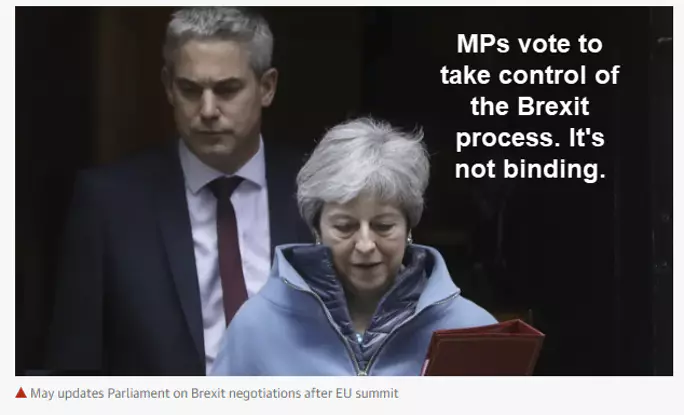
I am amused by widespread reports that the UK Parliament "Took Control" of Brexit. Second, I do have a plan for Tories.
Silly Headlines
- Financial Times: The week parliament takes back control of Brexit
- BBC: MPs voting on plan to take control of process
- Wall Street Journal: U.K. Parliament Seeks to Seize Control of Brexit Agenda
- CNN: Brexit deadlock as MPs take control of process from Theresa May
- Washington Post: Parliament to exert control over Brexit with “indicative votes”
- AP News: UK government defiant as Parliament takes control of Brexit
- New York Magazine: What Happens Now That Parliament Has Seized Control
Every one of those titles is flawed. Parliament has no means of "taking control" other that outing May and putting in a PM who would bow to the wishes of Parliament.
This was the subjected of at times heated debate yesterday on my website where I posted Brexit Groundhog Day # 402 (Or Whatever): MPs Attempt Brexit Process Takeover.
That title could have been a bit better, but my lead-in image accurately stated the position. The vote was not legally binding.
I may have run out of characters (The Maven allows 80). I did spend the entire article mocking the idea. My opening lead-in was "Brexit silliness has been ongoing for at least a year. I made up a number. MPs voted to take control of Brexit. So What? "
So What?
Yes that is the correct idea. Now let's flash forward to my bottom line.
Here's the bottom line that few seem to realize. MPs can instruct the Prime Minister to do something but they cannot force the PM to do it. The EU deals with heads of states, not MPs.
One person, I believe from the UK responded that I was wrong. I repeatedly asked how the MPs could force May to do anything. I got nonsense for a response, including this silliness: "Nick Boles a Tory rebel MP was asked by Emily Maitlis on BBC2 would happen if Theresa May ignored the result of the indicative vote, he replied that We would enact legislation to force her to go back to Brussels."
What a laughable joke. They would pass legislation. So what? Parliament cannot force Theresa May to go to Brussels.
Not Legally Binding
- The Guardian in yesterday's Live blog: Theresa May stated "The government would not be obliged to accept any plan deemed most popular with MPs, and in fact May strongly hinted this afternoon that she would reject what many expect might emerge as the most widely-supported idea - staying in a customs union with the EU."
- The Financial Times: "The so-called indicative votes, tentatively scheduled for Wednesday, would not be legally binding on the government but could be the strongest indication yet of what kind of Brexit deal could pass the Commons."
Both of those idea state the situation accurately. Eurointelligence is even more emphatic.
No, the UK parliament has not taken control
At 3:00 AM this morning, Eurointelligence posted this headline: No, the UK parliament has not taken control
Be wary of blather. Nothing has been taken off the table. Nobody is in control. The UK press hails last night’s passing of the so-called Letwin amendment as the House of Commons finally taking control of Brexit. It certainly demonstrates that the UK government has lost its majority and that elections will probably happen very soon. But the impact on Brexit itself is far less clear. And nobody seems to be in control.
Most of the UK’s political class, including MPs, do not understand the legal status of last week’s resolution by the European Council. It constitutes an official adjunct to EU law. It sets out two clear pathways to avoid a no-deal Brexit - either pass the deal this week, and leave on May 22; or agree to hold European elections and leave later, which would also require a political process.
Yesterday May explicitly ruled out support for a no-deal, but beware: this is merely her saying that this is not her first choice. She said parliament can stop it. This is true but also misleading. Parliament can stop it by revoking Art 50, or replacing her another leader within the next 14 days. Neither is very likely.
Accidental Brexit
This Paragraph is key.
It is not hard to see how an accidental no-deal Brexit can still happen: Theresa May loses the meaningful vote; indicative votes produce a narrow victory for one of the alternative options; May refuses to honour the vote; May refuses European elections; she goes to Brussels on April 12 with nothing to say; Emmanuel Macron says Non.
Wresting Control
That's it. No one can force May to do anything. But they can remove her.
Radical Idea
Tories fear a general election. They could easily lose although they are slightly ahead in the polls.
Rules state that Tories can only hold a leadership challenge once every 365 days.
Why Not Change the Rules?!
I believe there is still a small window of opportunity, thanks to the EU-granted extension, not for parliament to wrest control, but for Tories to do so by changes the rules.
I am unclear of the process in which Tories can do this. But there are 15 days before the April 12 cutoff. If the Tories can quickly change the rules then vote Theresa May out, say within the next 5 days, the Tories do have a chance to wrest control.
Bottom Line
The UK parliament cannot wrest control of Brexit against May's will.
The Tories may have a small window of opportunity if they agree to change the rules, then quickly act on it. I believe this takes a minimum of 10 days, so the window of opportunity for this is 4-5 days.
Author

Mike “Mish” Shedlock's
Sitka Pacific Capital Management,Llc
Mike “Mish” Shedlock is a registered investment advisor for SitkaPacific Capital Management.