|

XLF rally from blue box delivers risk‑free setup

XLF (State Street Financial Select Sector SPDR ETF) has shown a bullish impulse since the June 3, 2026 low. The 1‑hour Elliott Wave structure favors further upside as the ETF has been making higher highs and higher lows, which supports a buy‑the‑dip approach at defined blue box areas.

Elliott Wave technical view from June 19 2026

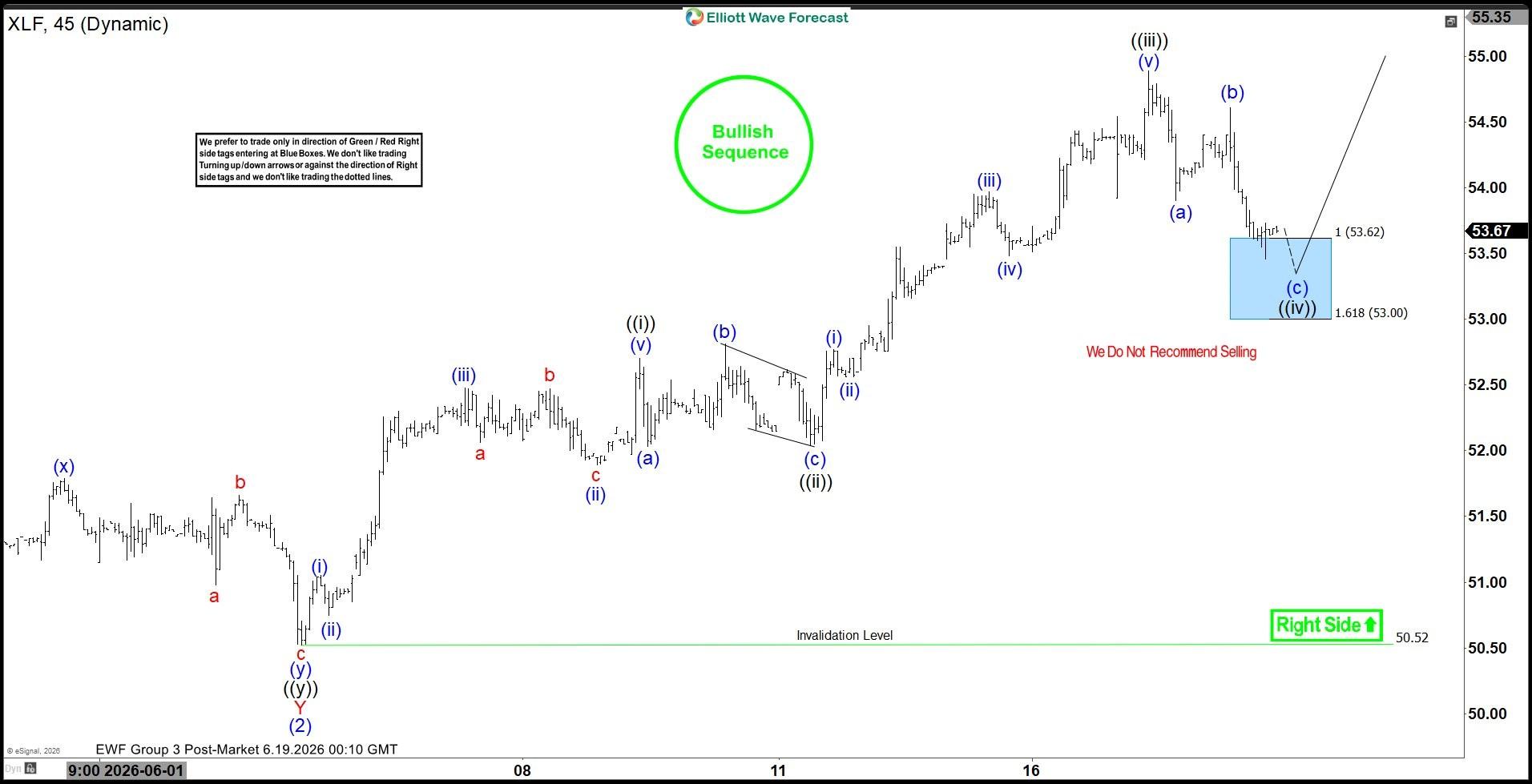
The rally from the June 3 low is unfolding as an impulse.

The advance completed wave ((iii)) at $54.89.

A corrective wave ((iv)) followed, unfolding as a zigzag:

  • Wave (a) ended at $53.90.
  • Wave (b) bounced to $54.61.
  • Wave (c) reached the blue‑box area near $53.62–$53.00 (equal‑legs zone).

Buyers were expected to appear in that blue box, offering a low‑risk long entry and the potential for at least a three‑wave bounce.
XLF

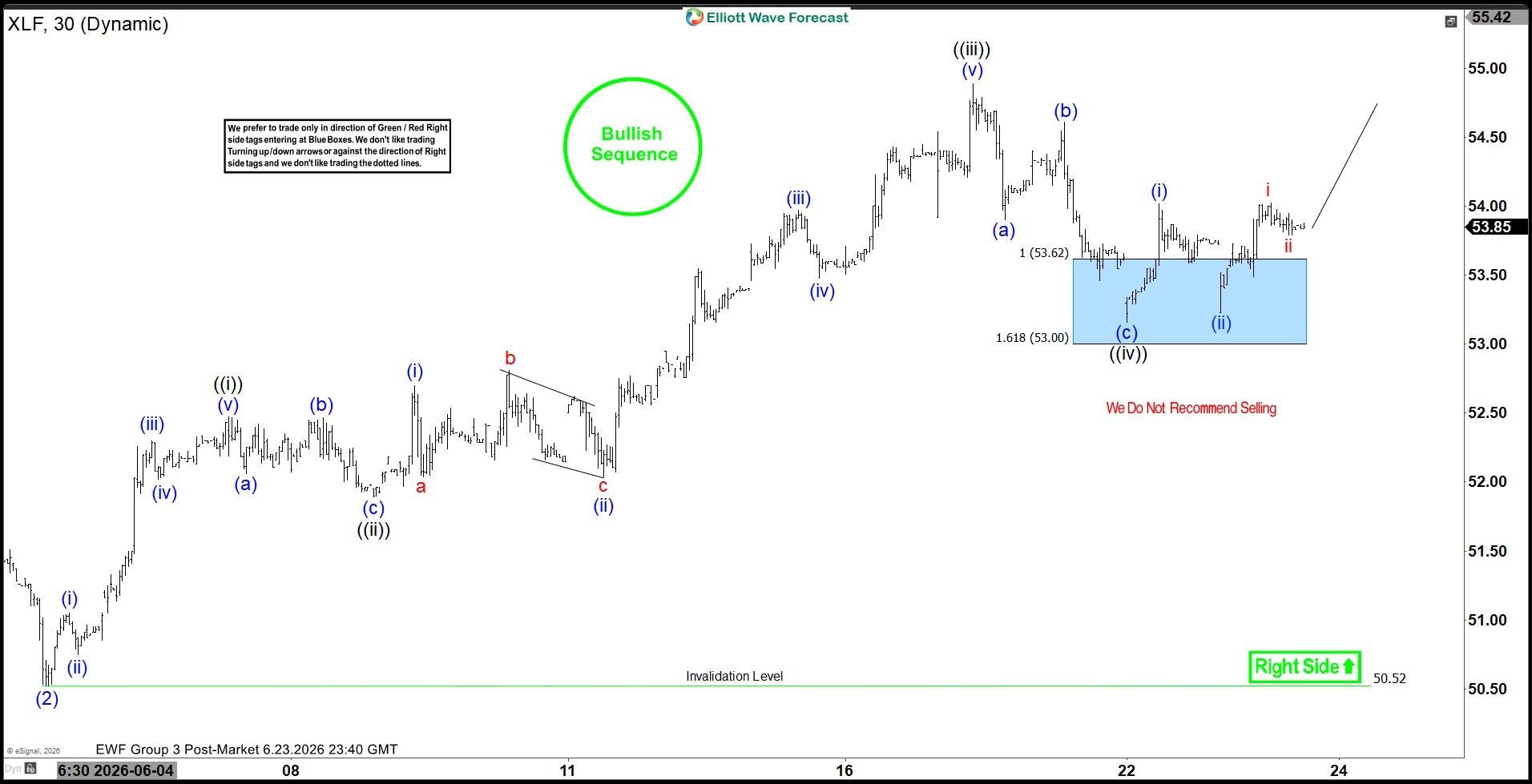
Updated one‑hour view from June 23 2026

After the blue‑box reaction, XLF produced a clean rally that allowed members to establish risk‑free long positions once protective stops were in place.

A break above the prior $54.89 high is required to confirm the next leg higher.

Initial upside targets on confirmation are $55.29 and $55.94 before a likely profit‑taking pullback that may unfold in 3 or 7 swings.
XLF

Key levels and rules

Invalidation / Critical Support: below the blue‑box low near $53.00 (use chart‑specific invalidation).

Short‑term confirmation: break and hold above $54.89.    

Targets on confirmation: $55.29; $55.94.

Trade plan: buy dips into blue boxes using 3, 7, or 11‑swing sequences; place stop‑losses below the invalidation pivot and scale into winners.

Trading insight

Maintain a bullish bias while the impulse structure and higher‑high sequence remain intact. Use corrective pullbacks to the blue‑box zones as defined entry areas, then manage positions with clearly defined stop‑losses and profit targets. This approach lets you create risk‑defined or near risk‑free positions once the trade is in your favor. Discipline in risk and money management, combined with a working knowledge of Elliott Wave and cycle relationships, is essential to execute this plan consistently.

Author

Elliott Wave Forecast Team

Elliott Wave Forecast Team

ElliottWave-Forecast.com

More from Elliott Wave Forecast Team
Share:

Editor's Picks

GBP/USD appears well offered near 1.3160

GBP/USD builds on Tuesday’s losses, although it now manages to pick up some pace and bounce off earlier multi-month troughs near 1.3140. The Greenback’s solid performance and continued political turmoil in the UK are keeping Cable under persistent pressure, with little sign of a meaningful recovery.

EUR/USD trims losses, hovers around 1.1350

EUR/USD now regains some composure and rebounds to the 1.1350 zone on Wednesday, partially reversing the prior pullback to fresh yearly lows near 1.1320. Meanwhile, spot remains on the back foot as the US Dollar continues to draw support from hawkish Fed expectations and uncertainty over the outcome of US-Iran peace negotiations.

Gold puts $4,000 to the test, new yearly lows

Gold accelerates its decline and gyrates around the key $4,000 mark per troy ounce on Wednesday, its lowest level since November 2025. In the meantime, tighter-for-longer Fed expectations and a broadly firmer US Dollar continue to weigh on the yellow metal, while uncertainty surrounding a potential US-Iran peace agreement has done little to revive demand for the safe haven space.

Crypto Today: Bitcoin, Ethereum, XRP trade under pressure as September Fed rate-hike odds increase

Bitcoin is trading between $62,000 and $63,000 at the time of writing on Wednesday, weighed down by headwinds stemming from macroeconomic uncertainty and geopolitical tensions in the Middle East.

5.90% to 5.45%: Why the Pound ignored the bond market’s relief rally

Keir Starmer resigned on Monday, and the Pound barely moved. That near-silence is the tell. Sterling's real driver these past four months has not been the prime minister, nor the left-leaning frontrunner lining up to replace him, but the long end of the gilt curve, which answers to a force no British politician controls.

Regime change: Inside Kevin Warsh's first move to make the Fed unreadable on purpose

The rate did not move. That was the least interesting thing about Kevin Warsh's first meeting in charge of the Fed. The FOMC held its benchmark at 3.50%-3.75% for the fourth straight meeting, exactly as priced, and then the new chair used his first press conference to dismantle the machinery the market has leaned on for a decade.