WTI Price Forecast: Returns above 20-day EMA as Trump dismisses Iran’s response
- The Oil price jumps to near $96.60 at the start of the week on renewed uncertainty over the US-Iran permanent resolution.
- US President Trump said that Iran’s response to the peace proposal is totally unacceptable.
- Iran wants its authority near the Strait of Hormuz and compensation for war damages.

West Texas Intermediate (WTI), futures on NYMEX, is up 5.2% to near $96.60 in the Asian trade at the start of the week. The Oil price attracts significant bids as expectations that the United States (US) and Iran will reach a permanent ceasefire in the near term have faded.
Over the weekend, US President Donald Trump called Iran’s response to the one-page peace proposal “totally unacceptable, through a post on Truth Social, which diminished hopes of an imminent US-Iran ceasefire.
According to the Iranian state media, Tehran wants the recognition of its authority near the Strait of Hormuz, a vital passage to almost 20% of global energy supply, compensation for war damages, the release of its frozen assets, and lifting sanctions, CNN reported. Dashed US-Iran peace hopes have prompted fears of a prolonged closure of the Strait of Hormuz.
Meanwhile, growing concerns that the Federal Reserve (Fed) will keep interest rates at their current levels for longer amid de-anchored inflation projections due to elevated energy prices and upbeat Nonfarm Payrolls (NFP) data for April could have a limited impact on the Oil price’s upside.
WTI technical analysis
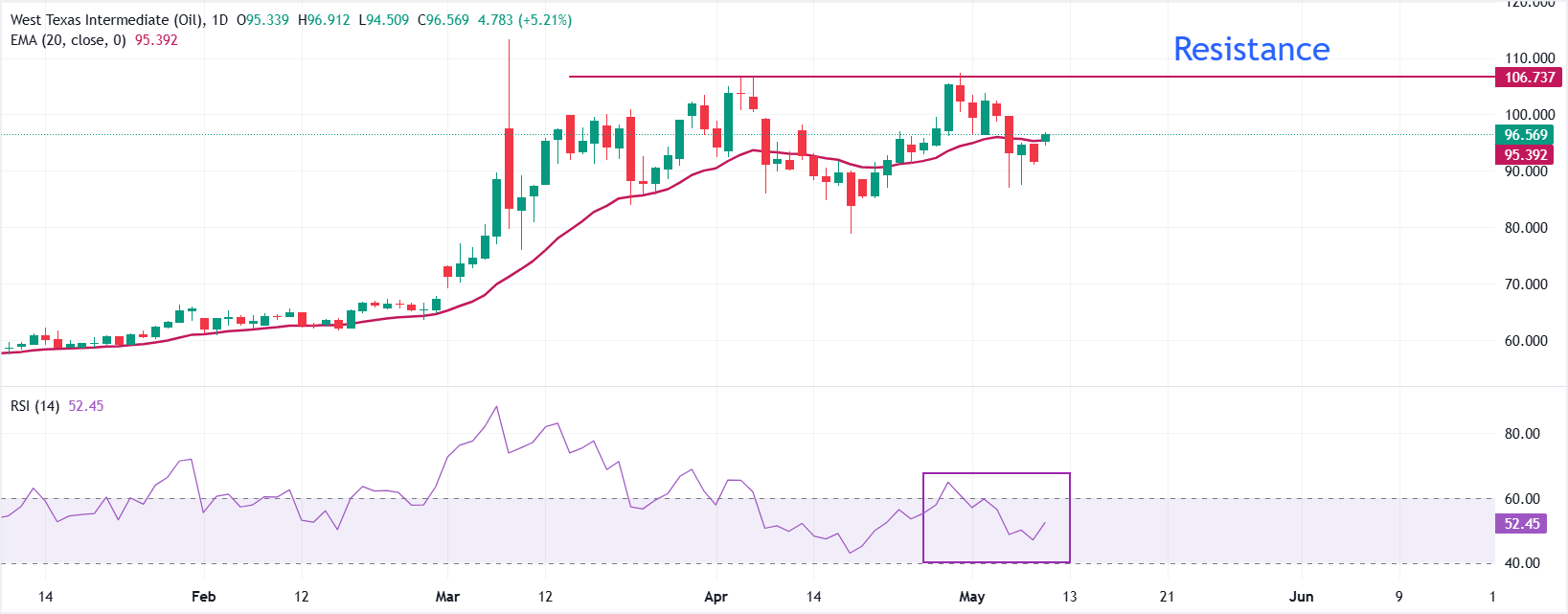
WTI US Oil trades strongly at around $96.60 in the Asian trade. The near-term bias of the contract has turned bullish as it has returned above the 20-day exponential moving average (EMA) at $95.39, suggesting the recent pullback is consolidative rather than a full reversal.
The Relative Strength Index (RSI) at 52.45 sits in neutral territory, hinting at modest positive momentum without stretched conditions in either direction.
On the downside, initial support is seen at the 20-day EMA near $95.39, where a break would expose a deeper correction toward $90. As long as the price holds above this moving average, buyers are likely to retain control, and the oil price could aim to extend its advance towards the psychological level of $100, followed by the April 30 high of $107.35.
(The technical analysis of this story was written with the help of an AI tool.)
WTI Oil FAQs
WTI Oil is a type of Crude Oil sold on international markets. The WTI stands for West Texas Intermediate, one of three major types including Brent and Dubai Crude. WTI is also referred to as “light” and “sweet” because of its relatively low gravity and sulfur content respectively. It is considered a high quality Oil that is easily refined. It is sourced in the United States and distributed via the Cushing hub, which is considered “The Pipeline Crossroads of the World”. It is a benchmark for the Oil market and WTI price is frequently quoted in the media.
Like all assets, supply and demand are the key drivers of WTI Oil price. As such, global growth can be a driver of increased demand and vice versa for weak global growth. Political instability, wars, and sanctions can disrupt supply and impact prices. The decisions of OPEC, a group of major Oil-producing countries, is another key driver of price. The value of the US Dollar influences the price of WTI Crude Oil, since Oil is predominantly traded in US Dollars, thus a weaker US Dollar can make Oil more affordable and vice versa.
The weekly Oil inventory reports published by the American Petroleum Institute (API) and the Energy Information Agency (EIA) impact the price of WTI Oil. Changes in inventories reflect fluctuating supply and demand. If the data shows a drop in inventories it can indicate increased demand, pushing up Oil price. Higher inventories can reflect increased supply, pushing down prices. API’s report is published every Tuesday and EIA’s the day after. Their results are usually similar, falling within 1% of each other 75% of the time. The EIA data is considered more reliable, since it is a government agency.
OPEC (Organization of the Petroleum Exporting Countries) is a group of 12 Oil-producing nations who collectively decide production quotas for member countries at twice-yearly meetings. Their decisions often impact WTI Oil prices. When OPEC decides to lower quotas, it can tighten supply, pushing up Oil prices. When OPEC increases production, it has the opposite effect. OPEC+ refers to an expanded group that includes ten extra non-OPEC members, the most notable of which is Russia.
Author

Sagar Dua
FXStreet
Sagar Dua is associated with the financial markets from his college days. Along with pursuing post-graduation in Commerce in 2014, he started his markets training with chart analysis.

















