WTI Price Forecast: 20-day EMA remains key hurdle
- The oil price falls sharply amid reports confirming that the US-Iran peace talks are intact.
- US President Trump stated that recent attacks didn’t mean the restart of an all-out war.
- Investors seek fresh cues regarding the progress in US-Iran negotiations.

West Texas Intermediate (WTI), futures on NYMEX, trade almost 3% lower to near $87.60 during the European trading session on Thursday. The oil price faces selling pressure amid hopes that negotiations between the United States (US) and Iran regarding a permanent peace deal remain intact despite the exchange of attacks between both nations.
Earlier in the day, a report from CNN showed that a diplomatic source has confirmed that the US-Iran talks are still going on despite trading attacks.
On late Wednesday, US President Trump also told aides to deliver a message to Iran via Qatar, that the attacks did not mean a “restart of all-out war,” and were only in response to the helicopter downing, The Wall Street Journal (WSJ) reported.
The US Central Command (CENTCOM) has been conducting military operations on several targets in Iran in the last two days in retaliation for Tehran shooting down the US Apache helicopter patrolling over the Strait of Hormuz earlier this week.
Meanwhile, investors seek fresh cues regarding the progress of US-Iran negotiations towards a permanent peace deal.
WTI technical analysis
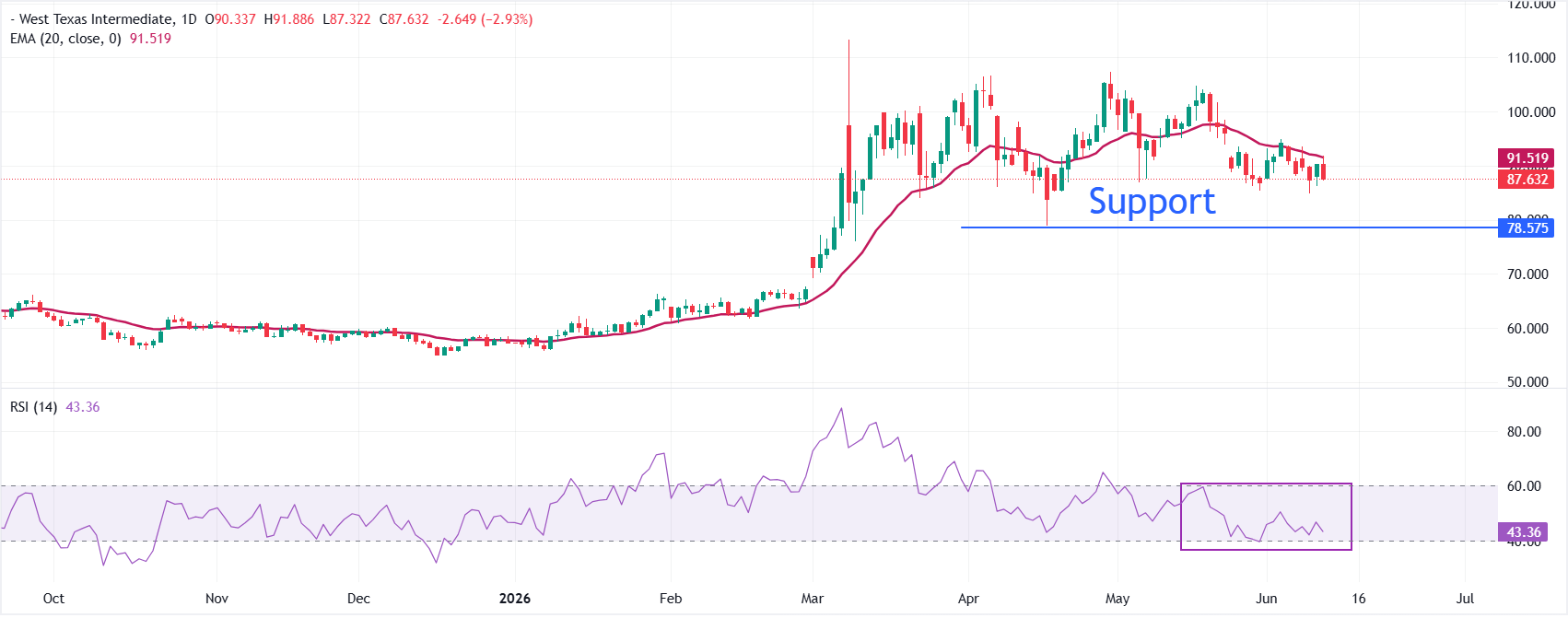
The WTI US Oil trades sharply lower at around $87.60 at press time, extending a bearish near-term tone as price holds beneath the 20-day Exponential Moving Average (EMA) at $91.52. The placement of spot below this key dynamic barrier suggests sellers retain control, while the Relative Strength Index (RSI) around 43 leans lower but stays above oversold territory, hinting at persistent downside pressure without an immediate exhaustion signal.
On the topside, initial resistance emerges at the 20-day EMA near $91.52, and a sustained break above this level would be needed to ease the current downside bias and open the way for a more meaningful recovery. Looking down, the oil price could extend its decline towards the April 17 low at $78.88 if it slides below the June 9 low at $84.87.
(The technical analysis of this story was written with the help of an AI tool.)
WTI Oil FAQs
WTI Oil is a type of Crude Oil sold on international markets. The WTI stands for West Texas Intermediate, one of three major types including Brent and Dubai Crude. WTI is also referred to as “light” and “sweet” because of its relatively low gravity and sulfur content respectively. It is considered a high quality Oil that is easily refined. It is sourced in the United States and distributed via the Cushing hub, which is considered “The Pipeline Crossroads of the World”. It is a benchmark for the Oil market and WTI price is frequently quoted in the media.
Like all assets, supply and demand are the key drivers of WTI Oil price. As such, global growth can be a driver of increased demand and vice versa for weak global growth. Political instability, wars, and sanctions can disrupt supply and impact prices. The decisions of OPEC, a group of major Oil-producing countries, is another key driver of price. The value of the US Dollar influences the price of WTI Crude Oil, since Oil is predominantly traded in US Dollars, thus a weaker US Dollar can make Oil more affordable and vice versa.
The weekly Oil inventory reports published by the American Petroleum Institute (API) and the Energy Information Agency (EIA) impact the price of WTI Oil. Changes in inventories reflect fluctuating supply and demand. If the data shows a drop in inventories it can indicate increased demand, pushing up Oil price. Higher inventories can reflect increased supply, pushing down prices. API’s report is published every Tuesday and EIA’s the day after. Their results are usually similar, falling within 1% of each other 75% of the time. The EIA data is considered more reliable, since it is a government agency.
OPEC (Organization of the Petroleum Exporting Countries) is a group of 12 Oil-producing nations who collectively decide production quotas for member countries at twice-yearly meetings. Their decisions often impact WTI Oil prices. When OPEC decides to lower quotas, it can tighten supply, pushing up Oil prices. When OPEC increases production, it has the opposite effect. OPEC+ refers to an expanded group that includes ten extra non-OPEC members, the most notable of which is Russia.
Author

Sagar Dua
FXStreet
Sagar Dua is associated with the financial markets from his college days. Along with pursuing post-graduation in Commerce in 2014, he started his markets training with chart analysis.

















