WTI plummets to near $82 as US economic pressure on Iran seems less risky
- The Oil price dives 3% to near $82.00 due to a shift in the US focus to economic pressure from military aggression.
- US Treasury Secretary warned to isolate Iran from the global financial system.
- China says that its cooperation with Iran is within the international law framework and should not be interrupted.
West Texas Intermediate (WTI), futures on NYMEX, trade 3% lower at around $82.00 during the European trading session on Tuesday. The Oil price faces intense selling pressure as market experts see warning of fresh United States (US) economic sanctions on Iran as less fearful for oil markets than increasing military operations.
On Monday, US Treasury Secretary Scott Bessent said that the US is launching "an economic onslaught against Iran's financial connections around the globe". At a press conference, Bessent outlined plans to launch an " economic D-Day" on Iran and stated the United States would pursue a "zero leakage" approach to enforcing its sanctions.
US sanctions on Iran seen as warning shot with limited immediate market impact
Analysts at Danske Bank observe that the US “economic D-Day” against Iran has so far been “a limited market mover,” noting that Treasury Secretary Scott Bessent largely confined himself to “a broad warning of secondary sanctions against entities still doing business with Iran, without providing concrete details on timing, monitoring or the scope of enforcement.” While the stated US objective is to further isolate Iran and “sever every economic lifeline,” Danske argues that the absence of specifics meant the move “felt more like a warning shot than a decisive escalation,” leaving the immediate macro and market reaction muted. On the other side, Iran has “promised to retaliate against expanded US economic sanctions that the Americans said would cut off Iran’s economic lifeline,” with Tehran signalling confidence that key partners such as China will “resist Washington’s pressure campaign.”
Strategists at SaxoBank have stated that the shift from “military conflict to economic pressure” in the US-Israeli war with Iran has reduced some of the oil market’s anxiety, Reuters reports.
Meanwhile, a spokesperson from China’s Foreign Ministry, Lin Jian, has stated that its cooperation with Iran is conducted within the framework of international law and should not be interfered with or disrupted.
WTI Technical Analysis
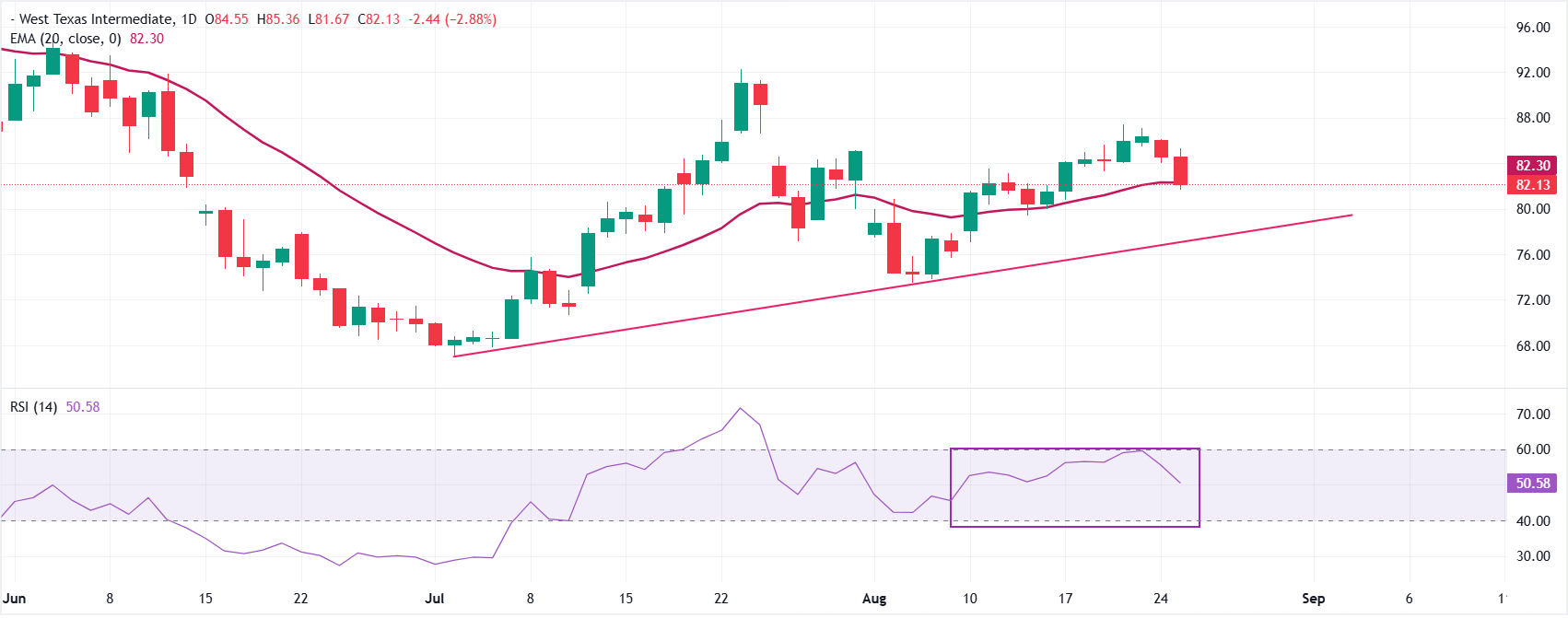
In the daily chart, WTI US Oil trades at $82.14, holding just under the 20-day Exponential Moving Average (EMA) at $82.31, which caps the upside and keeps the near-term tone slightly bearish. The price remains well above the rising trend-line support coming in near $77.76, so the broader uptrend is still intact, while the Relative Strength Index (RSI) at 50.60 sits close to neutral and hints at a consolidative phase rather than strong directional momentum.
On the downside, the first meaningful support is the upward-sloping trend line around $77.76, where buyers would be expected to re-emerge if the current pullback deepens. On the topside, immediate resistance is located at the 20-day EMA at $82.31; a daily close above this barrier would ease bearish pressure and reopen the path toward higher levels in the prevailing medium-term uptrend.
(The technical analysis of this story was written with the help of an AI tool. Know more.)
WTI Oil FAQs
WTI Oil is a type of Crude Oil sold on international markets. The WTI stands for West Texas Intermediate, one of three major types including Brent and Dubai Crude. WTI is also referred to as “light” and “sweet” because of its relatively low gravity and sulfur content respectively. It is considered a high quality Oil that is easily refined. It is sourced in the United States and distributed via the Cushing hub, which is considered “The Pipeline Crossroads of the World”. It is a benchmark for the Oil market and WTI price is frequently quoted in the media.
Like all assets, supply and demand are the key drivers of WTI Oil price. As such, global growth can be a driver of increased demand and vice versa for weak global growth. Political instability, wars, and sanctions can disrupt supply and impact prices. The decisions of OPEC, a group of major Oil-producing countries, is another key driver of price. The value of the US Dollar influences the price of WTI Crude Oil, since Oil is predominantly traded in US Dollars, thus a weaker US Dollar can make Oil more affordable and vice versa.
The weekly Oil inventory reports published by the American Petroleum Institute (API) and the Energy Information Agency (EIA) impact the price of WTI Oil. Changes in inventories reflect fluctuating supply and demand. If the data shows a drop in inventories it can indicate increased demand, pushing up Oil price. Higher inventories can reflect increased supply, pushing down prices. API’s report is published every Tuesday and EIA’s the day after. Their results are usually similar, falling within 1% of each other 75% of the time. The EIA data is considered more reliable, since it is a government agency.
OPEC (Organization of the Petroleum Exporting Countries) is a group of 12 Oil-producing nations who collectively decide production quotas for member countries at twice-yearly meetings. Their decisions often impact WTI Oil prices. When OPEC decides to lower quotas, it can tighten supply, pushing up Oil prices. When OPEC increases production, it has the opposite effect. OPEC+ refers to an expanded group that includes ten extra non-OPEC members, the most notable of which is Russia.
Author

Sagar Dua
FXStreet
Sagar Dua is associated with the financial markets from his college days. Along with pursuing post-graduation in Commerce in 2014, he started his markets training with chart analysis.

















