Eurozone flash Composite PMI drops to 50.5 in March vs. 51.9 prior
Eurozone's preliminary HCOB Composite PMI arrives lower at 50.5 in March against estimates of 51.1 and 51.9 in February. The growth in the overall private sector business activity slows down due to weakness in the services sector.
The Services PMI drops sharply to 50.1 against estimates of 51.0 and the previous reading of 51.9. The Manufacturing PMI jumps to 51.4 from 50.8 in February.
"The flash Eurozone PMI is ringing stagflation alarm bells as the war in the Middle East drives prices sharply higher while stifling growth. Firms’ costs are rising at the fastest rate for over three years amid the surge in energy prices and choking of supply chains resulting from the war. Supplier delays have jumped to their highest since mid-2022, largely linked to shipping issues," Chris Williamson, Chief Business Economist at S&P Global Market Intelligence said.
Market reaction
EUR/USD faces slight selling pressure after the PMI data release. As of writing, the major currency pair trades 0.2% down to near 1.1585.
Euro Price Today
The table below shows the percentage change of Euro (EUR) against listed major currencies today. Euro was the weakest against the US Dollar.
| USD | EUR | GBP | JPY | CAD | AUD | NZD | CHF | |
|---|---|---|---|---|---|---|---|---|
| USD | 0.22% | 0.31% | 0.14% | 0.16% | 0.71% | 0.62% | 0.10% | |
| EUR | -0.22% | 0.07% | -0.09% | -0.05% | 0.49% | 0.40% | -0.12% | |
| GBP | -0.31% | -0.07% | -0.13% | -0.12% | 0.42% | 0.33% | -0.19% | |
| JPY | -0.14% | 0.09% | 0.13% | 0.04% | 0.58% | 0.48% | -0.03% | |
| CAD | -0.16% | 0.05% | 0.12% | -0.04% | 0.54% | 0.44% | -0.06% | |
| AUD | -0.71% | -0.49% | -0.42% | -0.58% | -0.54% | -0.09% | -0.63% | |
| NZD | -0.62% | -0.40% | -0.33% | -0.48% | -0.44% | 0.09% | -0.51% | |
| CHF | -0.10% | 0.12% | 0.19% | 0.03% | 0.06% | 0.63% | 0.51% |
The heat map shows percentage changes of major currencies against each other. The base currency is picked from the left column, while the quote currency is picked from the top row. For example, if you pick the Euro from the left column and move along the horizontal line to the US Dollar, the percentage change displayed in the box will represent EUR (base)/USD (quote).
(This section below was published at 08:31 GMT to cover the release of the flash German PMI data for March)
German Composite PMI drops sharply to 51.9 from 53.2 in February, according to flash estimates, but remains higher than expectations of 51.8. The overall private business activity expanded moderately due to a sharp slowdown in the service sector output growth. The Services PMI arrives lower at 51.2 vs. estimates of 52.5 and the previous release of 53.5.
The manufacturing sector output expanded at a faster pace, while it was expected to swing to a declining trajectory. The Manufacturing PMI rises to 51.7 from 50.9 in February. Economists expected the data to arrive lower at 49.8.
"March's flash data show the first impacts of the war in the Middle East on growth, demand, business confidence and, perhaps most notably, prices. "The service sector has seen an immediate negative impact. Growth in business activity has slowed sharply to its weakest since the current upturn began last September, weighed down by a drop in inflows of new work that reflects a combination of increased uncertainty and rising price pressures. "The big surprise is perhaps the acceleration in growth in the manufacturing sector. Reports from goods producers indicate that demand has in some cases been boosted by companies reacting to the disruption and uncertainty brought on by the war in the Middle East, with some bringing forward purchases over concerns about potential supply disruption in the coming months," Phil Smith, Economics Associate Director at S&P Global Market Intelligence said.
Market reaction
There seems to be a negligible impact of the German PMI data on the Euro (EUR). As of writing, EUR/USD trades 0.15% down to near 1.1600.
(This section below was published at 06:31 GMT as a preview of the German/ Eurozone flash PMI data for March)
German/ Eurozone flash PMIs Overview
The preliminary German and Eurozone flash HCOB Purchasing Managers’ Index (PMI) data for March is due for release today at 08:30 and 09:00 GMT, respectively.
Amongst the Euro area economies, the German and the composite Eurozone PMI reports hold more relevance, in terms of their impact on the European currency and the related markets as well.
The flash Composite PMI for Germany is expected to come in lower due to a slowdown in both manufacturing and the service sector activity. In February, the Composite PMI came in at 53.2.
Germany’s Manufacturing PMI is expected to have swung to contraction again after returning to growth for a month in February. A figure below 50.0 is considered a contraction in the business activity. The Manufacturing PMI is seen arriving lower at 49.8 from the previous reading of 50.9. Flash Services PMI is estimated to have dropped to 52.5 from 53.5 in February.
The forecast for the Eurozone flash Composite PMI also shows that the overall private sector output expanded at a moderate pace in March due to a decline in the manufacturing sector output and a slowdown in the services sector output growth.
The Composite PMI is expected to come in at 51.1, lower than 51.9 in February. The Services PMI is seen at 51.0, down from the previous reading of 51.9. Like the German Manufacturing PMI, the manufacturing activity in the old continent is estimated to have returned to the declining trajectory. The Manufacturing PMI is seen arriving lower at 49.5 against the prior release of 50.8.
How could German/ Eurozone flash PMIs affect EUR/USD?
Signs of continuous strength in the overall business sector activity from the German/ Eurozone flash PMI prints would be favorable for the Euro (EUR), while weak numbers would act as a drag on the shared currency. However, developments regarding the war in the Middle East are expected to be the key driver of the EUR/USD pair.
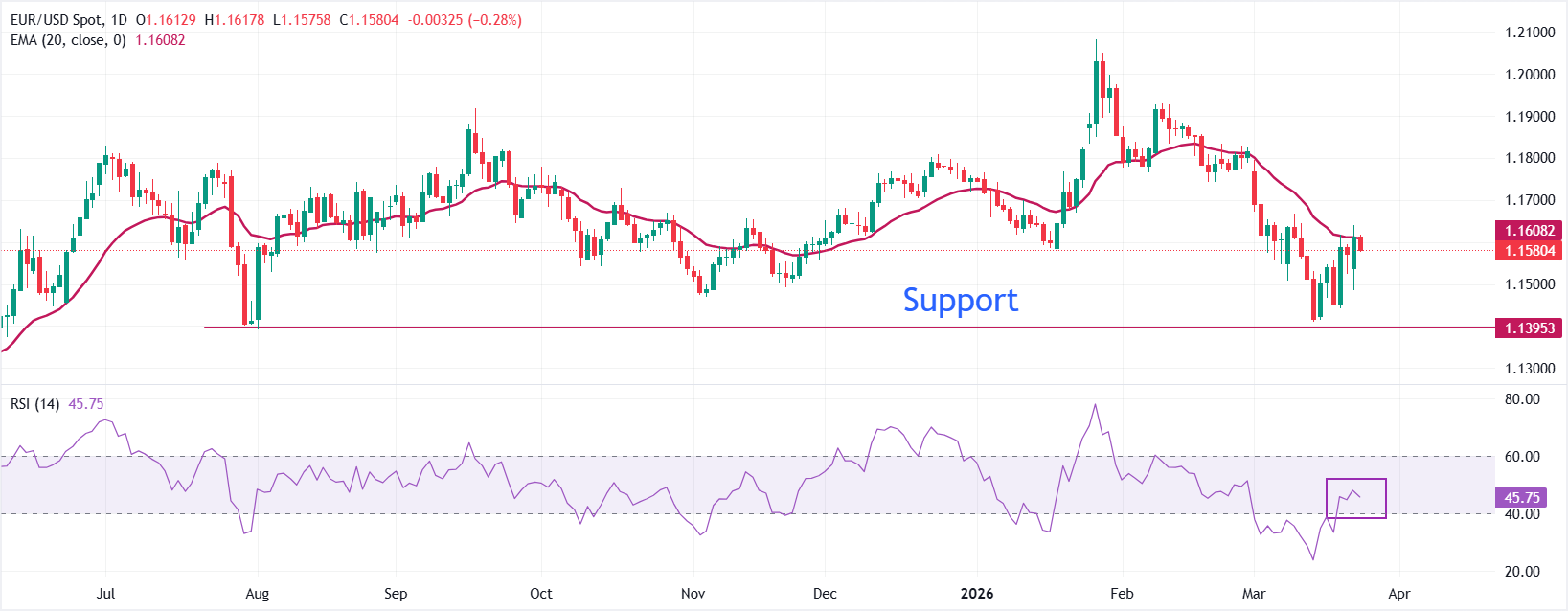
EUR/USD trades 0.22% lower to near 1.1580 in the early European session. The pair stays pressured below the 20-day Exponential Moving Average (EMA) near 1.16, which keeps the near-term bias mildly bearish despite the recent stabilization off the lows. Price action has carved out a sequence of lower daily closes over recent weeks, and the failed attempts to reclaim the 20-day EMA reinforce a downside-oriented structure.
The 14-day Relative Strength Index (RSI) at 45 remains below the 50 midline, signaling persistent, though not extreme, bearish momentum.
Initial resistance emerges at 1.1610, where the 20-day EMA converges with recent daily highs, and a break above this area would be needed to ease immediate downside pressure. Further resistance stands at the March 10 high of 1.1667. On the downside, immediate support aligns at 1.1510, guarding the recent cluster of lows, with a break exposing an over seven-month low of around 1.1390 as the next bearish target.
(The technical analysis of this story was written with the help of an AI tool.)
Euro FAQs
The Euro is the currency for the 20 European Union countries that belong to the Eurozone. It is the second most heavily traded currency in the world behind the US Dollar. In 2022, it accounted for 31% of all foreign exchange transactions, with an average daily turnover of over $2.2 trillion a day. EUR/USD is the most heavily traded currency pair in the world, accounting for an estimated 30% off all transactions, followed by EUR/JPY (4%), EUR/GBP (3%) and EUR/AUD (2%).
The European Central Bank (ECB) in Frankfurt, Germany, is the reserve bank for the Eurozone. The ECB sets interest rates and manages monetary policy. The ECB’s primary mandate is to maintain price stability, which means either controlling inflation or stimulating growth. Its primary tool is the raising or lowering of interest rates. Relatively high interest rates – or the expectation of higher rates – will usually benefit the Euro and vice versa. The ECB Governing Council makes monetary policy decisions at meetings held eight times a year. Decisions are made by heads of the Eurozone national banks and six permanent members, including the President of the ECB, Christine Lagarde.
Eurozone inflation data, measured by the Harmonized Index of Consumer Prices (HICP), is an important econometric for the Euro. If inflation rises more than expected, especially if above the ECB’s 2% target, it obliges the ECB to raise interest rates to bring it back under control. Relatively high interest rates compared to its counterparts will usually benefit the Euro, as it makes the region more attractive as a place for global investors to park their money.
Data releases gauge the health of the economy and can impact on the Euro. Indicators such as GDP, Manufacturing and Services PMIs, employment, and consumer sentiment surveys can all influence the direction of the single currency. A strong economy is good for the Euro. Not only does it attract more foreign investment but it may encourage the ECB to put up interest rates, which will directly strengthen the Euro. Otherwise, if economic data is weak, the Euro is likely to fall. Economic data for the four largest economies in the euro area (Germany, France, Italy and Spain) are especially significant, as they account for 75% of the Eurozone’s economy.
Another significant data release for the Euro is the Trade Balance. This indicator measures the difference between what a country earns from its exports and what it spends on imports over a given period. If a country produces highly sought after exports then its currency will gain in value purely from the extra demand created from foreign buyers seeking to purchase these goods. Therefore, a positive net Trade Balance strengthens a currency and vice versa for a negative balance.
Author

Sagar Dua
FXStreet
Sagar Dua is associated with the financial markets from his college days. Along with pursuing post-graduation in Commerce in 2014, he started his markets training with chart analysis.

















