|

Wheat futures rally from blue box zone

Wheat Futures (ZW_F) have been trending higher since the June 2026 low, unfolding a bullish impulse that supports further upside. The sequence of higher highs and higher lows continues to favor buying dips in 3, 7, or 11 swing sequences at defined blue box areas, rather than selling against the trend.

June 30, 2026 (One‑hour chart update)
Chart

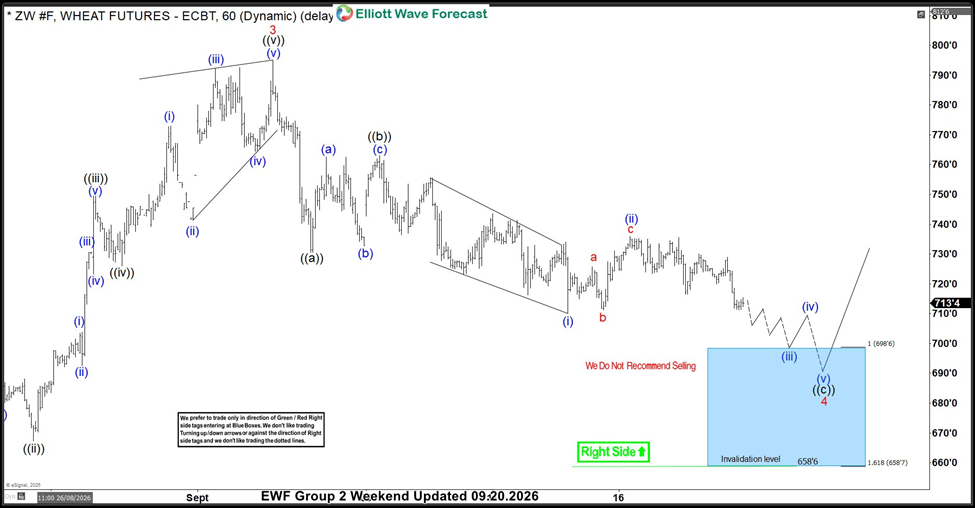
Rally from the August 6 low ended wave 3 at $795’0.

The pullback in wave 4 unfolded as a zigzag correction:

((a)) ended at $730’4.

((b)) bounced to $763’0.

((c)) reached the blue box zone658’7.

This zone provided a low‑risk buying opportunity, where buyers were expected to step in for new highs or at least a 3‑wave bounce.

October 7, 2026 (One‑hour chart update)
Chart

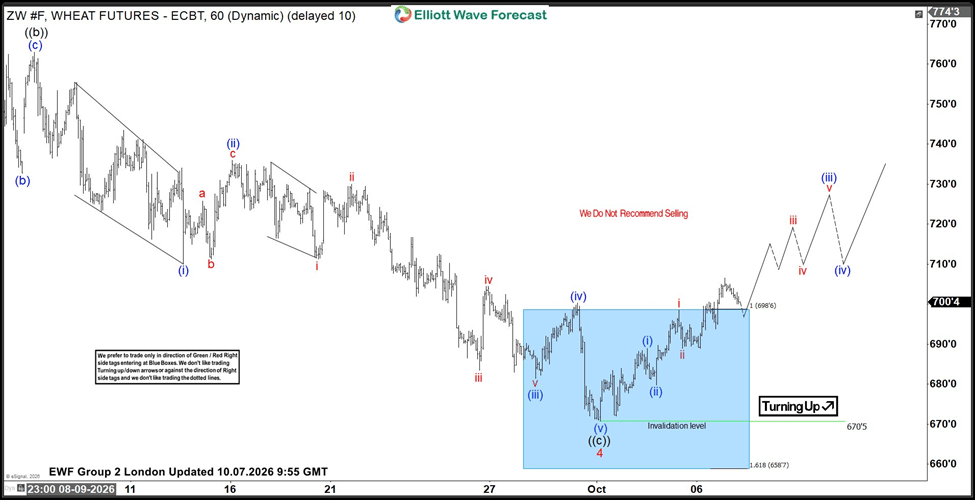
Wheat Futures reacted higher after completing the correction in the blue box.

Members are managing positions with the goal of securing risk‑free status, aiming for742’0.

A decisive break above $795’0 is required to confirm the next leg higher, with upside targets around

871’6 before another corrective pullback in 3 or 7 swings.

Trade Plan and Risk Management

Entry: Buy dips into the blue box using 3, 7, or 11 swing sequences.

Stops: Place stop‑losses below the blue box to define invalidation and protect capital.

Targets: Scale out into the742’0 zone, with extended targets toward871’6.

Timeframe: Favor tactical short‑ to medium‑term trades; avoid passive long exposure without active risk controls.

Position sizing: Adjust size conservatively to account for futures volatility.

Why This Setup Works

The blue‑box framework blends Elliott Wave structure with measured risk zones, enabling traders to:

Enter with defined risk and clear invalidation levels.

Convert positions to risk‑free quickly after confirmation.

Capture high‑probability moves while limiting downside exposure.

Discipline in risk and money management, combined with Elliott Wave and cycle analysis, is essential to execute this plan consistently.

Author

Elliott Wave Forecast Team

Elliott Wave Forecast Team

ElliottWave-Forecast.com

More from Elliott Wave Forecast Team
Share:

Editor's Picks

AUD/USD bulls regain control above 0.6950 amid USD retreat

AUD/USD regains traction and extends the previous day's bounce from the weekly low, aiming for 0.7000 in Asia on Friday. The overnight pullback in US bond yields keeps the US Dollar below an 18-month high, which in turn offers some support to the pair. Meanwhile, hawkish RBA expectations also keep the major underpinned.

USD/JPY holds gains near 158.00 after Japan's weak Household Spending data

USD/JPY clings to gains around 158.00 after data showed on Friday that Japan's Household Spending fell for the ninth straight month, undermining the Japanese Yen. Meanwhile, the US Dollar remains depressed as the overnight fall in US bond yields counters a hawkish Fed and geopolitical uncertainties, could cap any downside in the pair.

Gold remains range-bound below $4,200

Gold has given up some ground after an initial bullish attempt to reach weekly highs, returning to below the $4,200 mark per troy ounce on Friday. The US Dollar’s strong upside momentum, combined with rising US Treasury yields across the curve, seems to keep further gains in the yellow metal under scrutiny.

Has Bitcoin really escaped the macro forces it was built to fight?
Over 17 years ago, Satoshi Nakamoto designed Bitcoin (BTC) on the back of a global financial crisis as an alternative to the global monetary system outside the control of central banks, governments and traditional intermediaries. This raises a key question: has Bitcoin really become independent of the macroeconomic forces it was built to challenge?
The Euro is not the sick man of Europe. France's bond market is
EUR/USD remains under pressure, near the 17-month low of 1.1161 reached on Monday. The pair has lost more than 7% since its yearly peak, as concerns over France's public finances increasingly weigh on the single currency. But behind the weakness of the Euro (EUR), the problem does not necessarily lie with the European economy as a whole.
Has Bitcoin really escaped the macro forces it was built to fight?
Over 17 years ago, Satoshi Nakamoto designed Bitcoin (BTC) on the back of a global financial crisis as an alternative to the global monetary system outside the control of central banks, governments and traditional intermediaries. This raises a key question: has Bitcoin really become independent of the macroeconomic forces it was built to challenge?















