What Strait? US stocks soar as Oil market sells off on US-Iran negotiations
- Media reports suggest the US and Iran are considering meeting for further talks.
- S&P 500 and NASDAQ spike by 1% or more.
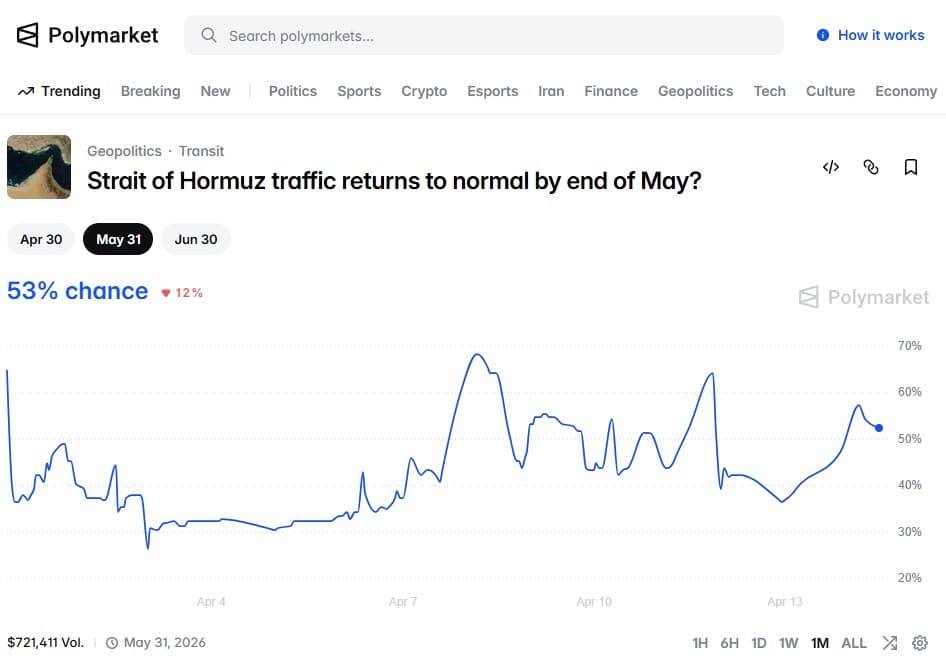
- Polymarket odds rise to 57% for the opening of the Strait before end of May.
- S&P 500 now in spitting distance of all-time high.

Talks of another round of negotiations between the US and Iran are pushing US stock indices higher on Tuesday. Oil (WTI) futures buckled under the pressure, shedding nearly 7% to trade below $93 as the NASDAQ Composite and S&P 500 added 1.5% and 1.0%, respectively.
Multiple news outlets are reporting that the US has reached out to Iran to schedule another round of talks before the ceasefire ends, and that negotiators are continuing to keep communication lines open.
Oil tanker traffic has been minimal through the Strait of Hormuz, which the United States (US) began blockading on Monday.
Strait of Hormuz remains closed
Oil futures collapsing on the chances of peace talks are nothing new in this 45-day-old war between the US, Iran and Israel, but the markets think the US is intent on getting a peace deal agreed to earlier than many previously considered.
Polymarket's odds concerning the Strait of Hormuz opening before the end of May reached a daily high of 57% early Tuesday morning after trading as low as 37% on Sunday.
Based on statements from officials in either nation, the negotiation terms still seem widely apart, with the US now calling for zero uranium enrichment, a complete non-starter, according to Iranian interlocutors. Over the weekend, Iranian officials said that the US was intent on obtaining concessions through diplomacy that it couldn't win on the battlefield.
Some foreign outlets are reporting that a Chinese-owned, Malawi-flagged ship exited the Strait on Tuesday, but traffic remains largely at a standstill. The US has announced that it will intercept all tankers carrying Iranian crude or those that pay an exit toll to Iran.
Goldman Sachs analysts said this week that their models continue to call for Brent Oil peaking in April before leveling off in the months ahead.
Equities remain euphoric
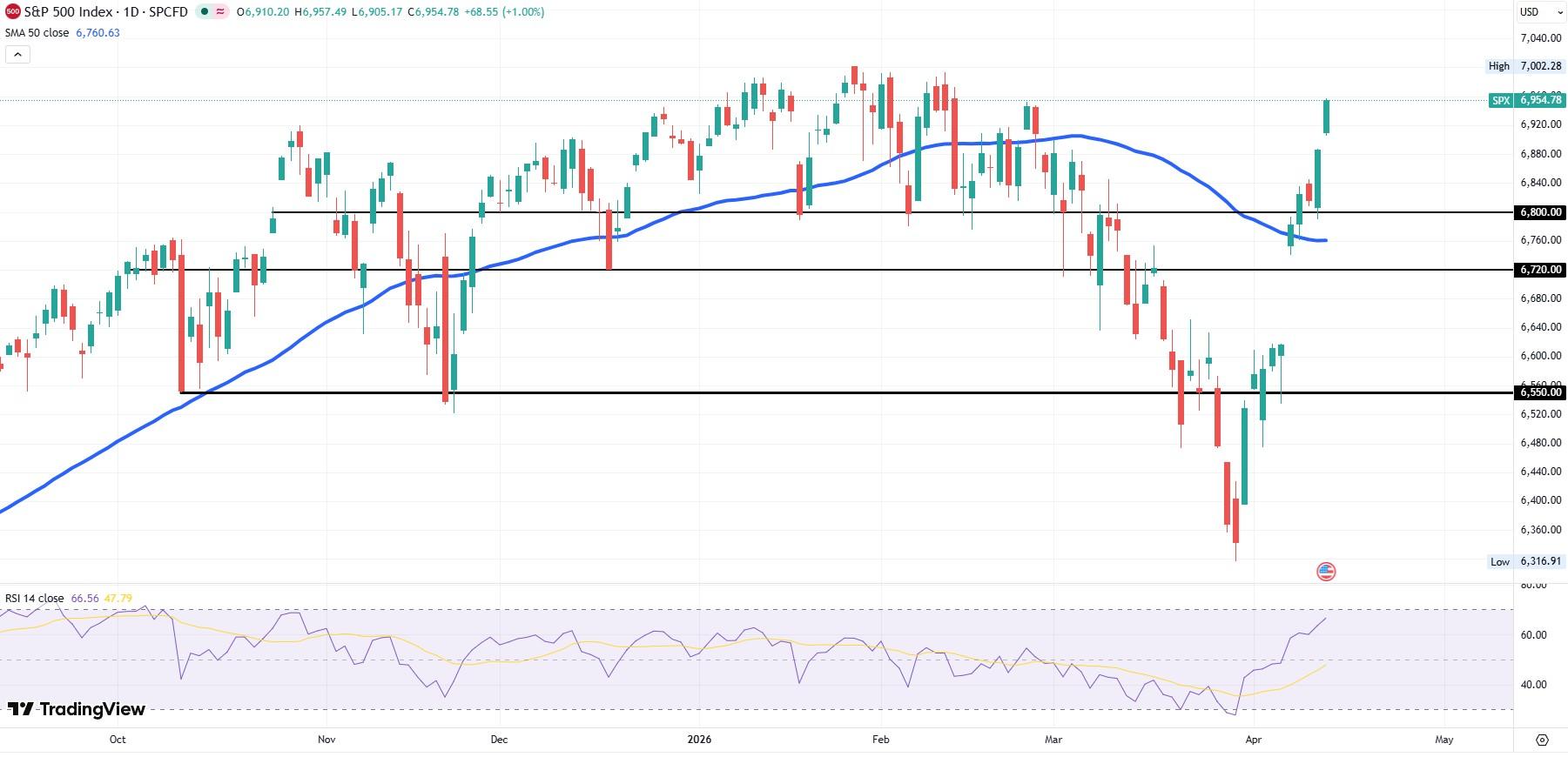
The S&P 500, trading at 6,955 at the time of writing, is now less than 1% away from all-time highs notched back in late January. The index owes its rally on Tuesday to the Consumer Discretionary, up 2.2%, and the Communications, up 1.6%, sectors.
On Monday, Morgan Stanley said the notable correction brought about by the Iran war and the consequent closure of the Strait of Hormuz might be further along than thought. The correction pushed the S&P 500 forward P/E ratio down by as much as 18%, the analyst noted, suggesting that investors were now focused on gobbling up stocks at lower valuations.
Goldman Sachs (GS) and JPMorgan (JPM) both sold off on earnings releases this week due to contracting net interest income, but both banks still registered major beats on earnings per share (EPS).
Another aspect of the recent rally is that the US Dollar has been losing strength for the last week, making share prices relatively cheaper to foreign investors.
Additionally, the market remains focused on the shortage in memory and other sectors of the semiconductor space. Shares of Ichor Holdings (ICHR) and Micron (MU) continue to move higher. Delta Air Lines (DAL) and Robinhood Markets (HOOD) are also rallying.
S&P 500 index chart
The S&P 500 index gapped up on strong buying pressure on Tuesday and didn't let up by lunchtime. The buying pressure might be helped by $43 billion of CTA buying this week, according to data from Goldman Sachs, which estimated that $34 billion will be dedicated to the S&P 500.
The index has strong support at 6,800, but it seems likely that bulls will endeavor to secure a new all-time high above the January 28 high of 7,002 — at the very least, by the end of this week. The Relative Strength Index (RSI) at 66 tells us that the index is not yet overbought and further buying pressure could emerge.
Author

Clay Webster
FXStreet
Clay Webster grew up in the US outside Buffalo, New York and Lancaster, Pennsylvania. He began investing after college following the 2008 financial crisis.














