Washington bought the Japanese Yen again without meaning to
- USD/JPY closed 0.92% lower, the largest decline since the intervention.
- Japan's policy rate is 1.00% against a 3.50% to 3.75% American band.
- July trade data at 23:50 GMT, national inflation 24 hours later.

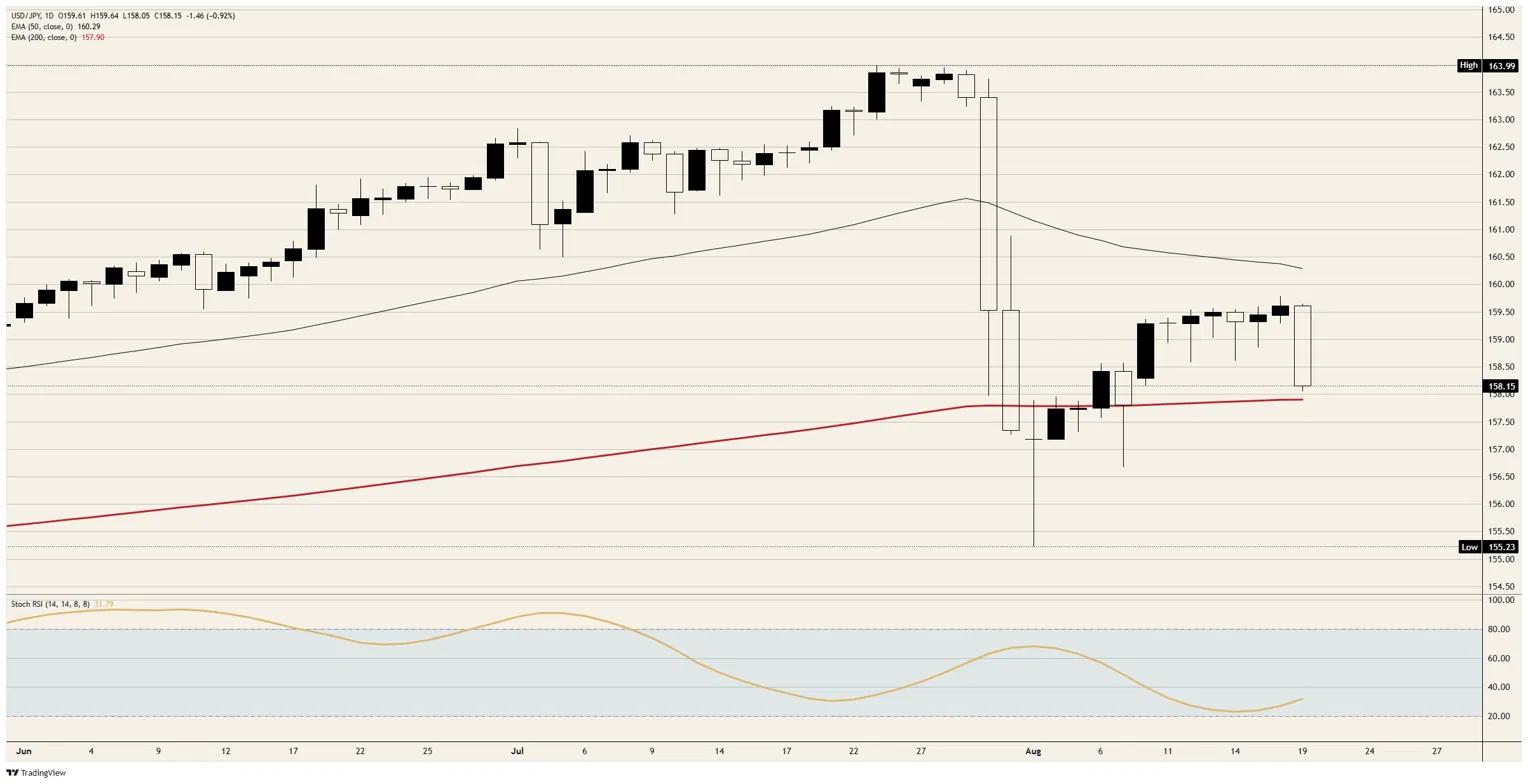
USD/JPY closed Wednesday 0.92% lower just above 158.00, the largest single-session decline since the early-August intervention, and Tokyo did not lift a finger for it. The Yen's best session since Tokyo last spent money defending it was delivered instead by the United States Treasury, which was not aiming at the Yen and never mentioned it. The pair ended the session sitting on its 200-day Exponential Moving Average (EMA).
The Yen trades the American long end, not Tokyo
The Treasury said it would at least double the size of its liquidity support buyback operations in longer-dated bonds, taking each operation from 2 billion Dollars to at least 4 billion, effective September 9 through November 4. The thirty-year had printed above 5.33% on August 18, its highest since June 2007, and gave back close to ten basis points inside the afternoon, with the ten-year easing toward 4.65%.
Japan's policy rate is 1.00% against a 3.50% to 3.75% band in the United States, so this pair is a spread instrument wearing a currency ticker. Intervention moves the spot rate and leaves the spread exactly where it was, which is why a record joint operation of 8.45 trillion Yen in a single session, followed by roughly 5.3 trillion more alongside the American Treasury, bought about eight big figures and surrendered close to half of them inside a fortnight. A bond notice aimed at the 20-year sector took more than a hundred pips out of the pair in two hours.
Tokyo's own long end belongs to the same problem. Japanese government bond yields have been climbing alongside American ones, so the differential that drives this pair stayed wide even while both curves sold off, and a domestic argument over swelling budget requests and how a consumption tax cut gets funded keeps that premium in place. The absence of any follow-up operation through the first half of August was all speculators needed to take back half the intervention move without a fight.
September was Tokyo's problem and Washington just eased it
The Bank of Japan (BoJ) held at 1.00% in July while warning that underlying inflation could overshoot its target, and market pricing for a September increase now sits just under 80%, up from around 65% in the first week of August. That case rests on imported inflation rather than domestic strength. Wholesale prices rose 7.2% annually in July and the Yen-based import price index rose 29.1%, which is the exchange rate arriving in the price level.
The domestic side is not carrying the argument at all. Second-quarter Gross Domestic Product (GDP) grew 1.1% annualised against a 2% consensus, weak household demand offsetting robust exports. A tightening justified by a weak currency gets harder to justify every time somebody else strengthens that currency, and Wednesday's work was done by a Washington bond desk rather than by anything said in Tokyo.
That is the loop worth holding onto through the next four weeks. Every big figure the Dollar surrenders on American fiscal news takes a slice out of the imported-inflation case that the September hike is built on, which means a Yen strengthened from the outside quietly lowers the odds of the domestic tightening that would strengthen it from the inside. A currency rescued by somebody else's balance sheet does not get to keep the rescue.
Trade tonight, national inflation tomorrow
July trade figures land at 23:50 GMT Wednesday, with the total merchandise balance forecast at a 680 billion Yen deficit against a 406.9 billion prior. Exports are seen at 19.9% annually from 19.3% and imports at 26.5% from 25.4%. Imports outrunning exports by that margin is the war's energy bill and the currency's arithmetic printed on the same line, and it is the deficit rather than the export headline that decides how the Asian session reads it.
National inflation follows at 23:30 GMT Thursday, the reading excluding fresh food forecast at 1.8% from 1.6% with the headline and core series both carrying a 1.7% prior. Both national gauges sit beneath the 2% target while wholesale prices run above 7%, and that split is what the September decision has to resolve. A firm print hardens the hike case. A soft one leaves the Yen holding a Dollar story it has no control over.
Japanese Yen levels
Resistance: 158.50 is the first line, then the session high near 159.50, with the declining 50-day E
xponential Moving Average (EMA) just beneath 160.50 capping any recovery. A daily close back above 159.50 puts the August range back in play.
Support: The 200-day EMA just beneath 158.00 is the line the session stopped on, then 157.50 and the 156.50 area, with the intervention low just above 155.00 the structural floor. Daily Stochastic Relative Strength Index (Stoch RSI) near 32 has room lower before it becomes an argument for a bounce.
Bias: Bearish beneath 159.50, objectives 157.50 then the 156.50 area, invalidation on a daily close back above 159.50.
USD/JPY daily chart
Japanese Yen FAQs
The Japanese Yen (JPY) is one of the world’s most traded currencies. Its value is broadly determined by the performance of the Japanese economy, but more specifically by the Bank of Japan’s policy, the differential between Japanese and US bond yields, or risk sentiment among traders, among other factors.
One of the Bank of Japan’s mandates is currency control, so its moves are key for the Yen. The BoJ has directly intervened in currency markets sometimes, generally to lower the value of the Yen, although it refrains from doing it often due to political concerns of its main trading partners. The BoJ ultra-loose monetary policy between 2013 and 2024 caused the Yen to depreciate against its main currency peers due to an increasing policy divergence between the Bank of Japan and other main central banks. More recently, the gradually unwinding of this ultra-loose policy has given some support to the Yen.
Over the last decade, the BoJ’s stance of sticking to ultra-loose monetary policy has led to a widening policy divergence with other central banks, particularly with the US Federal Reserve. This supported a widening of the differential between the 10-year US and Japanese bonds, which favored the US Dollar against the Japanese Yen. The BoJ decision in 2024 to gradually abandon the ultra-loose policy, coupled with interest-rate cuts in other major central banks, is narrowing this differential.
The Japanese Yen is often seen as a safe-haven investment. This means that in times of market stress, investors are more likely to put their money in the Japanese currency due to its supposed reliability and stability. Turbulent times are likely to strengthen the Yen’s value against other currencies seen as more risky to invest in.
Author

Joshua Gibson
FXStreet
Joshua joins the FXStreet team as an Economics and Finance double major from Vancouver Island University with twelve years' experience as an independent trader focusing on technical analysis.

















