USDCHF creeps lower toward 0.9400 after SNB Jordan’s hawkish remarks
- Federal Reserve members stressed the need to prolong rate hikes, even though at a slower pace, bolstering the US Dollar.
- The Swiss Franc continues to strengthen against the US Dollar.
- Based on data, SNB Governor Thomas J. Jordan said they could hike in December.
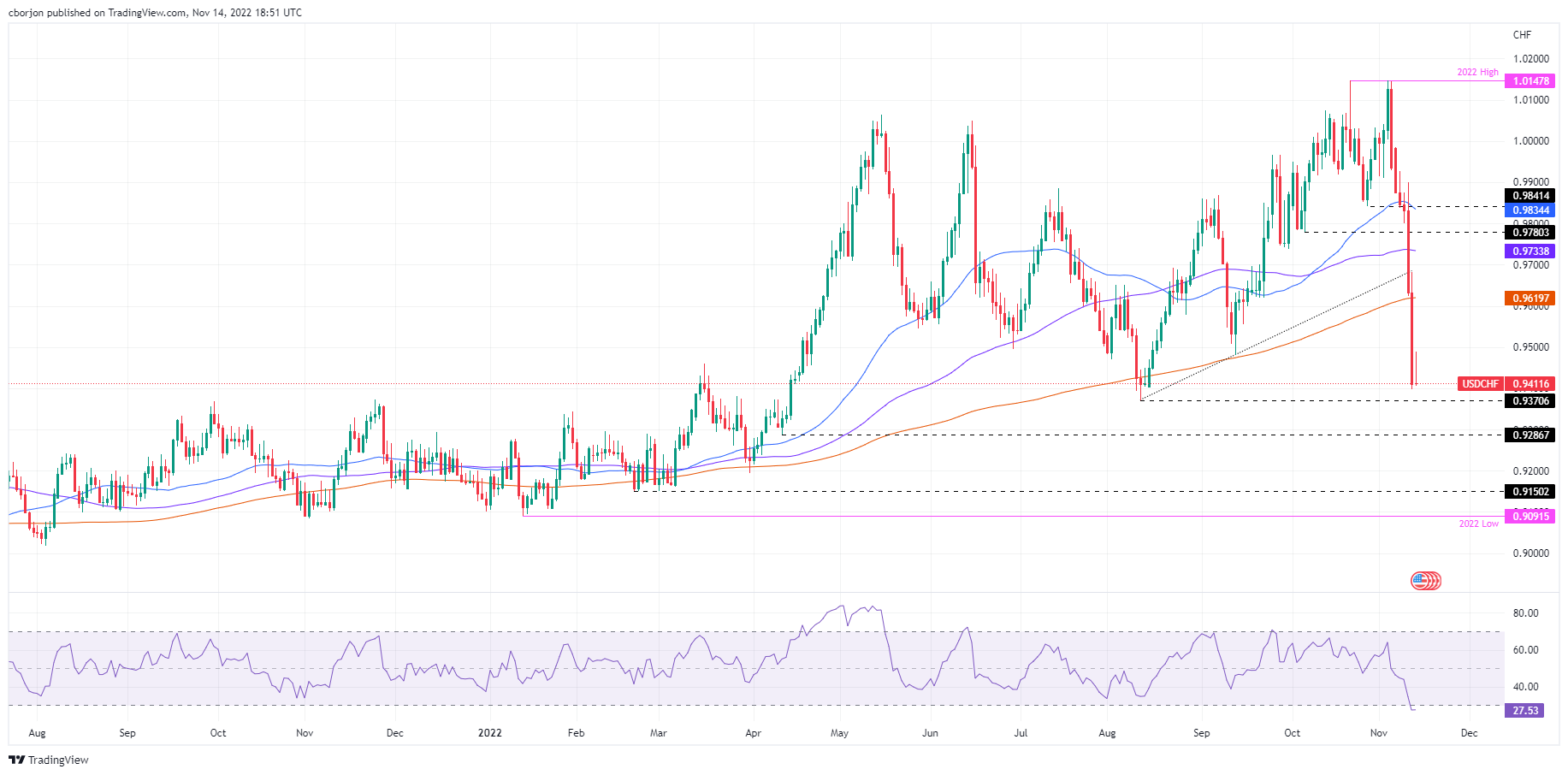
- USDCHF Price Analysis: To continue weakening once it clears 0.9370.

The USDCHF extends some of last week’s losses, courtesy of the Federal Reserve’s official hawkish commentary, which spurred risk aversion in the financial markets. Therefore, global equities dropped while the safe-haven status of the US Dollar rose. At the time of writing, the USDCHF is trading at 0.9410, registering decent losses of 0.18%.
Vice-Chair Brainard sees appropriate slowing the pace of rate hikes
US equities dwindled following remarks by two Federal Reserve (Fed) board members. During the weekend, Christopher Waller said that the Fed “still has ways to go” regarding tightening monetary conditions. He added that the Central Bank is not close to pausing and that it could moderate the size of interest-rate increases to 50 bps at their December meeting or the one after that, reiterating that the US central bank is not close to pausing.
Of late, the Fed Vice-Chair Lael Brainard commented that it’s appropriate to slow the pace of rate hikes, though emphasized that “we(Fed) have additional work to do.” Brainard added that it would take some time for the cumulative tightening “to flow through” the economy. She said that October’s CPI print might suggest that the Fed’s favorite gauge for inflation, the Core PCE, “might be also showing a little bit of reduction.”
On the Swiss Franc side, the Swiss National Bank (SNB) Chairman of the Governing Board, Thomas J. Jordan, crossed newswires. He said that Swiss growth is foreseen to be weaker in 2023 than in the current year and added that unemployment would not prevent additional rate hikes. Jordan said inflation has broadened and predicts a “great probability” that the SNB would need to tighten conditions. Regarding the December meeting, he said that the Central Bank could hike, but it will depend on data.
Therefore, the USDCHF is expected to lean on US and Switzerland’s economic data alongside monetary policy. However, speculations for a Fed pivot would likely keep the US Dollar on the defensive, propelling the Swiss Franc prospects for a stronger Swissy. Hence, the USDCHF could test August’s monthly lows at around 0.9370 before extending its fall to the YTD low at 0.9091.
USDCHF Price Analysis: Technical outlook
From a technical perspective, the USDCHF free fall will likely continue after dropping below the 200-day Exponential Moving Average (EMA) at 0.9617. Also, once the USDCHF tumbles below the August 11 daily low at 0.9379, that could open the door towards testing the YTD low at 0.9091. Of note, the Relative Strength Index (RSI) is oversold, but due to the strength of the downtrend, it could fall towards 20, marked by “some” analysts, as the most extreme oversold condition.
Therefore, the USDCHF key support levels lie at 0.9400, followed by the August 11 low at 0.9379. A Break below will expose the April 12 swing low at 0.9286, ahead of the February 21 daily low at 0.9150.
Author

Christian Borjon Valencia
FXStreet
Markets analyst, news editor, and trading instructor with over 14 years of experience across FX, commodities, US equity indices, and global macro markets.















