AUD/USD Price Forecast: Upside bias intact despite mixed momentum
- AUD/USD turns lower as hawkish Fed expectations support the US Dollar.
- The pair holds above its key daily SMAs, keeping the broader bullish structure intact.
- Momentum indicators show fading upside pressure, with the RSI near 48 and the MACD slightly negative.

AUD/USD reverses its earlier gains on Monday as a broadly firmer US Dollar (USD) and hawkish Federal Reserve (Fed) expectations cap the upside. However, expectations that the Reserve Bank of Australia (RBA) could deliver another rate hike provide underlying support to the Australian Dollar (AUD) and limit a deeper decline. At the time of writing, AUD/USD trades around 0.7123 after touching an intraday high of 0.7140.
US Dollar Price Today
The table below shows the percentage change of US Dollar (USD) against listed major currencies today. US Dollar was the strongest against the Japanese Yen.
| USD | EUR | GBP | JPY | CAD | AUD | NZD | CHF | |
|---|---|---|---|---|---|---|---|---|
| USD | 0.11% | 0.18% | 0.38% | 0.31% | 0.02% | 0.09% | -0.12% | |
| EUR | -0.11% | 0.00% | 0.22% | 0.14% | -0.16% | -0.11% | -0.29% | |
| GBP | -0.18% | -0.00% | 0.21% | 0.15% | -0.14% | -0.12% | -0.28% | |
| JPY | -0.38% | -0.22% | -0.21% | -0.06% | -0.39% | -0.28% | -0.46% | |
| CAD | -0.31% | -0.14% | -0.15% | 0.06% | -0.32% | -0.23% | -0.41% | |
| AUD | -0.02% | 0.16% | 0.14% | 0.39% | 0.32% | 0.07% | -0.12% | |
| NZD | -0.09% | 0.11% | 0.12% | 0.28% | 0.23% | -0.07% | -0.19% | |
| CHF | 0.12% | 0.29% | 0.28% | 0.46% | 0.41% | 0.12% | 0.19% |
The heat map shows percentage changes of major currencies against each other. The base currency is picked from the left column, while the quote currency is picked from the top row. For example, if you pick the US Dollar from the left column and move along the horizontal line to the Japanese Yen, the percentage change displayed in the box will represent USD (base)/JPY (quote).
The RBA has delivered three 25-basis-point (bps) rate hikes since the start of the year, lifting the cash rate to 4.35%. The central bank is widely expected to raise rates by another 25 bps on September 29 as inflation stays above its 2%-3% target range.
The Fed also raised interest rates last week, lifting the federal funds rate to 3.75%–4.00%, and signalled that another increase could follow by year-end. If the RBA raises rates again later this month, the policy gap between Australia and the United States (US) would widen, giving the Australian Dollar a relative yield advantage.
Technical Analysis
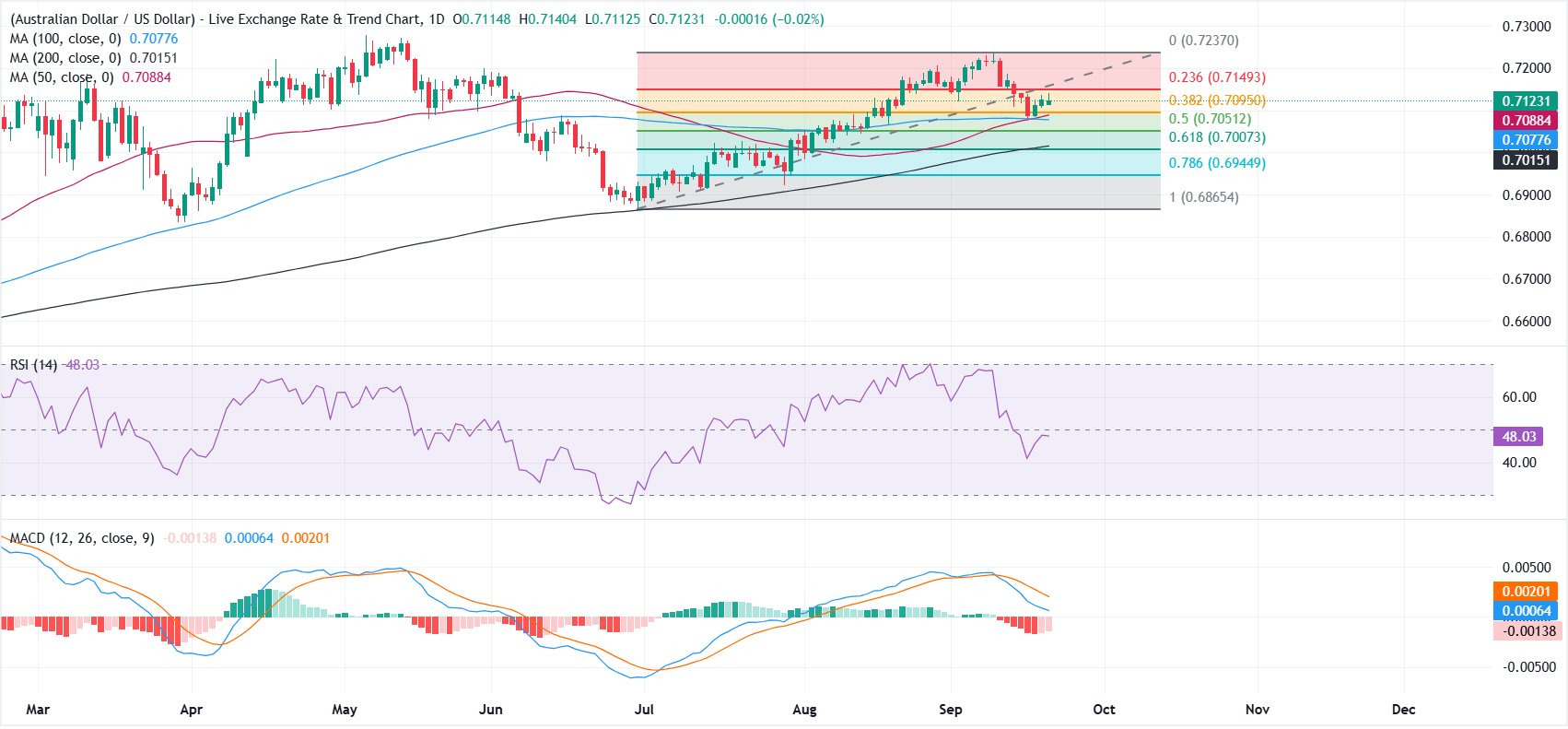
From a technical perspective, the path of least resistance stays tilted to the upside as the pair holds above its key daily Simple Moving Averages (SMA), reinforcing the underlying bullish structure.
Momentum is more mixed, with the Relative Strength Index (RSI) hovering near a neutral 48 and the Moving Average Convergence Divergence (MACD) slipping slightly into negative territory, which hints at waning upside pressure rather than a completed topping pattern.
On the downside, initial support is clustered around the 38.2% Fibonacci retracement at 0.7095, backed by the nearby 50-day SMA at 0.7088 and the 100-day SMA at 0.7078, while a deeper pullback would expose the 50.0% retracement at 0.7051 and the 200-day SMA around 0.7015.
On the topside, immediate resistance emerges at the 23.6% Fibonacci retracement at 0.7149, with a sustained break above this level opening the door toward the cycle barrier at 0.7237, where the current Fibonacci leg terminates.
(The technical analysis of this story was written with the help of an AI tool. Know more.)
RBA FAQs
The Reserve Bank of Australia (RBA) sets interest rates and manages monetary policy for Australia. Decisions are made by a board of governors at 11 meetings a year and ad hoc emergency meetings as required. The RBA’s primary mandate is to maintain price stability, which means an inflation rate of 2-3%, but also “..to contribute to the stability of the currency, full employment, and the economic prosperity and welfare of the Australian people.” Its main tool for achieving this is by raising or lowering interest rates. Relatively high interest rates will strengthen the Australian Dollar (AUD) and vice versa. Other RBA tools include quantitative easing and tightening.
While inflation had always traditionally been thought of as a negative factor for currencies since it lowers the value of money in general, the opposite has actually been the case in modern times with the relaxation of cross-border capital controls. Moderately higher inflation now tends to lead central banks to put up their interest rates, which in turn has the effect of attracting more capital inflows from global investors seeking a lucrative place to keep their money. This increases demand for the local currency, which in the case of Australia is the Aussie Dollar.
Macroeconomic data gauges the health of an economy and can have an impact on the value of its currency. Investors prefer to invest their capital in economies that are safe and growing rather than precarious and shrinking. Greater capital inflows increase the aggregate demand and value of the domestic currency. Classic indicators, such as GDP, Manufacturing and Services PMIs, employment, and consumer sentiment surveys can influence AUD. A strong economy may encourage the Reserve Bank of Australia to put up interest rates, also supporting AUD.
Quantitative Easing (QE) is a tool used in extreme situations when lowering interest rates is not enough to restore the flow of credit in the economy. QE is the process by which the Reserve Bank of Australia (RBA) prints Australian Dollars (AUD) for the purpose of buying assets – usually government or corporate bonds – from financial institutions, thereby providing them with much-needed liquidity. QE usually results in a weaker AUD.
Quantitative tightening (QT) is the reverse of QE. It is undertaken after QE when an economic recovery is underway and inflation starts rising. Whilst in QE the Reserve Bank of Australia (RBA) purchases government and corporate bonds from financial institutions to provide them with liquidity, in QT the RBA stops buying more assets, and stops reinvesting the principal maturing on the bonds it already holds. It would be positive (or bullish) for the Australian Dollar.
Author

Vishal Chaturvedi
FXStreet
I am a macro-focused research analyst with over four years of experience covering forex and commodities market. I enjoy breaking down complex economic trends and turning them into clear, actionable insights that help traders stay ahead of the curve.