|

USDCHF climbs above 0.9500, as bears eye rallies to re-engage after cracking the 200-DMA

  • US Dollar got underpinned by Federal Reserve policymakers, hawkish speaking.
  • US economic data was mixed as the housing market plunged while unemployment claims decelerated.
  • Swiss National Bank Maechler: “To continue rate hikes if inflation projections remain above target.”
  • USDCHF remains bearish-biased, though a break of 0.9600 would exacerbate a rally to the 200-DMA.
USDCHF climbs above 0.9500, as bears eye rallies to re-engage after cracking the 200-DMA

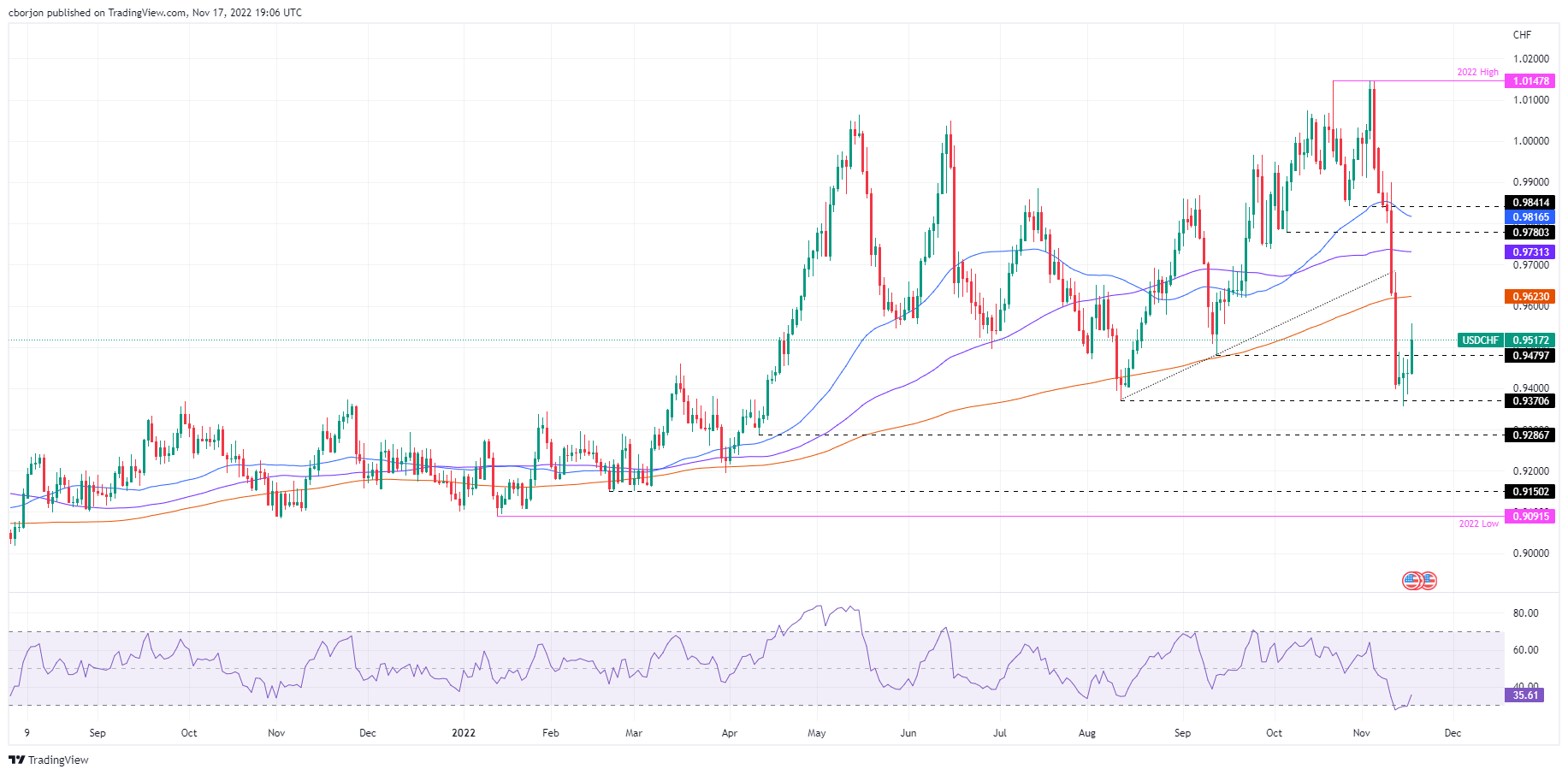
The USDCHF extended its weekly rally, to four consecutive days, after registering a new seven-month-old low around 0.9356 on Monday. However, hawkish commentary by US Federal Reserve (Fed) speakers shifted sentiment sour for the benefit of the US Dollar (USD). Hence, the USDCHF is trading at 0.9518, above its opening price by 0.86%.

Fundamentally speaking, nothing has changed. The Federal Reserve would continue on its upward trajectory, hiking rates, after the St. Louis Fed President James Bullard said that rates are not “sufficiently restrictive,” as he foresees the Federal Funds rate (FFR) to peak at around the 5% to 7% range. On Wednesday, the San Francisco Fed President Mary Daly said that pausing hikes “was off the table.”

Data-wise, the housing market continued to weaken, even though speculations that a Fed pause might occur increased due to US equities pairing some of its year losses. Housing Starts plunged 4.2% in October, on a monthly pace, below September’s 1.3% contraction. Building Permits followed suit, dropping 2.4%, below 1.4$ September’s increase.

Of late, US Initial Jobless Claims for the last week decelerated to 222K, beneath estimates of 225K. At the same time, Continuing claims advanced 13K to 1.51 million, flashing signs that the labor market is easing.

Aside from this, the Switzerland National Bank (SNB) Governor, Andrea Maechler, is crossing newswires. She said that inflation in Switzerland is no longer “shock driven” and added that the SNB would continue to lift rates if inflation projections remained above the central bank’s target.

USDCHF Price Analysis: Technical outlook

All that said, the USDCHF recovered from last week’s losses and is up in the week 1.13%. Nevertheless, the USDCHF is bearish-biased once it cleared the 200-day Exponential Moving Average (EMA) at 0.9623. Still, it could be subject to a correction, as the Relative Strength Index (RSI) pulled out from oversold conditions, exacerbating a rally above 0.9500.

That said, the USDCHF’s first resistance would be 0.9600, ahead of the 200-day EMA at 0.9623. On the flip side, USDCHF key supports are the 0.9500 psychological figure, followed by the September 13 daily low at 0.9479, ahead of the August 11 swing low at 0.9370.
USD/CHF

Overview
Today last price0.9517
Today Daily Change0.0075
Today Daily Change %0.79
Today daily open0.9442
 
Trends
Daily SMA200.984
Daily SMA500.9826
Daily SMA1000.9737
Daily SMA2000.9626
 
Levels
Previous Daily High0.947
Previous Daily Low0.9386
Previous Weekly High0.9988
Previous Weekly Low0.9398
Previous Monthly High1.0148
Previous Monthly Low0.9781
Daily Fibonacci 38.2%0.9438
Daily Fibonacci 61.8%0.9418
Daily Pivot Point S10.9396
Daily Pivot Point S20.9349
Daily Pivot Point S30.9312
Daily Pivot Point R10.9479
Daily Pivot Point R20.9516
Daily Pivot Point R30.9563

Author

Christian Borjon Valencia

Markets analyst, news editor, and trading instructor with over 14 years of experience across FX, commodities, US equity indices, and global macro markets.


More from Christian Borjon Valencia
Share:

Editor's Picks

AUD/USD extends losses below 0.6600, fresh YTD low amid US tariff threats

AUD/USD turns south in the European session on Wednesday, following the Australian consumer inflation-led uptick to the 0.6665 area, or a fresh weekly top. The latest downfall drives the pair further below the 0.6600 mark, or the lowest since December 2025, courtesy of US tariff risks-led broad US Dollar strength. Expectations of the Fed-RBA monetary policy divergence also adds to the weight on the Aussie.

USD/JPY flatlines above 159.00 amid intervention risks ahead of US PCE

USD/JPY is holding steady above 159.00 in the Asian session on Wednesday, stalling its two-day recovery from a two-week low as intervention risks offer support to the Japanese Yen. Meanwhile, the US Dollar attempts a bounce after the previous day’s sharp retracement from a 20-month peak ahead of US PCE Price Index data, guarding the downside for the currency pair.

Gold stays weak below $3,550 as traders await US PCE data for Fed cues amid firmer USD

Gold sticks to a negative bias for the second straight day, trading below $3,550 through the first half of the European session, and stays within striking distance of the year-to-date low amid a bearish fundamental backdrop. Hawkish signals from the US Federal Reserve continue to undermine the non-yielding bullion. Adding to this, Middle East jitters revive demand for the safe-haven US Dollar after the previous day's pullback from its highest level since March 2025.

Bitcoin risks fresh yearly low ahead of US PCE

Bitcoin extends correction, trading below $58,700 on Wednesday and putting its yearly low of $55,130 back in focus. The bearish outlook strengthens as BTC spot Exchange Traded Funds record persistent outflows and broader market uncertainty weighs on sentiment.

US core PCE inflation set to heat up in October, prompting Federal Reserve rate hikes in 2027

The United States Bureau of Economic Analysis will publish the Personal Consumption Expenditures (PCE) Price Index data for October on Wednesday at 13:30 GMT. Market participants closely monitor this indicator as it is the Federal Reserve’s preferred measure of inflation and plays a key role in shaping monetary policy decisions.

Gold snaps a five-day losing streak as Bessent warns the Fed against overtightening
Gold (XAU/USD) stages a strong recovery on Monday to trade above the $3,600 level. The precious metal snaps a five-day losing streak after suffering a nearly 9% decline last week, its steepest weekly setback in the recent sell-off, as investors reconsider the prospects for further monetary tightening in the United States (US).