USD/THB sees red on quiet Monday, eyes on May's FOMC minutes
- USD/THB trades at around 36.11, marking a 0.15% decrease in Monday's session.
- Fed officials ask for caution on premature easing, despite some recent data weakness.
- May’s FOMC minutes, April’s S&P PMIs, and Durable Goods figures from May will be the highlights this week.

The USD/THB pair is trading mildly down on Monday after falling to a low of 36.05 earlier in the session and managed to clear most of the daily losses. The USD is holding its ground, driven by cautious comments from the Federal Reserve (Fed) officials who are reluctant to loosen monetary policy prematurely.
Fed policymakers reiterated their reluctance towards premature easing on Monday, referencing that it is too soon to consider as evidence of disinflation the recent soft inflation data. The odds of a cut by the Fed until September is bookmarked at around 35% but officials and mid-tier data this week may change those odds.
Investors seem to be waiting for additional delivery of Fed speeches this week and for May's Federal Open Market Committee (FOMC) minutes slated for release this Wednesday, hoping for greater clarity on the direction of the Fed’s outlook. On Thursday, May’s S&P readings and weekly Jobless Claims will be looked upon as well as Friday’s Durable Goods figures from April.
USD/THB technical analysis
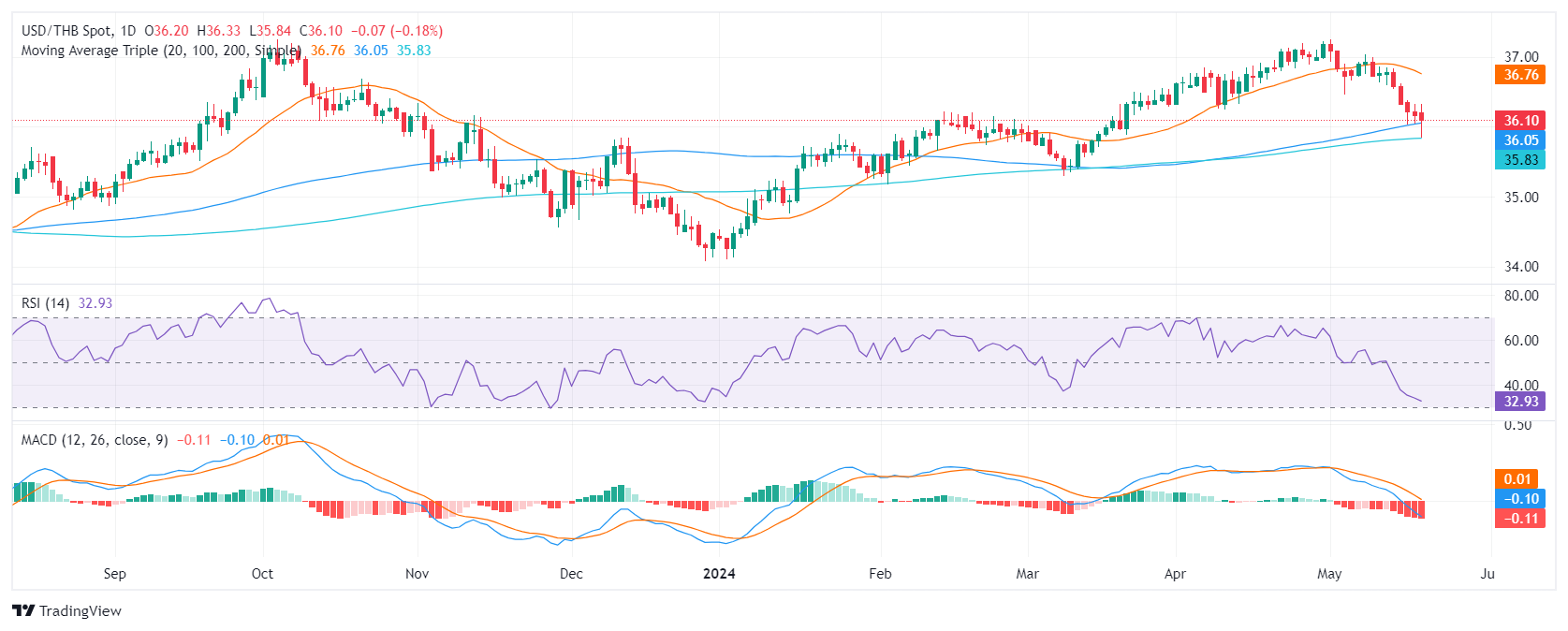
Examining the daily graph, the Relative Strength Index (RSI) of the USD/THB is hovering in the negative territory, suggesting a hint of bearish momentum. Simultaneously, the Moving Average Convergence Divergence (MACD) histogram is displaying red bars, indicating a negative momentum. Yet, as the histogram bars are flat, these suggest a decreasing selling pressure and the potential for a lessening in the current bearish bias.
USD/THB daily chart
Regarding the Simple Moving Average (SMA), the pair is below the 20, 100-day SMAs. However, it is noteworthy that in Monday's session, buyers defended the 200-day SMA at the 35.83 mark. This reveals resilience, potentially impeding the bearish narrative and may trigger a bullish sentiment if sustained. This combination reveals that the pair is in a bearish trend but if the bulls remain resilient, the losses might be limited.
Author

Patricio Martín
FXStreet
Patricio is an economist from Argentina passionate about global finance and understanding the daily movements of the markets.