USD/JPY Price Forecast: Struggles at 144.00 and falls, as Trump slams Powell again
- USD/JPY trades at 143.63 in early Asia, after closing Wednesday with modest 0.18% gains.
- Trump urges Fed Chair Powell to resign, adding pressure as markets await NFP data.
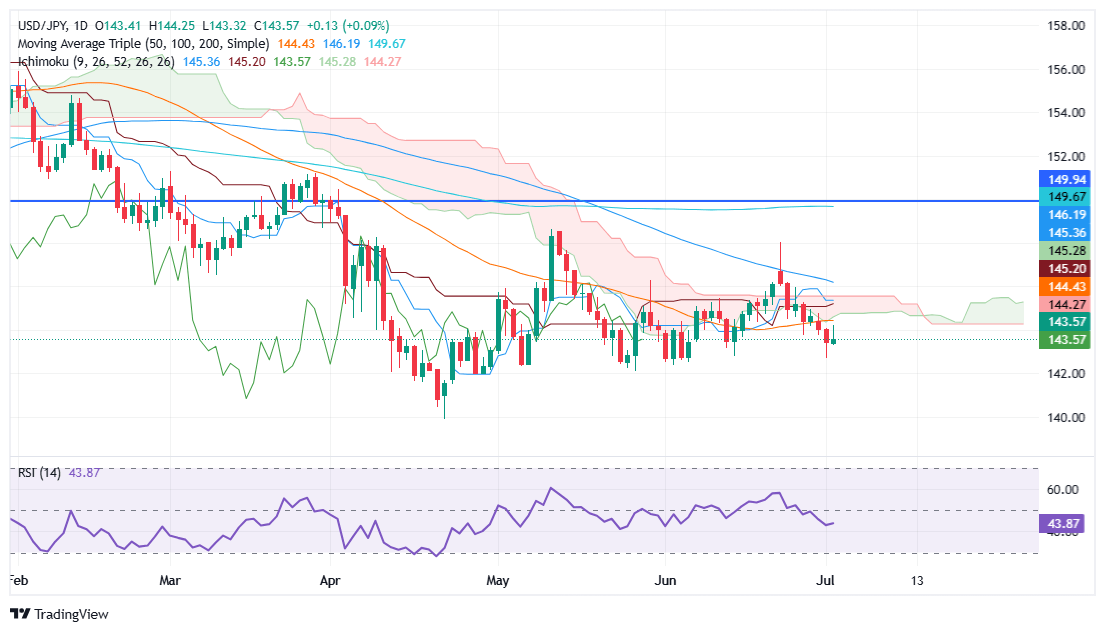
- Technical bias turns bearish below 144.00; support seen at 143.00, then 142.68.


The USD/JPY registered modest gains on Wednesday, with the pair closing up 0.18%, finishing the session below 143.70. As Thursday’s Asian session begins, the pair trades at 143.63, virtually unchanged.
The narrative of the financial markets remains unchanged. The US continues to negotiate trading deals, while the approval of US President Donald Trump's “One Big Beautiful Bill” is pending. In the meantime, Trump attacked the Fed Chair Jerome Powell once again, saying that he should resign immediately.
The docket in Japan is absent, but not so in the US. June Nonfarm Payroll figures are expected to show the ongoing slowdown in the jobs market.
USD/JPY Price Forecast: Technical Outlook
From a technical standpoint, the USD/JPY remains skewed to the downside after hitting a two-day high at 144.24. Buyers lacking the strength to claim $ 145.00 exacerbated a drop below the $ 144.00 figure, setting the stage for further losses.
Therefore, the first support targeted by sellers is 143.00. Once surpassed, the next support is the July 1 swing low of 142.68, ahead of testing the April 29 daily low of 141.97.
USD/JPY Price Chart – Daily
Japanese Yen FAQs
The Japanese Yen (JPY) is one of the world’s most traded currencies. Its value is broadly determined by the performance of the Japanese economy, but more specifically by the Bank of Japan’s policy, the differential between Japanese and US bond yields, or risk sentiment among traders, among other factors.
One of the Bank of Japan’s mandates is currency control, so its moves are key for the Yen. The BoJ has directly intervened in currency markets sometimes, generally to lower the value of the Yen, although it refrains from doing it often due to political concerns of its main trading partners. The BoJ ultra-loose monetary policy between 2013 and 2024 caused the Yen to depreciate against its main currency peers due to an increasing policy divergence between the Bank of Japan and other main central banks. More recently, the gradually unwinding of this ultra-loose policy has given some support to the Yen.
Over the last decade, the BoJ’s stance of sticking to ultra-loose monetary policy has led to a widening policy divergence with other central banks, particularly with the US Federal Reserve. This supported a widening of the differential between the 10-year US and Japanese bonds, which favored the US Dollar against the Japanese Yen. The BoJ decision in 2024 to gradually abandon the ultra-loose policy, coupled with interest-rate cuts in other major central banks, is narrowing this differential.
The Japanese Yen is often seen as a safe-haven investment. This means that in times of market stress, investors are more likely to put their money in the Japanese currency due to its supposed reliability and stability. Turbulent times are likely to strengthen the Yen’s value against other currencies seen as more risky to invest in.
Author
Christian Borjon Valencia
FXStreet
Christian Borjon began his career as a retail trader in 2010, mainly focused on technical analysis and strategies around it. He started as a swing trader, as he used to work in another industry unrelated to the financial markets.