USD/JPY Price Forecast: Likely trade sideways ahead of Fed-BoJ policy meetings
- USD/JPY jumps to near 154.20 as the US Dollar strengthens.
- Both the Fed and the BoJ are expected to raise interest rates this week.
- US President Trump stresses that interest rates should be lowest in the world.

The Japanese Yen (JPY) reflects a mixed performance against its major currency peers, but is significantly down against the US Dollar (USD), in the European trading session on Monday. As of writing, USD/JPY is up 0.44% to near 154.20.
The pair recovers strongly after a weak Friday, as comments from United States (US) President Donald Trump signaling his developing appetite to higher interest rates have strengthened the US Dollar.
At press time, the US Dollar Index (DXY), which gauges the Greenback’s value against six major currencies, trades 0.35% higher to near 99.43.
Over the weekend, US President Trump said while speaking to reporters at the Irish Open golf tournament that he did not know whether Federal Reserve (Fed) policymakers will raise interest rates at their meeting this week. But he said the US "should be paying the lowest interest rate in the world" no matter what the Federal Reserve's data indicates about inflation and the economy, Business Standard reported.
This is a dramatic shift from criticizing former Fed Chairman Jerome Powell several times in his term for not reducing interest rates to delivering neutral remarks.
Meanwhile, an increase in hawkish Fed bets for the monetary policy announcement on Wednesday after the release of the hot US consumer and producer inflation report has also strengthened the US Dollar.
On the Tokyo front, investors also await the Bank of Japan’s (BoJ) policy decision on Friday where it is expected to raise interest rates.
USD/JPY Technical Analysis
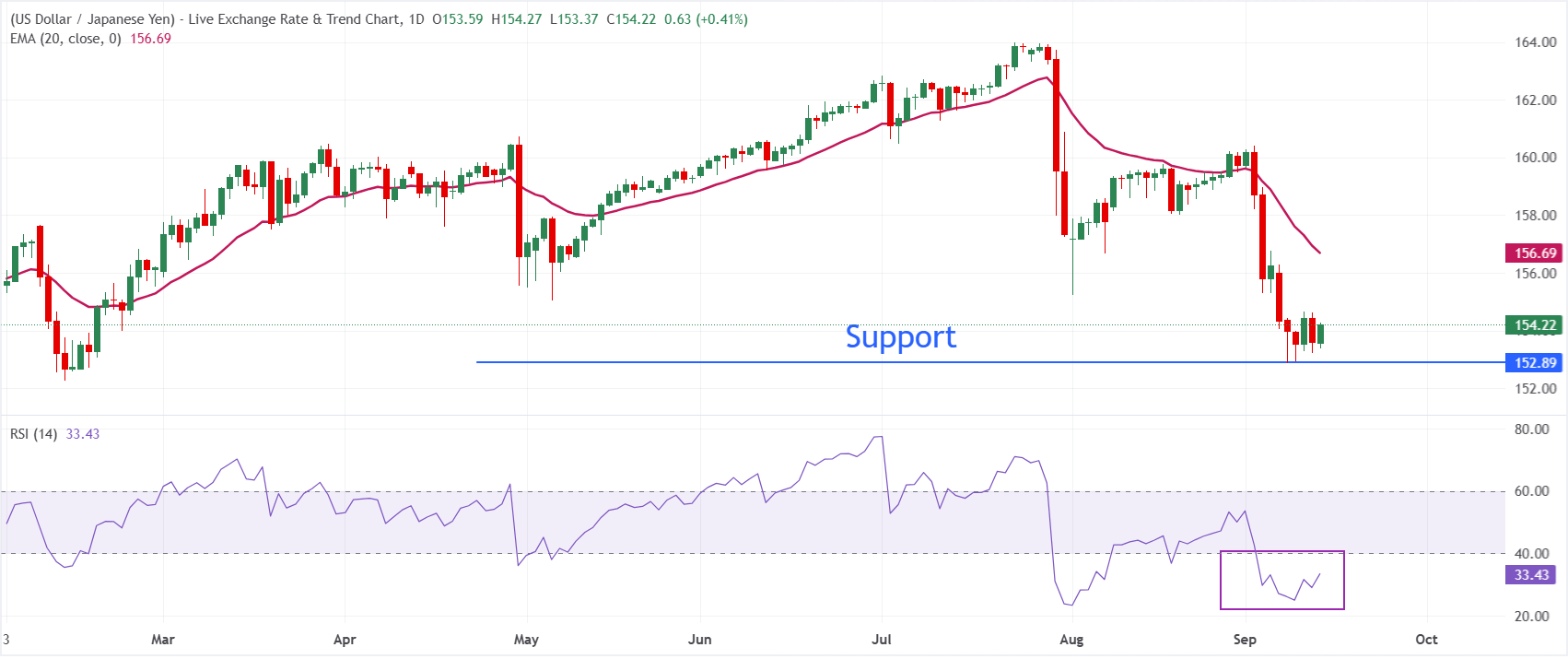
In the daily chart, USD/JPY trades at 154.20. The pair remains in a bearish near-term stance as spot holds beneath the 20-day Exponential Moving Average (EMA) at 156.69, keeping recent rebounds capped by this dynamic resistance.
The 14-day Relative Strength Index (RSI) at 33.43 has recovered from oversold territory but still hovers just above the 30 mark, suggesting that downside pressure persists, even if selling momentum is starting to ease.
On the topside, immediate resistance is defined by the 20-day EMA at 156.69, and a sustained break above this barrier would be needed to negate the current bearish bias and open the way for a broader recovery. On the downside, the previous week low near 152.90 is the immediate support; below that, the apir could extend the decline towards the Year-Till-Date (YTD) low at 152.10.
(The technical analysis of this story was written with the help of an AI tool. Know more.)
Economic Indicator
Fed Interest Rate Decision
The Federal Reserve (Fed) deliberates on monetary policy and makes a decision on interest rates at eight pre-scheduled meetings per year. It has two mandates: to keep inflation at 2%, and to maintain full employment. Its main tool for achieving this is by setting interest rates – both at which it lends to banks and banks lend to each other. If it decides to hike rates, the US Dollar (USD) tends to strengthen as it attracts more foreign capital inflows. If it cuts rates, it tends to weaken the USD as capital drains out to countries offering higher returns. If rates are left unchanged, attention turns to the tone of the Federal Open Market Committee (FOMC) statement, and whether it is hawkish (expectant of higher future interest rates), or dovish (expectant of lower future rates).
Read more.Next release: Wed Sep 16, 2026 18:00
Frequency: Irregular
Consensus: 4%
Previous: 3.75%
Source: Federal Reserve
Author

Sagar Dua
FXStreet
Sagar Dua is associated with the financial markets from his college days. Along with pursuing post-graduation in Commerce in 2014, he started his markets training with chart analysis.

















