USD/JPY Price Forecast: Likely return to two-month low near 155.00
- USD/JPY clings to recovery move near 157.80, which came after a significant plunge last week.
- The US and Japan might intervene again to prop up the Japanese Yen.
- Investors await the US NFP data for July.

The USD/JPY pair holds onto a three-day recovery move near 157.80 during the European trading session on Thursday. The pair recovers as the Japanese Yen (JPY) faced profit-booking after a juggernaut jump last week, following the United States (US)-Japan joint intervention to counter excessive volatility and disorderly movements in the Japanese yen in recent months.
Financial markets expect the Japanese currency won't be able to sustain US-Japan joint intervention-driven strength unless it gets boost from structural changes in the domestic economy.
Yen positioning stabilizes as BoJ follow-through seen key to renewed inflows
Analysts at BNY Mellon argue that recent “coordinated intervention has bought time but hasn’t materially increased foreign JPY holdings.” They note that “investors remain net long JPY, but exposure is well below H1 2026 levels and won’t rebuild without credible domestic follow-through: Bank of Japan (BOJ) tightening, fiscal consolidation and structural reform.” In their view, the current allocation picture is uneven across asset classes, with “Japanese equities remain largely passive and under-supported, while Japanese government bonds (JGBs) are attracting the clearest marginal demand.”
Meanwhile, hopes of US-Japan intervention again are high, as Japan Finance Minister (FM) Satsuki Katayama confirmed earlier this week that Japan “won't hesitate to carry out more forex intervention with the US”.
On the US Dollar (USD) front, investors shift their focus to the US Nonfarm Payrolls (NFP) data for July, which will be released on Friday.
USD/JPY Technical Analysis
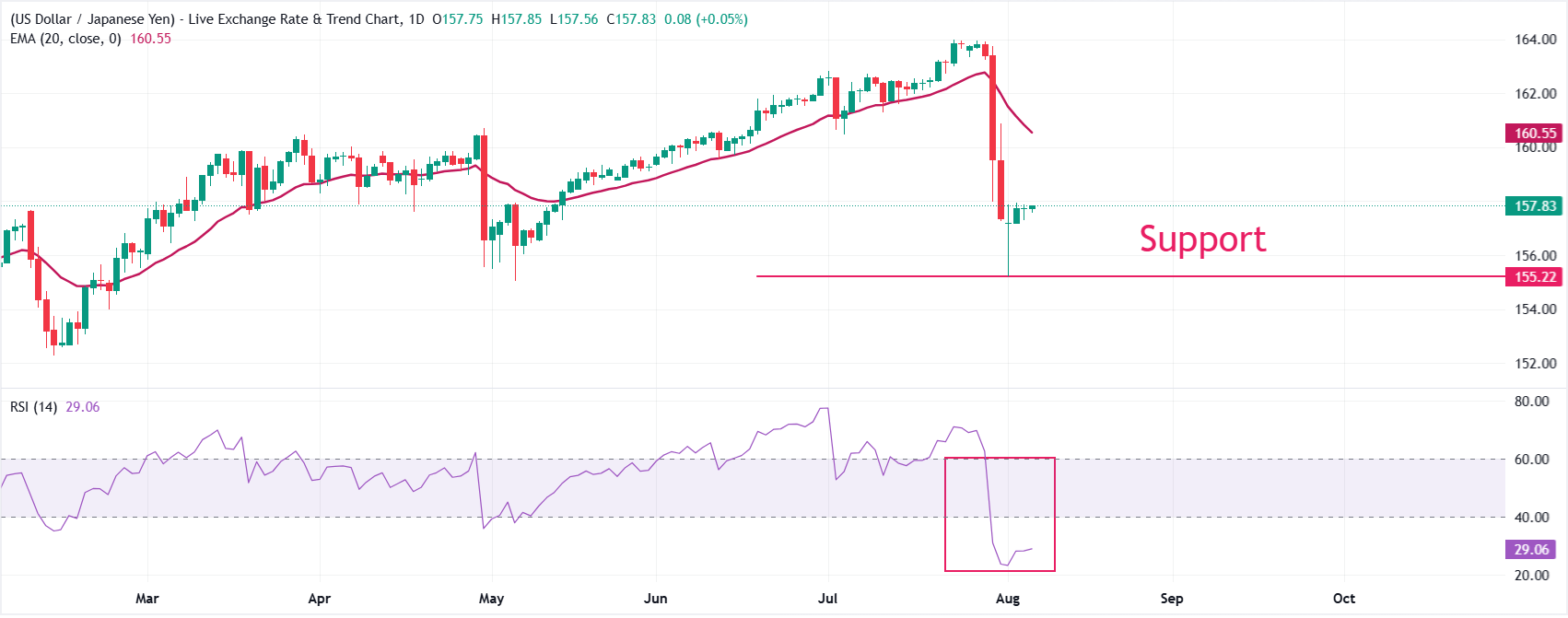
USD/JPY trades at around157.83, keeping a bearish near-term tone as spot remains below the 20-day exponential moving average (EMA) at 160.55. The pair has retreated from recent highs, and the EMA overhead suggests prices are still capped despite the latest bounce attempt, pointing to a market that is correcting rather than trending higher.
On the topside, initial resistance is located at the 20-day EMA at 160.55, which acts as the primary barrier that bulls would need to reclaim to alleviate downside pressure. On the downside, the key support level for the pair is the two-month low of 155.23; below this, the pair would find next support near the February 23 low at around 154.00
(The technical analysis of this story was written with the help of an AI tool. Know more.)
Japanese Yen FAQs
The Japanese Yen (JPY) is one of the world’s most traded currencies. Its value is broadly determined by the performance of the Japanese economy, but more specifically by the Bank of Japan’s policy, the differential between Japanese and US bond yields, or risk sentiment among traders, among other factors.
One of the Bank of Japan’s mandates is currency control, so its moves are key for the Yen. The BoJ has directly intervened in currency markets sometimes, generally to lower the value of the Yen, although it refrains from doing it often due to political concerns of its main trading partners. The BoJ ultra-loose monetary policy between 2013 and 2024 caused the Yen to depreciate against its main currency peers due to an increasing policy divergence between the Bank of Japan and other main central banks. More recently, the gradually unwinding of this ultra-loose policy has given some support to the Yen.
Over the last decade, the BoJ’s stance of sticking to ultra-loose monetary policy has led to a widening policy divergence with other central banks, particularly with the US Federal Reserve. This supported a widening of the differential between the 10-year US and Japanese bonds, which favored the US Dollar against the Japanese Yen. The BoJ decision in 2024 to gradually abandon the ultra-loose policy, coupled with interest-rate cuts in other major central banks, is narrowing this differential.
The Japanese Yen is often seen as a safe-haven investment. This means that in times of market stress, investors are more likely to put their money in the Japanese currency due to its supposed reliability and stability. Turbulent times are likely to strengthen the Yen’s value against other currencies seen as more risky to invest in.
Author

Sagar Dua
FXStreet
Sagar Dua is associated with the financial markets from his college days. Along with pursuing post-graduation in Commerce in 2014, he started his markets training with chart analysis.