USD/JPY Price Forecast: Faces selling pressure above 160.00
- USD/JPY declines to near 159.65 as the Japanese Yen outperforms its peers.
- Financial markets hope for US-Japan intervening jointly again.
- Investors await key US ISM Manufacturing PMI and the JOLTS Job Openings data.

The US Dollar (USD) is down 0.3% to near 159.65 against the Japanese Yen (JPY) during the European trading session on Monday. The USD/JPY pair declines as the Japanese currency outperforms its peers on hopes of support from the United States (US)-Japan joint intervention.
Japanese Yen Price Today
The table below shows the percentage change of Japanese Yen (JPY) against listed major currencies today. Japanese Yen was the strongest against the Australian Dollar.
| USD | EUR | GBP | JPY | CAD | AUD | NZD | CHF | |
|---|---|---|---|---|---|---|---|---|
| USD | -0.15% | -0.03% | -0.26% | -0.14% | 0.04% | -0.05% | -0.14% | |
| EUR | 0.15% | 0.10% | -0.09% | 0.00% | 0.15% | 0.11% | 0.00% | |
| GBP | 0.03% | -0.10% | -0.19% | -0.10% | 0.04% | -0.00% | -0.08% | |
| JPY | 0.26% | 0.09% | 0.19% | 0.10% | 0.29% | 0.22% | 0.14% | |
| CAD | 0.14% | -0.01% | 0.10% | -0.10% | 0.19% | 0.12% | 0.02% | |
| AUD | -0.04% | -0.15% | -0.04% | -0.29% | -0.19% | -0.06% | -0.11% | |
| NZD | 0.05% | -0.11% | 0.00% | -0.22% | -0.12% | 0.06% | -0.08% | |
| CHF | 0.14% | -0.01% | 0.08% | -0.14% | -0.02% | 0.11% | 0.08% |
The heat map shows percentage changes of major currencies against each other. The base currency is picked from the left column, while the quote currency is picked from the top row. For example, if you pick the Japanese Yen from the left column and move along the horizontal line to the US Dollar, the percentage change displayed in the box will represent JPY (base)/USD (quote).
Yen intervention in focus
Analysts at Scotiabank flag that the recent “defensive price action is notable, and somewhat worrisome for policymakers at the BoJ, as well as officials at the MoF,” particularly as media reports highlight “the aggregate $96.4bn intervention effort to support the yen from July 30 to August 26.”
US Treasury Secretary Scott Bessent stated that Washington would intervene with Japan to shore up the Asia-Pacific currency, if needed. These comments came after the US and Japan jointly intervened in late July, as USD/JPY jumped to a multi-decade high near 164.00.
Meanwhile, the US Dollar trades lower, with investors shifting their focus to a slew of US economic data, starting with ISM Manufacturing PMI for August and the JOLTS Job Openings data for July releasing on Tuesday.
As of writing, the US Dollar Index (DXY), which gauges the Greenback’s value against six major currencies, trades 0.16% lower to near 99.50.
USD/JPY Technical Analysis
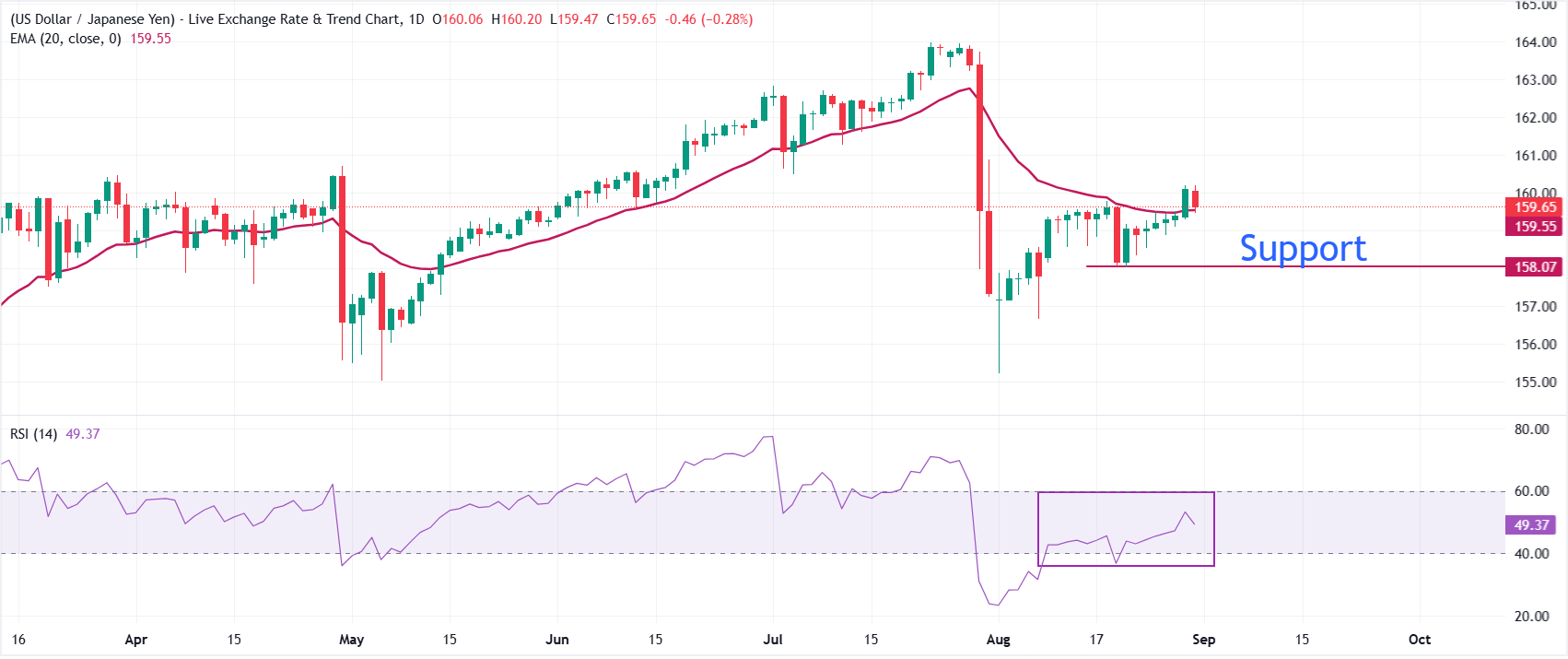
In the daily chart, USD/JPY trades at 159.66. The pair holds a mildly bullish near-term bias as spot remains above the 20-day exponential moving average (EMA) at 159.55, suggesting ongoing demand on dips.
The Relative Strength Index (RSI) at 49.39 sits just below the 50 mark, hinting at consolidative conditions rather than overextended momentum, but still compatible with a gradual topside bias while price holds over the short-term EMA.
On the downside, the August 19 low at 158.05 is the key support level. Looking up, the major hurdle is the Friday high at 160.20, followed by the July 31 high at 160.88.
(The technical analysis of this story was written with the help of an AI tool. Know more.)
Japanese Yen FAQs
The Japanese Yen (JPY) is one of the world’s most traded currencies. Its value is broadly determined by the performance of the Japanese economy, but more specifically by the Bank of Japan’s policy, the differential between Japanese and US bond yields, or risk sentiment among traders, among other factors.
One of the Bank of Japan’s mandates is currency control, so its moves are key for the Yen. The BoJ has directly intervened in currency markets sometimes, generally to lower the value of the Yen, although it refrains from doing it often due to political concerns of its main trading partners. The BoJ ultra-loose monetary policy between 2013 and 2024 caused the Yen to depreciate against its main currency peers due to an increasing policy divergence between the Bank of Japan and other main central banks. More recently, the gradually unwinding of this ultra-loose policy has given some support to the Yen.
Over the last decade, the BoJ’s stance of sticking to ultra-loose monetary policy has led to a widening policy divergence with other central banks, particularly with the US Federal Reserve. This supported a widening of the differential between the 10-year US and Japanese bonds, which favored the US Dollar against the Japanese Yen. The BoJ decision in 2024 to gradually abandon the ultra-loose policy, coupled with interest-rate cuts in other major central banks, is narrowing this differential.
The Japanese Yen is often seen as a safe-haven investment. This means that in times of market stress, investors are more likely to put their money in the Japanese currency due to its supposed reliability and stability. Turbulent times are likely to strengthen the Yen’s value against other currencies seen as more risky to invest in.
Author

Sagar Dua
FXStreet
Sagar Dua is associated with the financial markets from his college days. Along with pursuing post-graduation in Commerce in 2014, he started his markets training with chart analysis.

















