USD/JPY declines as Yen gains on trade friction and cautious global sentiment
- USD/JPY trades below 143.00 as safe-haven flows support the Japanese Yen.
- The United States rejects Japan’s tariff exemption request; agricultural talks expand trade agenda.
- Traders await Federal Reserve guidance amid rising yields and mixed data.


USD/JPY continues to trade lower as renewed safe-haven demand supports the Japanese Yen (JPY). Elevated trade tensions between the United States (US) and Japan, combined with investor caution ahead of the Federal Reserve’s (Fed) upcoming policy decision, are weighing on the pair and contributing to broader market volatility.
At the time of writing, USD/JPY is trading at 142.68, down 0.71% on the day. This decline comes despite a rise in US Treasury yields, with the 10-year note reaching 4.36%, its highest level in two weeks. The divergence highlights rising geopolitical and policy uncertainty, which is fueling defensive positioning across currency markets.
US rejects Japan’s request for tariff relief
On Monday, the United States formally rejected Japan’s request for a full exemption from both the 10% “reciprocal” tariff and the 14% country-specific levy.
While the latter remains suspended until early July, US officials – including Treasury Secretary Scott Bessent– have indicated that only a partial reduction may be considered, and only if negotiations progress meaningfully.
The decision has raised concerns in Tokyo, particularly within export-reliant sectors such as automobiles and steel. Japanese authorities have underscored the country’s significant investment footprint in the US and are seeking to prevent further deterioration in bilateral economic relations. Secretary Bessent is expected to issue remarks later on Tuesday, which could offer further direction for Yen crosses and regional FX sentiment.
US agricultural visit signals broader negotiating strategy
In a parallel development, US Secretary of Agriculture Brooke Rollins is expected in Tokyo this week to advocate for expanded access for American agricultural products. Her visit signals a broader strategic push from Washington, where trade objectives are increasingly interconnected.
Although agricultural discussions are formally distinct from industrial tariffs, market participants view Rollins’ visit as part of a wider diplomatic effort to secure concessions across multiple sectors. For Japan, the visit comes amid rising food price inflation and domestic political pressure to protect local producers. A compromise on agriculture may open the door to tariff flexibility, with potential implications for the currency outlook if tensions ease.
Federal Reserve decision in focus as guidance takes center stage
The Federal Reserve will announce its policy decision on Wednesday, and while no change to the benchmark interest rate is expected, the meeting is considered highly significant for forward guidance. The tone of Chair Jerome Powell’s press conference will be critical for market positioning heading into the second half of the year.
Following April’s stronger-than-expected Nonfarm Payrolls on Friday, expectations of imminent rate cuts have softened. However, subdued wage growth (0.2% month-over-month) and moderating inflation in recent data have kept hopes for policy easing alive. The market is now pricing in roughly one rate cut by year-end, a notable shift from earlier forecasts of two or more.
Traders will be focused on Chair Powell’s tone on inflation, labor market strength, and external risks such as trade tensions.
A more cautious or hawkish tone from the Fed could offer the US Dollar (USD) short-term support, potentially halting USD/JPY’s current decline. However, if the Fed signals growing concern over economic softness or outlines a clear path to cuts, the pair may come under renewed pressure, particularly given the Yen’s safe-haven appeal amid geopolitical and trade-related uncertainty.
In short, the direction of USD/JPY over the coming sessions will likely hinge on whether the Federal Reserve strikes a tone of patience or signals a pivot toward accommodation.
USD/JPY bias turns bearish below 144.00
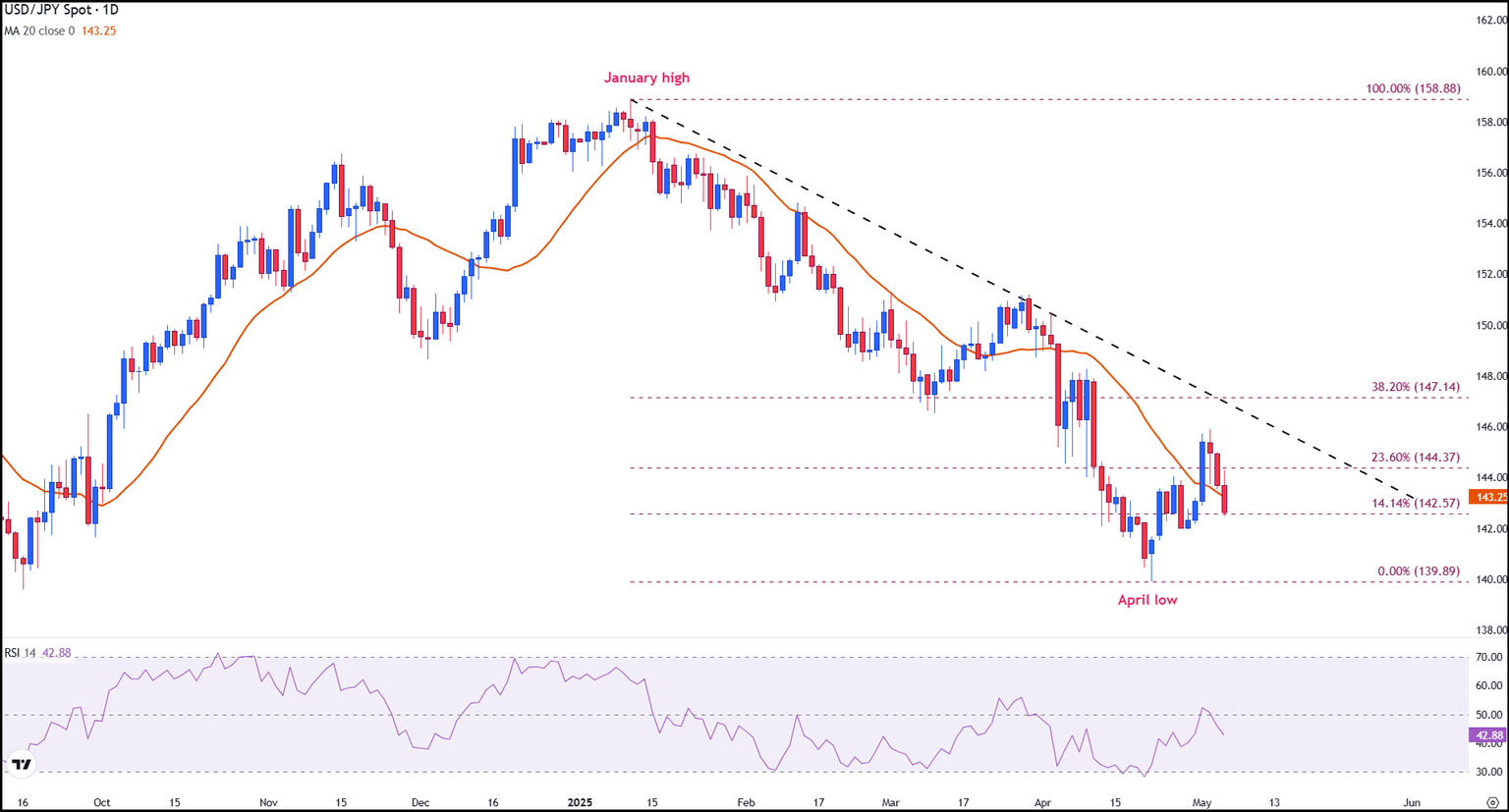
USD/JPY remains under near-term pressure following a clear rejection at 144.28 on Monday. The pair has since broken below the psychological 144.00 level and is currently testing support around 143.00.
Price action has shifted below the 20-day Simple Moving Average (SMA), reinforcing a short-term bearish bias, which could open the door for the next level of psychological support at 142.00.
On the upside, initial resistance is seen at 144.00, followed by the 144.28 swing high. A break above this zone would be required to re-establish bullish momentum, but any recovery is likely to remain fragile unless supported by a clear shift in policy tone from the Federal Reserve or easing in trade tensions.
Momentum indicators, including the Relative Strength Index (RSI), are turning lower and remain below neutral, supporting a cautious view while the pair holds beneath key resistance.
USD/JPY daily chart
Economic Indicator
Fed Monetary Policy Statement
Following the Federal Reserve's (Fed) rate decision, the Federal Open Market Committee (FOMC) releases its statement regarding monetary policy. The statement may influence the volatility of the US Dollar (USD) and determine a short-term positive or negative trend. A hawkish view is considered bullish for USD, whereas a dovish view is considered negative or bearish.
Read more.Next release: Wed May 07, 2025 18:00
Frequency: Irregular
Consensus: -
Previous: -
Source: Federal Reserve
Author
Tammy Da Costa, CFTe®
FXStreet
Tammy is an economist and market analyst with a deep passion for financial markets, particularly commodities and geopolitics.