USD/INR jumps on strong US Dollar demand
- The Indian Rupee softens in Thursday’s early European session.
- USD bids from importers and subdued foreign inflows continue to undermine the INR.
- India’s December Manufacturing PMI hit the 2024 low.
- Investors brace for the US weekly Initial Jobless Claims.

The Indian Rupee (INR) loses momentum on Thursday. The reasons attributed to the weakening in the local currency are an increase in demand for US Dollar (USD) from importers, a higher 10-year US Treasury yields and concerns about India's slowing economic growth.
The manufacturing activity in India registered its weakest growth of 2024 in December as the Manufacturing Purchasing Managers’ Index (PMI) fell to 56.4 versus 57.4 prior. This figure came in weaker than the 57.8 expected. The INR remains weak in an immediate reaction to the downbeat PMI data.
On the other hand, the downside for the INR might be limited as the Reserve Bank of India (RBI) will likely continue to intervene in the currency market to curb volatility. Later on Thursday, the US weekly Initial Jobless Claims and S&P Global Manufacturing PMI for December will be published.
Indian Rupee remains fragile amid importer USD bids and domestic factors
- “The rupee is still susceptible to downward pressure, given strong dollar bids and robust US yields,” said Anil Kumar Bhansali, Head of Treasury at Finrex Treasury Advisors LLP.
- According to Reuters, the bearish bias of the INR is driven by a combination of factors, including the Greenback maintaining its strength near 108.48 and persistent concerns over slowing domestic growth and a widening trade deficit.
- India's fiscal deficit for the April-November period of FY25 stood at 8.47 trillion rupees ($98.90 billion), or 52.5% of the estimate for the financial year, according to official data released on Tuesday. The fiscal deficit widened from 50.7% reported in the comparable year-earlier period.
- The real GDP growth is estimated at 6.6% for 2024-25, and 6.9% for the first quarter of 2025-26, as per the Reserve Bank of India (RBI).
- The US Housing Price Index rose 0.4% MoM in October versus 0.7% prior, according to the Federal Housing Finance Agency. This reading came in weaker than the 0.5% expected.
- The US S&P/Case-Shiller Home Price Indices climbed 4.2% YoY in October, compared to 4.6% in the previous reading, beating the estimation of 4.1%.
USD/INR maintains a positive tone despite the overbought RSI condition
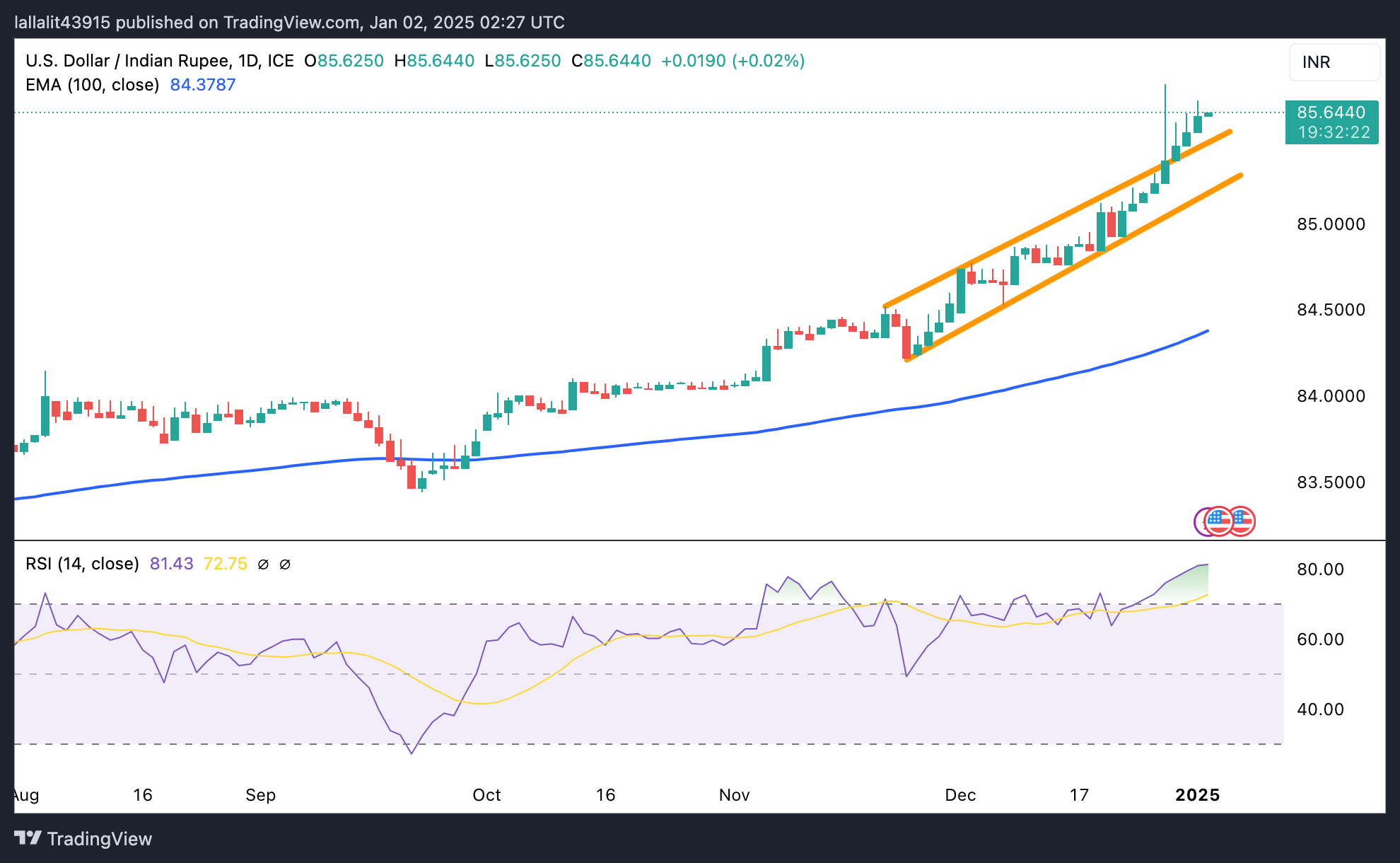
The all-time high of 85.81 acts as an immediate resistance level for USD/INR. If bulls manage to break above this level, then a move to the 86.00 psychological level could be in play in the short term.
On the flip side, the first downside target is seen at the resistance-turned-support level of 85.50. A breach of the mentioned level could draw in sellers to 85.00, the round figure, en route to the 100-day EMA at 84.37.
Indian economy FAQs
The Indian economy has averaged a growth rate of 6.13% between 2006 and 2023, which makes it one of the fastest growing in the world. India’s high growth has attracted a lot of foreign investment. This includes Foreign Direct Investment (FDI) into physical projects and Foreign Indirect Investment (FII) by foreign funds into Indian financial markets. The greater the level of investment, the higher the demand for the Rupee (INR). Fluctuations in Dollar-demand from Indian importers also impact INR.
India has to import a great deal of its Oil and gasoline so the price of Oil can have a direct impact on the Rupee. Oil is mostly traded in US Dollars (USD) on international markets so if the price of Oil rises, aggregate demand for USD increases and Indian importers have to sell more Rupees to meet that demand, which is depreciative for the Rupee.
Inflation has a complex effect on the Rupee. Ultimately it indicates an increase in money supply which reduces the Rupee’s overall value. Yet if it rises above the Reserve Bank of India’s (RBI) 4% target, the RBI will raise interest rates to bring it down by reducing credit. Higher interest rates, especially real rates (the difference between interest rates and inflation) strengthen the Rupee. They make India a more profitable place for international investors to park their money. A fall in inflation can be supportive of the Rupee. At the same time lower interest rates can have a depreciatory effect on the Rupee.
India has run a trade deficit for most of its recent history, indicating its imports outweigh its exports. Since the majority of international trade takes place in US Dollars, there are times – due to seasonal demand or order glut – where the high volume of imports leads to significant US Dollar- demand. During these periods the Rupee can weaken as it is heavily sold to meet the demand for Dollars. When markets experience increased volatility, the demand for US Dollars can also shoot up with a similarly negative effect on the Rupee.
Author

Lallalit Srijandorn
FXStreet
Lallalit Srijandorn is a Parisian at heart. She has lived in France since 2019 and now becomes a digital entrepreneur based in Paris and Bangkok.














