USD/INR recovers early losses while focus shifts to US NFP data
- The Indian Rupee struggles to extend its winning streak against the US Dollar.
- India’s Commerce and Industry Minister Goyal stated that the deal will be announced once it is fair.
- The impact of the US NFP data will be significant on the US Dollar and the Fed’s monetary policy expectations.

The Indian Rupee (INR) fails to extend its winning streak against the US Dollar (USD) for the fourth trading day on Wednesday. The USD/INR pair recovers its early losses and ticks up to near 88.75 as the US Dollar extends its rally.
The Indian currency struggles to attract bids despite growing expectations that the United States (US) and India could announce a trade deal soon.
The US-India trade deal hopes intensified last week after President Donald Trump stated that he will reduce tariffs on imports from New Delhi “at some point”, adding that India has agreed on halting Oil imports from Russia.
This week, expectations for the US-India trade pact accelerated further after India’s Commerce Secretary Rajesh Agarwal stated that the first part of the bilateral trade deal with the US is “nearly closure”, which addresses 50% tariffs and market access to the US, and the finalized deal will be announced on a mutually decided date, PTI reported.
Meanwhile, India’s Commerce and Industry Minister Piyush Goyal stated on Tuesday that the bilateral deal will be announced when negotiations from both sides have confidence that the agreement is “fair, equitable and balanced”. “When the deal will become fair, equitable, and balanced, you will hear good news," Goyal said at the Indo-US Economic Summit.
The table below shows the percentage change of Indian Rupee (INR) against listed major currencies today. Indian Rupee was the strongest against the Australian Dollar.
| USD | EUR | GBP | JPY | CAD | AUD | INR | CHF | |
|---|---|---|---|---|---|---|---|---|
| USD | 0.00% | 0.06% | 0.00% | 0.15% | 0.43% | -0.04% | -0.05% | |
| EUR | -0.01% | 0.06% | -0.02% | 0.14% | 0.41% | -0.05% | -0.06% | |
| GBP | -0.06% | -0.06% | -0.08% | 0.09% | 0.36% | -0.10% | -0.11% | |
| JPY | 0.00% | 0.02% | 0.08% | 0.16% | 0.44% | -0.03% | -0.04% | |
| CAD | -0.15% | -0.14% | -0.09% | -0.16% | 0.28% | -0.20% | -0.20% | |
| AUD | -0.43% | -0.41% | -0.36% | -0.44% | -0.28% | -0.49% | -0.45% | |
| INR | 0.04% | 0.05% | 0.10% | 0.03% | 0.20% | 0.49% | -0.01% | |
| CHF | 0.05% | 0.06% | 0.11% | 0.04% | 0.20% | 0.45% | 0.00% |
The heat map shows percentage changes of major currencies against each other. The base currency is picked from the left column, while the quote currency is picked from the top row. For example, if you pick the Indian Rupee from the left column and move along the horizontal line to the US Dollar, the percentage change displayed in the box will represent INR (base)/USD (quote).
Daily digest market movers: US President Trump announces that he has made choice for Fed Chair
- The USD/INR pair gains ground as the US Dollar as the latter extends its upside further ahead of the United States (US) Nonfarm Payrolls (NFP) data for September, which will be released on Thursday.
- At the time of writing, the US Dollar Index (DXY), which tracks the Greenback’s value against six major currencies, refreshes weekly high around 99.75.
- Investors will closely monitor the US NFP data to get cues on the Federal Reserve’s (Fed) monetary policy outlook, as it will be the first economic release since the federal reopening. Additionally, almost all Federal Open Market Committee (FOMC) members have been warning of weak labor demand amid increasing Artificial Intelligence (AI) adaptability.
- The US NFP report is expected to show that the economy added 50K fresh workers, higher than 22K in August. The Unemployment Rate is seen unchanged at 4.3%. Average Hourly Earnings, a key measure of wage growth, is expected to have grown steadily by 0.3% and 3.7% on a monthly as well as annual basis.
- Signs of a weak job trend from the US official employment data would prompt expectations of an interest rate cut by the Fed for its December policy meeting. On the contrary, better-than-projected figures would weaken the same.
- Currently, the CME FedWatch tool shows that the probability of the Fed cutting interest rates by 25 basis points (bps) to 3.50%-3.75% in the December meeting has diminished to 48.9% from 66.9% seen a week ago. Traders have trimmed Fed dovish bets as FOMC members have also warned of upside inflation risks, and have stressed the need to exercise caution on loosening monetary conditions further.
- Meanwhile, US President Donald Trump said to reporters on Tuesday that he has made the choice for the replacement of Fed Chair Jerome Powell, but didn’t mention the name. “I have started interviews for Fed chair, and I think I already know the choice,” Trump said. He added that he would “love to get Fed Chair Powell out right now”, but people are “holding me back”.
Technical Analysis: USD/INR attracts bids below 20-day EMA
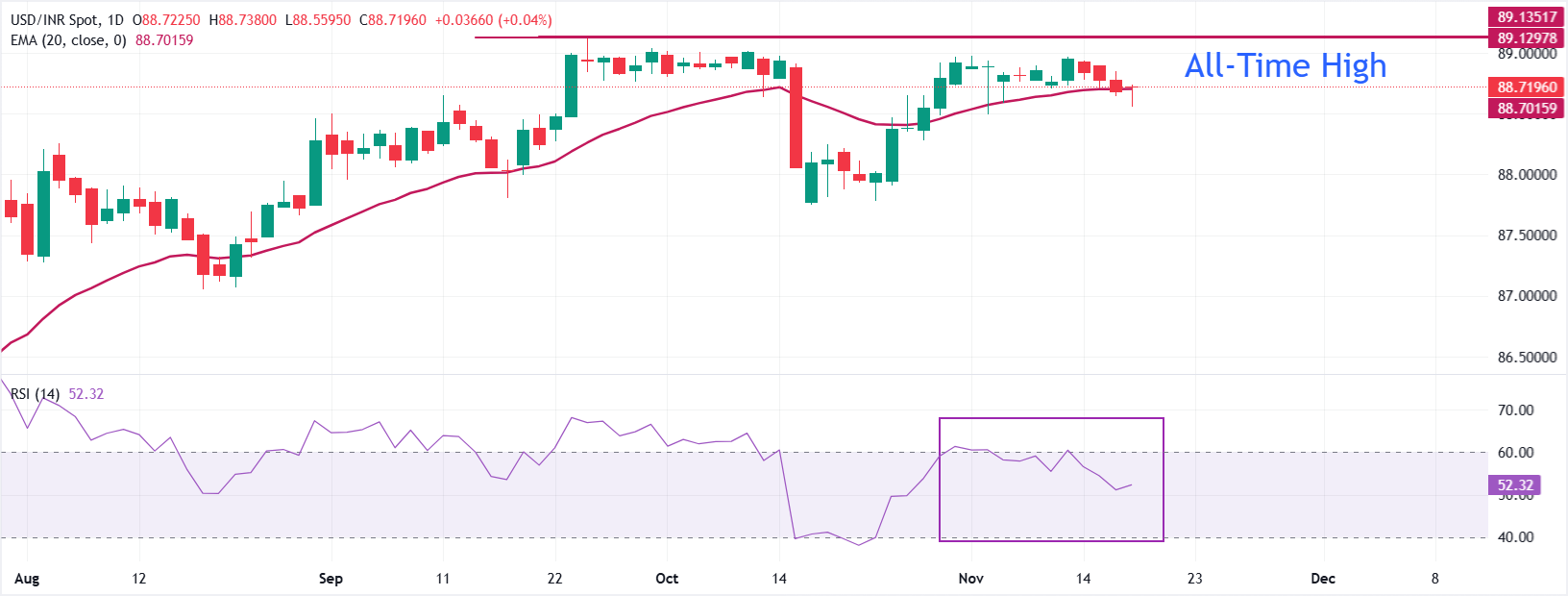
The USD/INR pair recovers its early losses and rebounds to near 88.75 on Wednesday. The pair attracted bids after sliding below the 20-day Exponential Moving Average (EMA), which trades around 88.70.
The 14-day Relative Strength Index (RSI) falls into the 40.00-60.00 range from the 60.00-80.00 zone. The range shift suggests that the overall momentum is not bullish anymore.
Looking down, the August 21 low of 87.07 will act as key support for the pair. On the upside, the all-time high of 89.12 will be a key barrier.
US Dollar FAQs
The US Dollar (USD) is the official currency of the United States of America, and the ‘de facto’ currency of a significant number of other countries where it is found in circulation alongside local notes. It is the most heavily traded currency in the world, accounting for over 88% of all global foreign exchange turnover, or an average of $6.6 trillion in transactions per day, according to data from 2022. Following the second world war, the USD took over from the British Pound as the world’s reserve currency. For most of its history, the US Dollar was backed by Gold, until the Bretton Woods Agreement in 1971 when the Gold Standard went away.
The most important single factor impacting on the value of the US Dollar is monetary policy, which is shaped by the Federal Reserve (Fed). The Fed has two mandates: to achieve price stability (control inflation) and foster full employment. Its primary tool to achieve these two goals is by adjusting interest rates. When prices are rising too quickly and inflation is above the Fed’s 2% target, the Fed will raise rates, which helps the USD value. When inflation falls below 2% or the Unemployment Rate is too high, the Fed may lower interest rates, which weighs on the Greenback.
In extreme situations, the Federal Reserve can also print more Dollars and enact quantitative easing (QE). QE is the process by which the Fed substantially increases the flow of credit in a stuck financial system. It is a non-standard policy measure used when credit has dried up because banks will not lend to each other (out of the fear of counterparty default). It is a last resort when simply lowering interest rates is unlikely to achieve the necessary result. It was the Fed’s weapon of choice to combat the credit crunch that occurred during the Great Financial Crisis in 2008. It involves the Fed printing more Dollars and using them to buy US government bonds predominantly from financial institutions. QE usually leads to a weaker US Dollar.
Quantitative tightening (QT) is the reverse process whereby the Federal Reserve stops buying bonds from financial institutions and does not reinvest the principal from the bonds it holds maturing in new purchases. It is usually positive for the US Dollar.
Author

Sagar Dua
FXStreet
Sagar Dua is associated with the financial markets from his college days. Along with pursuing post-graduation in Commerce in 2014, he started his markets training with chart analysis.