The Japanese Yen is doing something it hasn't done in ten weeks
USD/JPY climbs above the 159.00 resistance level, extending its advance on Wednesday, and bringing the Japanese Yen (JPY) back toward its weakest levels in ten weeks amid renewed strength in the US Dollar (USD).
The move reflects a sharp repricing of Federal Reserve (Fed) interest rate expectations following hawkish comments from Fed Governor Christopher Waller and stronger-than-expected US consumer inflation data. Investors are now increasingly anticipating additional rate hikes in both December and January, strengthening the US Dollar.
However, the Japanese Yen's renewed weakness comes as the Bank of Japan (BoJ) is also considering further monetary tightening, while several major banks see opportunities for a recovery in the Japanese currency.
Why is the Japanese Yen weakening again?
The Japanese Yen's latest decline reflects a significant hawkish shift in Fed expectations, which began even before Tuesday's release of the US Consumer Price Index (CPI). Earlier on Tuesday, Fed Governor Christopher Waller signaled his willingness to support further monetary tightening, saying he would “still support a 25 basis point increase” in December even if inflation moderated. More importantly, Waller warned that a “half-point Fed rate hike may be needed in December” if monthly core inflation remained “around 0.3% or higher.”
His remarks prompted investors to reassess the possibility of a more aggressive tightening cycle, providing initial support to the US Dollar ahead of the inflation report. The subsequent CPI figures reinforced these expectations. According to the Bureau of Labor Statistics (BLS), headline inflation rose 0.4% MoM in October, exceeding the 0.3% forecast, although slowing from September's 0.6% increase. Core CPI, which excludes volatile food and energy prices, increased 0.3%, above the 0.2% estimate and matching September's reading.
Crucially, the core inflation figure reached the exact threshold identified by Waller as potentially justifying a larger December rate increase, reinforcing expectations of further monetary tightening. According to the CME FedWatch Tool, markets now assign an 86.5% chance to a 25-basis-point rate hike in December, while the likelihood of a larger 50-basis-point increase stands at 13.5%. However, the most striking shift concerns January. The chance of another 25-basis-point rate increase at that meeting has surged to 60.5%, compared with just 19% before Tuesday's repricing.
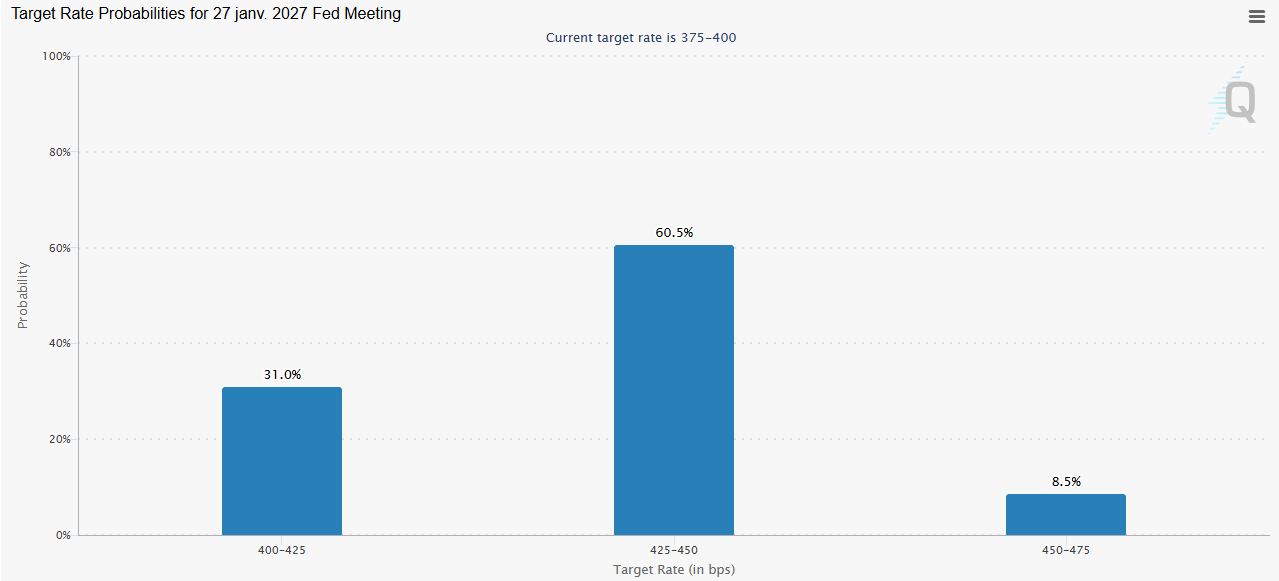
This sharp adjustment suggests that investors increasingly expect the Fed's tightening cycle to extend into early 2027, supporting the US Dollar and putting additional pressure on the Japanese Yen.
Hawkish comments from Fed officials add to the US Dollar's momentum. Dallas Fed President Lorie Logan argued that the central bank needs "at least two more 25-basis-point rate increases", reinforcing expectations that US borrowing costs could remain elevated.
The yield on the benchmark 10-year US Treasury also returns above 5%, making USD-denominated assets more attractive relative to their Japanese counterparts. This interest rate differential remains a central driver of USD/JPY. While the Fed maintains its benchmark rate between 3.75% and 4.00%, the BoJ's policy rate stands at 1.25%, encouraging investors to favor higher-yielding US assets.
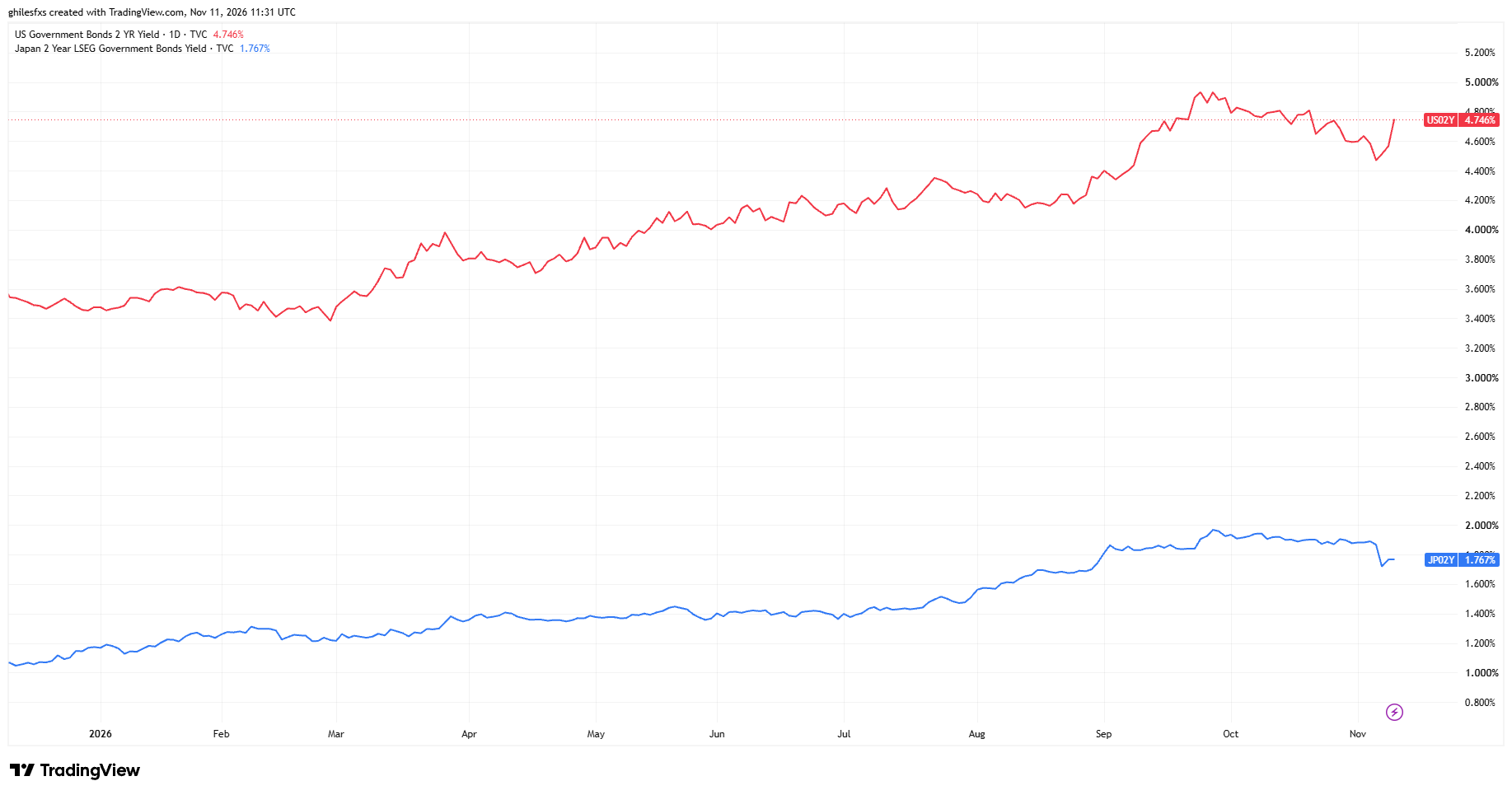
The Bank of Japan is becoming more hawkish, but the Japanese Yen is not responding
Interestingly, the Japanese currency continues to weaken despite increasing signs that BoJ policymakers are preparing to raise interest rates further. The Summary of Opinions from the central bank's October meeting reveals growing support for additional tightening as underlying inflation approaches its 2% target.
One policymaker argued that the BoJ should raise interest rates "without becoming overly cautious", while another considered that Japan is entering a new phase requiring faster monetary normalization. However, policymakers remain divided over the appropriate timing. Some officials expressed concerns about weak domestic consumption, the sustainability of wage growth and uncertainty surrounding demand linked to Artificial Intelligence.
This hesitation contrasts with the increasingly hawkish outlook in the United States, helping explain why the Japanese Yen struggles to benefit from expectations of another Japanese rate increase.
Nevertheless, ING strategist Chris Turner sees improving Japanese economic fundamentals as a potential catalyst for further tightening: "All of the above can feed into the Bank of Japan's view that inflation is now stable at 2.00% and its accommodative monetary policy can be reined in," noted Turner.
Why the 160 level could change the outlook for USD/JPY
The return above 159.00 places USD/JPY increasingly close to the psychologically important 160.00 threshold, where the possibility of intervention by Japanese authorities could become a major consideration. Japan has previously intervened in currency markets to counter excessive Japanese Yen depreciation, making investors particularly sensitive to further advances in the exchange rate.
Turner acknowledged that US Dollar strength could push the pair beyond its current resistance but warned that higher levels may attract buyers of the Japanese currency: "The broadly strong dollar means that USD/JPY could easily push through resistance at 159, but we increasingly think investors will be looking to acquire cheap yen should USD/JPY push above 160 again," wrote Turner.
This assessment suggests that further US Dollar gains could eventually become self-limiting as intervention concerns and demand for undervalued Japanese Yen increase.
MUFG Strategist Derek Halpenny also highlighted improving confidence in the Japanese government bond market and potential measures designed to encourage domestic investment. He argued that these developments, combined with the prospect of additional BoJ tightening, could support a more sustainable recovery. "With intervention likely halting the prospects to the upside, and confidence in the BoJ improving, the risks certainly look more skewed to yen strength over the medium term," noted Halpenny.
Can USD/JPY break above 159.00 hold?
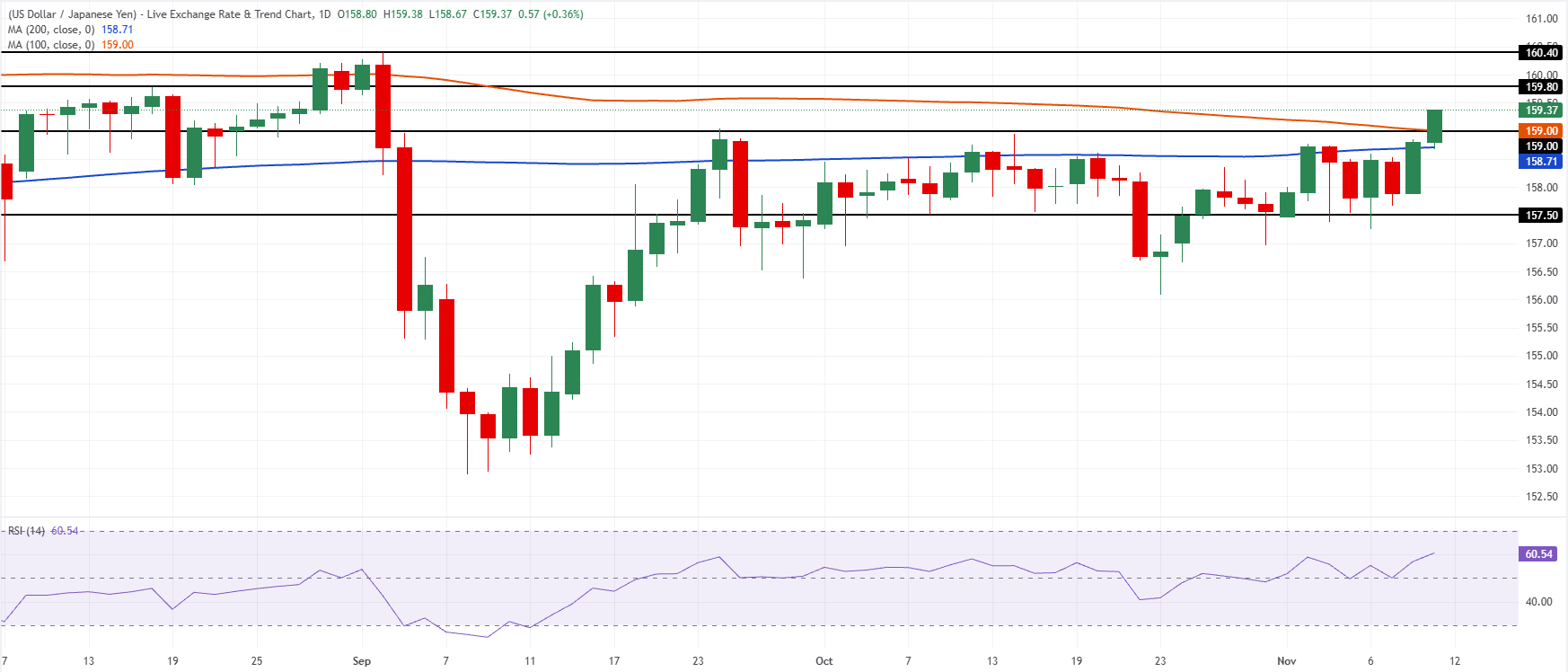
USD/JPY is testing the key 159.00 resistance level on the daily chart, a barrier that has capped several upside attempts since late September. The pair returns to this area on Wednesday for the first time since September 24, supported by renewed bullish momentum.
The pair is also challenging the 100-day Simple Moving Average (SMA) at 159.00, after recently reclaiming the 200-day SMA at 158.70. Meanwhile, the Relative Strength Index (RSI) rises toward 58, indicating strengthening bullish momentum without signaling overbought conditions.
A sustained break above 159.00 on a daily basis would reinforce the bullish outlook and open the door to the next resistance at 159.80, followed by the September 2 high near 160.40. A move beyond this level could accelerate the recovery toward the psychologically important 161.00 level.
Conversely, failure to overcome 159.00 could trigger renewed selling pressure, with initial support at the 200-day SMA around 158.70. A break below this level would weaken the immediate bullish momentum and expose the recent consolidation area around 157.50.
Author

Ghiles Guezout
FXStreet
Ghiles Guezout is a Market Analyst with a strong background in stock market investments, trading, and cryptocurrencies. He combines fundamental and technical analysis skills to identify market opportunities.