USD/INR rises ahead of holiday-shortened trading week, eyes on possible RBI’s intervention
- The Indian Rupee loses traction to an all-time low in Tuesday’s early European session.
- A weak offshore Chinese Yuan, strong USD demand from importers, and higher crude oil prices weigh on the INR.
- The intervention by the RBI might help limit the local currency’s losses.

The Indian Rupee (INR) extends its downside to near a fresh record low on Tuesday. The strong US Dollar (USD) demand by corporates, likely related to month-end payments and weakness in the Chinese Yuan could drag the local currency lower. The slight uptick in crude oil prices contributes to the INR’s downside as India is the world's third-largest oil consumer.
However, the routine intervention by the Reserve Bank of India (RBI) might help limit the INR’s losses. The RBI has been intervening aggressively to support the INR. The Indian central bank has ramped up its forward USD sales to limit the impact of spot market interventions on cash in the banking system and on foreign exchange reserves. The markets are likely to trade in a quiet session ahead of the holiday trading week.
Indian Rupee softens amid global cues
- India's benchmark indexes were closed higher on Monday. The Nifty 50 rose 0.7% to 23,753.45 points, while the BSE Sensex climbed 0.64% to 78,540.17, with both benchmarks snapping a five-session losing streak.
- "The Reserve Bank of India likely intervened in the currency market to prevent the exchange rate from depreciating further from the 85.12 levels. There were dollar sales from public sector banks, likely on behalf of the RBI," a currency trader from a state-run bank said.
- The US New Home Sales climbed 5.9% to a seasonally adjusted annual rate of 664,000 in November, the Census Bureau reported on Monday. The sales pace for October was revised higher to a rate of 627,000 units from the previously reported 610,000 units.
- Durable Goods Orders in the US dropped by 1.1% in November to $285.1 billion, according to the US Census Bureau on Monday. This reading followed a 0.8% increase reported in October, missing the estimation of a 0.4% decline.
USD/INR’s positive picture prevails
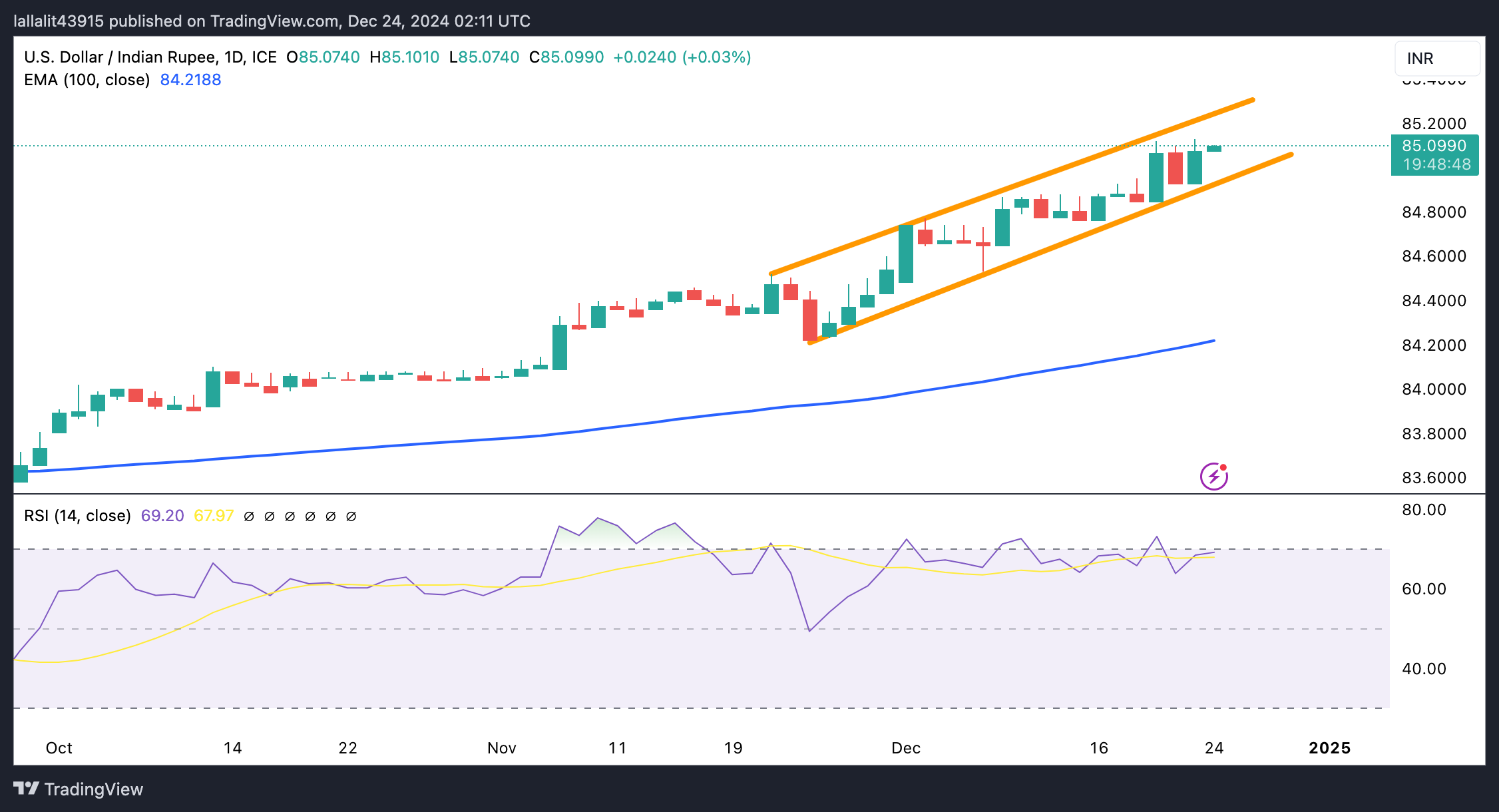
The Indian Rupee edges lower on the day. However, the constructive view of the USD/INR pair remains in play, characterized by the price holding above the key 100-day Exponential Moving Average (EMA) on the daily timeframe.
The first upside barrier to watch is the ascending channel upper boundary at 85.25. Extended gains above this level could see a rally to 85.50, en route to the 86.00 psychological level.
On the downside, the 85.00-84.95 zone acts as a potential support area for USD/INR. The 14-day Relative Strength Index (RSI) is located above the midline near 68.95, suggesting that the support level is likely to hold rather than break. Else, a breach of the mentioned level could expose 84.21, the 100-day EMA.
Indian Rupee FAQs
The Indian Rupee (INR) is one of the most sensitive currencies to external factors. The price of Crude Oil (the country is highly dependent on imported Oil), the value of the US Dollar – most trade is conducted in USD – and the level of foreign investment, are all influential. Direct intervention by the Reserve Bank of India (RBI) in FX markets to keep the exchange rate stable, as well as the level of interest rates set by the RBI, are further major influencing factors on the Rupee.
The Reserve Bank of India (RBI) actively intervenes in forex markets to maintain a stable exchange rate, to help facilitate trade. In addition, the RBI tries to maintain the inflation rate at its 4% target by adjusting interest rates. Higher interest rates usually strengthen the Rupee. This is due to the role of the ‘carry trade’ in which investors borrow in countries with lower interest rates so as to place their money in countries’ offering relatively higher interest rates and profit from the difference.
Macroeconomic factors that influence the value of the Rupee include inflation, interest rates, the economic growth rate (GDP), the balance of trade, and inflows from foreign investment. A higher growth rate can lead to more overseas investment, pushing up demand for the Rupee. A less negative balance of trade will eventually lead to a stronger Rupee. Higher interest rates, especially real rates (interest rates less inflation) are also positive for the Rupee. A risk-on environment can lead to greater inflows of Foreign Direct and Indirect Investment (FDI and FII), which also benefit the Rupee.
Higher inflation, particularly, if it is comparatively higher than India’s peers, is generally negative for the currency as it reflects devaluation through oversupply. Inflation also increases the cost of exports, leading to more Rupees being sold to purchase foreign imports, which is Rupee-negative. At the same time, higher inflation usually leads to the Reserve Bank of India (RBI) raising interest rates and this can be positive for the Rupee, due to increased demand from international investors. The opposite effect is true of lower inflation.
Author

Lallalit Srijandorn
FXStreet
Lallalit Srijandorn is a Parisian at heart. She has lived in France since 2019 and now becomes a digital entrepreneur based in Paris and Bangkok.

















