USD/INR weakens as likely RBI intervention caps gains
- The Indian Rupee trades in positive territory in Tuesday’s early European session.
- A weak tone in the domestic markets and persistent outflows weigh on the INR, but RBI intervention might limit its losses.
- Traders await the US December ISM Services PMI, which is due later on Tuesday.

The Indian Rupee (INR) rebounds on Tuesday after reaching a record low in the previous session. The Reserve Bank of India (RBI) intervention could help contain further loss in the local currency. On the other hand, the local currency remains fragile amid broad-based US Dollar (USD) bids. Furthermore, a steep fall in domestic equity markets and an unabated outflow of foreign capital might contribute to the INR’s downside.
Investors will closely watch the development surrounding the incoming US administration under Donald Trump’s tariff plan. Analysts believe that if US tariffs are broadly lower than Trump promised on the campaign trail and aimed only at critical sectors, then the outlook for global growth should improve and the USD should weaken.
The US ISM Services Purchasing Managers Index (PMI) is due later on Tuesday. On Wednesday, the minutes of the Federal Reserve's (Fed) December policy meeting will be published. All eyes will be on the US Nonfarm Payrolls (NFP) report on Friday.
Indian Rupee gains ground despite domestic and global challenges
- The HSBC final India Services PMI eased to 59.3 in December from 60.8 in a preliminary estimate. This reading came in below the consensus of 60.5.
- "Forward-looking indicators such as new business and future activity suggested that the strong performance will likely continue in the near future," said Ines Lam, economist at HSBC.
- Trump denied the Washington Post story that his aides are considering narrowing his tariff plan so that it would only apply to specific critical imports.
- Fed Governor Lisa Cook said on Monday that Fed policymakers could be more cautious with further rate cuts, citing labor market resilience and stickier inflation.
- The US ISM Services PMI is expected to improve to 53.0 in December from 52.1 in November.
USD/INR’s bullish bias prevails, overbought RSI conditions could limit its advance
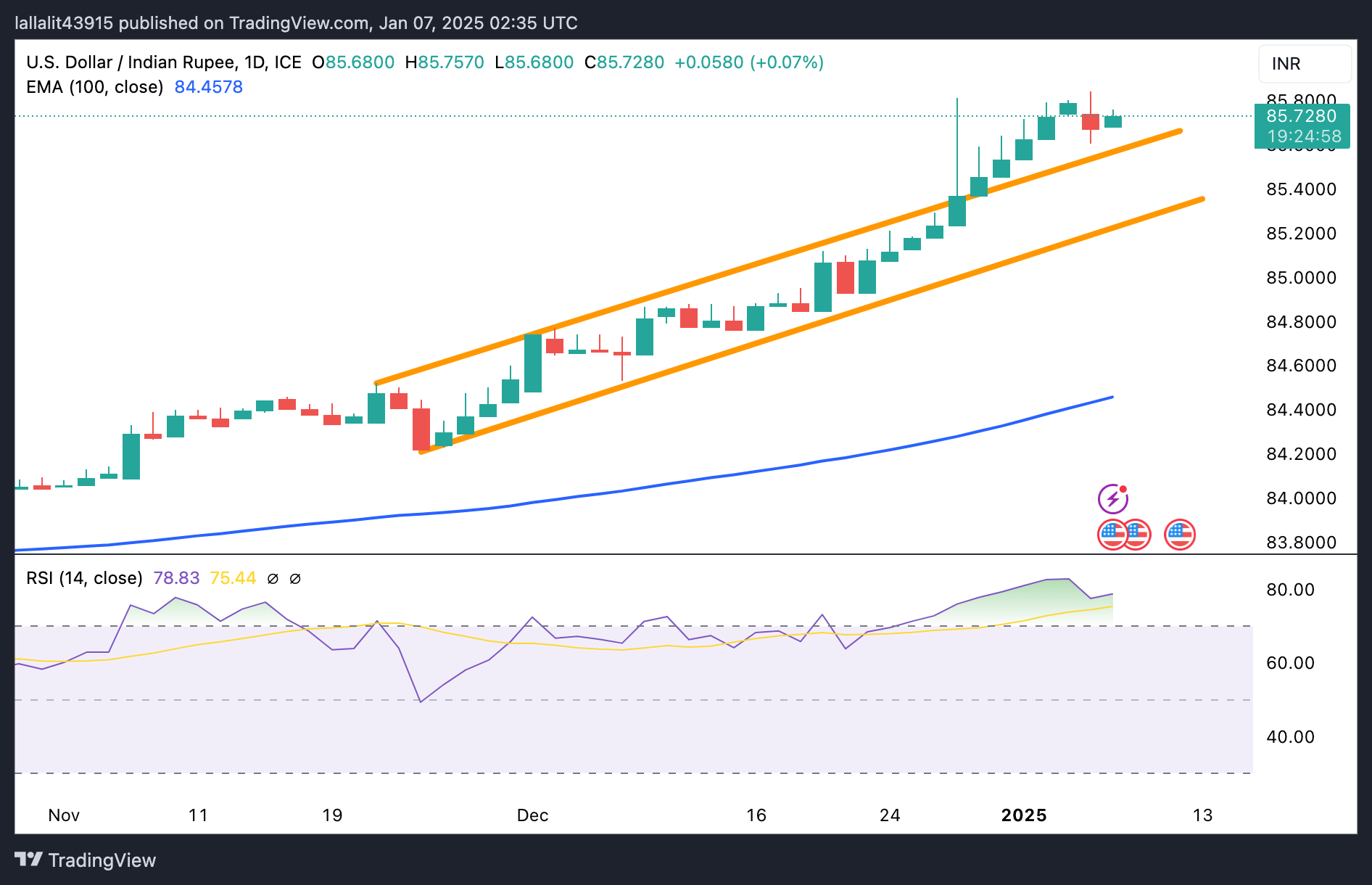
The Indian Rupee trades stronger on the day. The USD/INR pair remains on a bullish trajectory as the price has broken above the ascending trend channel over the past week and holds above the key 100-day Exponential Moving Average (EMA) on the daily chart.
Nonetheless, the 14-day Relative Strength Index (RSI) moves beyond the 70.00 mark, warranting some caution for bulls. The overbought condition suggests that further consolidation cannot be ruled out.
The crucial upside barrier emerges at an all-time high of 85.84. Sustained trading above this level could pave the way to the 86.00 psychological mark.
On the downside, the low of January 6 at 85.60 acts as an initial support level for USD/INR. Further south, the next contention level is located at 85.00, followed by 84.45, the 100-day EMA.
Indian Rupee FAQs
The Indian Rupee (INR) is one of the most sensitive currencies to external factors. The price of Crude Oil (the country is highly dependent on imported Oil), the value of the US Dollar – most trade is conducted in USD – and the level of foreign investment, are all influential. Direct intervention by the Reserve Bank of India (RBI) in FX markets to keep the exchange rate stable, as well as the level of interest rates set by the RBI, are further major influencing factors on the Rupee.
The Reserve Bank of India (RBI) actively intervenes in forex markets to maintain a stable exchange rate, to help facilitate trade. In addition, the RBI tries to maintain the inflation rate at its 4% target by adjusting interest rates. Higher interest rates usually strengthen the Rupee. This is due to the role of the ‘carry trade’ in which investors borrow in countries with lower interest rates so as to place their money in countries’ offering relatively higher interest rates and profit from the difference.
Macroeconomic factors that influence the value of the Rupee include inflation, interest rates, the economic growth rate (GDP), the balance of trade, and inflows from foreign investment. A higher growth rate can lead to more overseas investment, pushing up demand for the Rupee. A less negative balance of trade will eventually lead to a stronger Rupee. Higher interest rates, especially real rates (interest rates less inflation) are also positive for the Rupee. A risk-on environment can lead to greater inflows of Foreign Direct and Indirect Investment (FDI and FII), which also benefit the Rupee.
Higher inflation, particularly, if it is comparatively higher than India’s peers, is generally negative for the currency as it reflects devaluation through oversupply. Inflation also increases the cost of exports, leading to more Rupees being sold to purchase foreign imports, which is Rupee-negative. At the same time, higher inflation usually leads to the Reserve Bank of India (RBI) raising interest rates and this can be positive for the Rupee, due to increased demand from international investors. The opposite effect is true of lower inflation.
Author

Lallalit Srijandorn
FXStreet
Lallalit Srijandorn is a Parisian at heart. She has lived in France since 2019 and now becomes a digital entrepreneur based in Paris and Bangkok.