USD/INR climbs as Indian Rupee weakens due to potential FII outflows
- The Indian Rupee weakens ahead of economic figures from India due on Monday.
- Indian equities lose ground due to profit-booking after the indices hit eight-month highs on Friday.
- The US Dollar may struggle as traders expect that the Fed will cut interest rates in September.

The Indian Rupee (INR) loses ground against the US Dollar (USD) on Monday after registering gains in the previous two sessions. The NIFTY 50 trades around 25,550, declined by 0.33%, while the BSE SENSEX trades around 83,770, down by 0.34%, at the time of writing. Indian equities erase solid gains from the previous session, as traders engaged in profit-taking after the indices hit eight-month highs on Friday. The Indian Rupee potentially receives downward pressure from Foreign Institutional Investors’ (FIIs) outflows.
The USD/INR pair rose also because of the higher crude Oil prices, putting downward pressure on the INR. It is important to note that India is one of the largest crude Oil importers in the world. Traders await a slew of economic figures from India on Monday, including Industrial Output, Manufacturing Output, and Trade Deficit.
West Texas Intermediate (WTI) Oil price is trading around $64.70 per barrel at the time of writing. However, the upside of Crude Oil prices could be limited amid easing fears over supply disruptions, driven by the Middle East ceasefire. Moreover, OPEC+, the Organization of the Petroleum Exporting Countries and its allies, is set to boost production by 411,000 barrels per day in August, following a similar hike already planned for July.
The Indian Rupee gained ground due to strong foreign inflows. Foreign Institutional Investors (FIIs) bought Indian equities worth Rs 8,915 crore into Indian equities so far this June. Analysts note that this renewed interest reflects confidence in India’s economic growth story and the market’s underlying strength.
Daily digest market movers: Indian Rupee declines amid a stable US Dollar
- The US Dollar Index (DXY), which measures the value of the US Dollar against six major currencies, is trading lower at around 97.20 at the time of writing. US employment figures are scheduled to be released later in the week, which may further offer fresh impetus on the US Federal Reserve’s (Fed) policy outlook.
- The US Nonfarm Payrolls report is expected to show the economy added 110,000 new jobs in June, down from 135,000 in May. The estimated range is currently between a high of 140,000 and a low of 75,000. Moreover, Unemployment is anticipated to tick higher to 4.3% from 4.2%.
- The US Dollar may struggle amid rising expectations of the Federal Reserve (Fed) cutting interest rates at the September meeting. Data showed on Friday that US Personal Spending unexpectedly fell in May, the second decline this year. Meanwhile, US Personal income dropped by 0.4% in May, the largest decrease since September 2021.
- US President Donald Trump may announce a successor for Federal Reserve (Fed) Chair Jerome Powell by September or October. Trump might consider former Fed Governor Kevin Warsh and National Economic Council Director Kevin Hassett, according to the Wall Street Journal.
- Chicago Fed President Austan Goolsbee said on Thursday that the political waves are not a factor in decision-making, nor would the naming of a shadow chair, per CNBC.
- Fed Chair Jerome Powell noted on Wednesday that Trump's tariff policies may cause a one-time price hike, but they could also lead to more persistent inflation. The Fed should be careful in considering further rate cuts.
- Economists have projected a slightly slower Gross Domestic Product (GDP) growth in India for the current financial year ending in March at 6.4%, compared to 6.5% growth seen last year, according to a poll from Reuters. Economists have projected a slower growth despite the Reserve Bank of India (RBI) having front-loaded interest rate cuts.
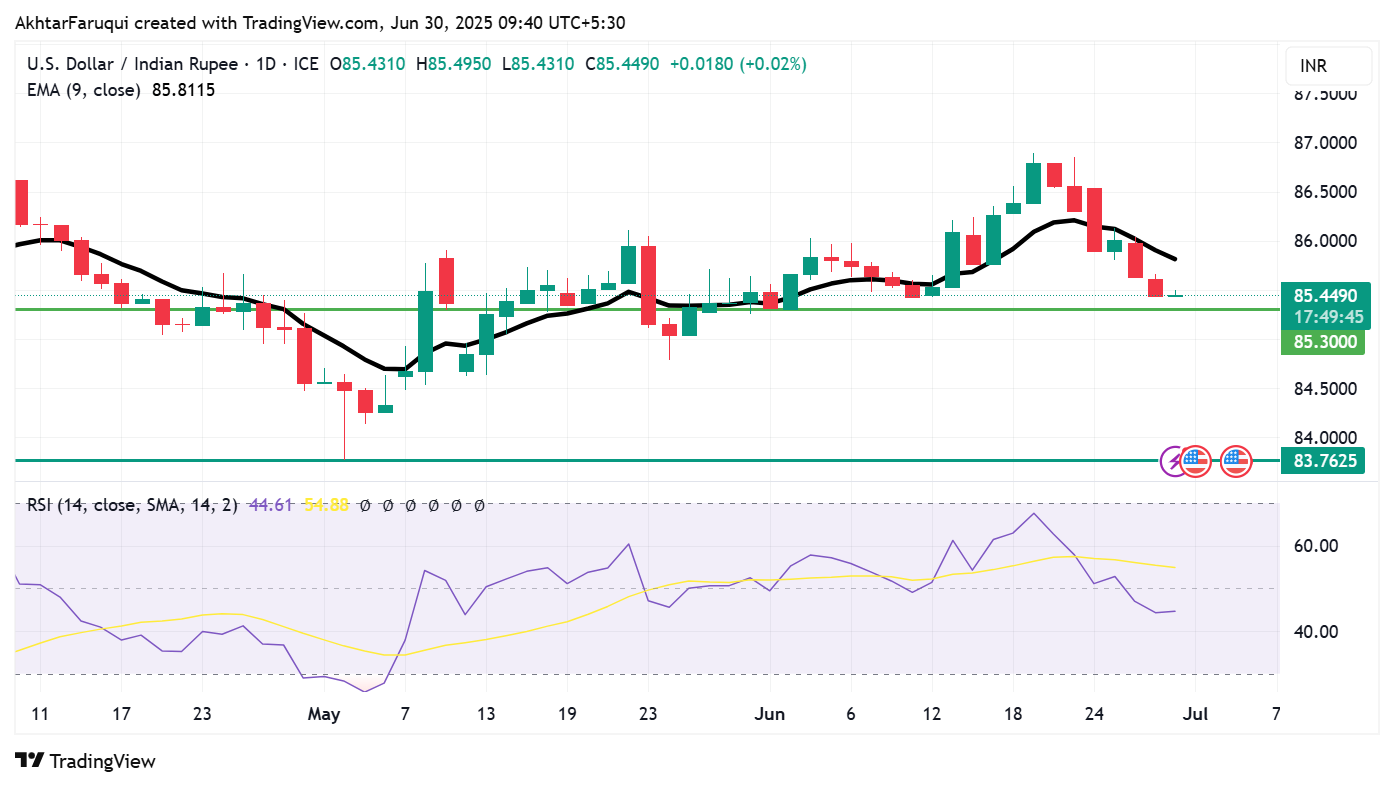
Technical Analysis: USD/INR holds gains around 85.50
The USD/INR pair holds modest gains near 85.50 on Monday, falling below the nine-day Exponential Moving Average (EMA), suggesting a weaker short-term price momentum.
The 14-day Relative Strength Index (RSI) remains below the 50 mark, indicating a persistent bearish bias.
On the downside, the monthly low at 85.30 appears as the immediate support. Meanwhile, the nine-day EMA at 85.81 could act as the primary barrier.
USD/INR: Daily Chart
Indian Rupee FAQs
The Indian Rupee (INR) is one of the most sensitive currencies to external factors. The price of Crude Oil (the country is highly dependent on imported Oil), the value of the US Dollar – most trade is conducted in USD – and the level of foreign investment, are all influential. Direct intervention by the Reserve Bank of India (RBI) in FX markets to keep the exchange rate stable, as well as the level of interest rates set by the RBI, are further major influencing factors on the Rupee.
The Reserve Bank of India (RBI) actively intervenes in forex markets to maintain a stable exchange rate, to help facilitate trade. In addition, the RBI tries to maintain the inflation rate at its 4% target by adjusting interest rates. Higher interest rates usually strengthen the Rupee. This is due to the role of the ‘carry trade’ in which investors borrow in countries with lower interest rates so as to place their money in countries’ offering relatively higher interest rates and profit from the difference.
Macroeconomic factors that influence the value of the Rupee include inflation, interest rates, the economic growth rate (GDP), the balance of trade, and inflows from foreign investment. A higher growth rate can lead to more overseas investment, pushing up demand for the Rupee. A less negative balance of trade will eventually lead to a stronger Rupee. Higher interest rates, especially real rates (interest rates less inflation) are also positive for the Rupee. A risk-on environment can lead to greater inflows of Foreign Direct and Indirect Investment (FDI and FII), which also benefit the Rupee.
Higher inflation, particularly, if it is comparatively higher than India’s peers, is generally negative for the currency as it reflects devaluation through oversupply. Inflation also increases the cost of exports, leading to more Rupees being sold to purchase foreign imports, which is Rupee-negative. At the same time, higher inflation usually leads to the Reserve Bank of India (RBI) raising interest rates and this can be positive for the Rupee, due to increased demand from international investors. The opposite effect is true of lower inflation.
Author

Akhtar Faruqui
FXStreet
Akhtar Faruqui is a Forex Analyst based in New Delhi, India. With a keen eye for market trends and a passion for dissecting complex financial dynamics, he is dedicated to delivering accurate and insightful Forex news and analysis.
















