USD/INR maintains position near all-time high due to fading odds of Fed bumper rate cuts
- The Indian Rupee remains near its all-time low of 84.14, recorded on August 5.
- Lower crude Oil prices may ease downward pressure on the INR.
- The US Dollar gains ground due to the fading likelihood of further bumper rate cuts by the Fed.

The Indian Rupee (INR) edges lower against the US Dollar (USD) on Tuesday due to the fading likelihood of further aggressive interest rate cuts by the US Federal Reserve (Fed).
The USD/INR pair may weaken due to declining Oil prices, as India is the world's third-largest Oil importer, and Oil constitutes a significant portion of the country's import expenditures. Crude Oil prices are experiencing downward pressure following a media report indicating that Israel is inclined to avoid targeting Iranian Oil facilities, which has alleviated concerns about potential supply disruptions.
On Monday, the Indian Rupee received downward pressure as Foreign institutional investors sold a net total of 37.32 billion rupees ($444 million) in stocks, marking their eleventh consecutive session of net selling. In contrast, domestic investors net purchased shares valued at 22.78 billion rupees, per Reuters.
Daily Digest Market Movers: Indian Rupee loses ground due to rising risk aversion
- According to the CME FedWatch Tool, markets are currently pricing in an 88.2% probability of a 25-basis-point rate cut in November, with no anticipation of a larger 50-basis-point reduction.
- The Washington Post reported on Monday that Israeli Prime Minister Benjamin Netanyahu informed the United States (US) that Israel plans to focus on Iranian military targets rather than nuclear or Oil infrastructure.
- Federal Reserve (Fed) Bank of Minneapolis President Neel Kashkari reassured markets late on Monday by reaffirming the Fed's data-dependent approach. Kashkari reiterated familiar Fed policymaker views on the strength of the US economy, noting continued easing of inflationary pressures and a robust labor market, despite a recent uptick in the overall unemployment rate, per Reuters.
- The risk-sensitive INR faces challenges from safe-haven flows amid escalating tensions in the Middle East that have sparked concerns of a broader regional conflict. According to CNN, at least four Israeli soldiers were killed, and over 60 people were injured in a drone attack in north-central Israel on Sunday.
- India’s Consumer Price Index (CPI) increased to 5.49% year-over-year in September, up from 3.65% in the previous month, significantly surpassing market expectations of 5.0%. This marks the highest inflation rate recorded since the beginning of the year, exceeding the Reserve Bank of India's target of 4%, after dipping below this threshold in the first two months of the September quarter.
Technical Analysis: USD/INR remains above 84.00, close to the highest level
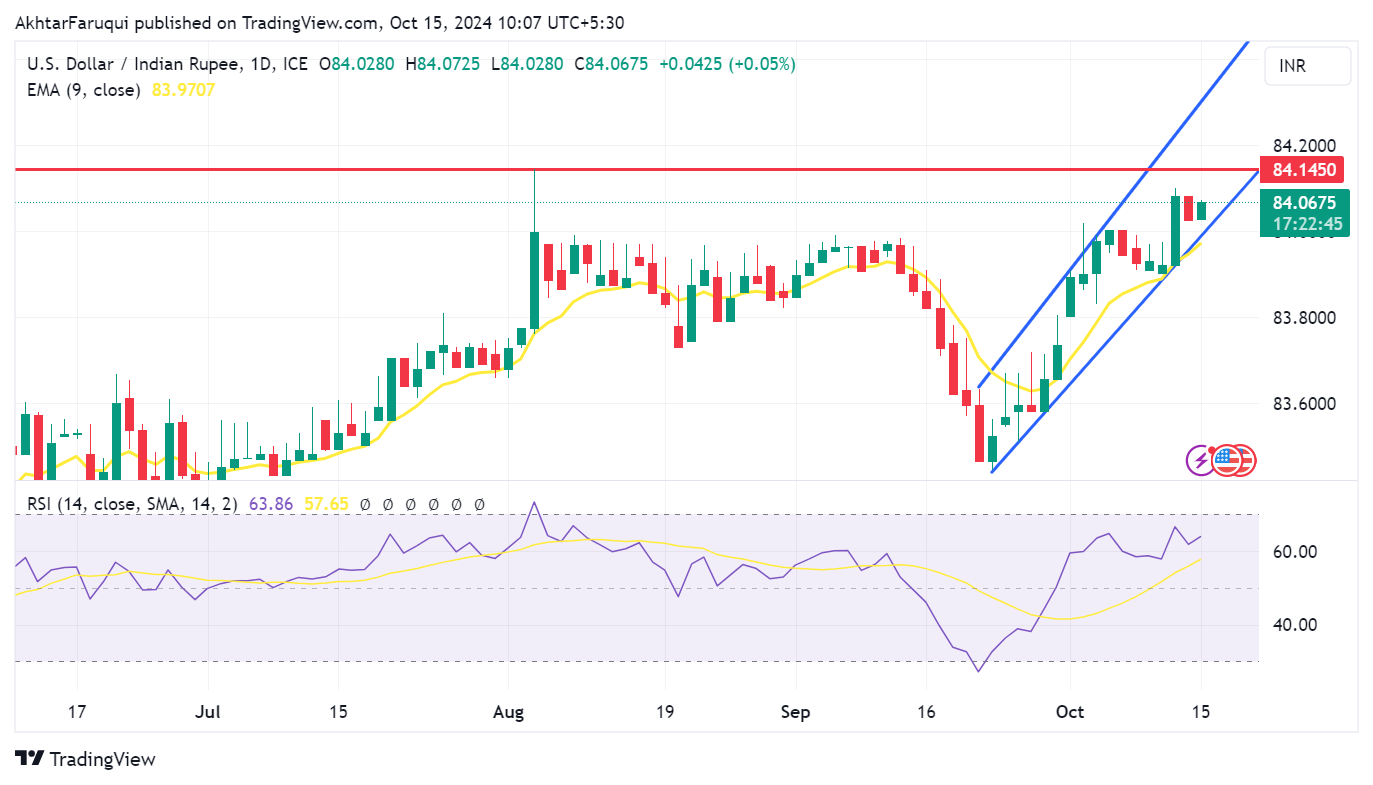
The USD/INR pair trades around 84.00 on Tuesday. Analysis of the daily chart shows that the USD/INR pair is positioned within the ascending channel pattern, suggesting a bullish bias. Additionally, the 14-day Relative Strength Index (RSI) remains above the 50 level, confirming the ongoing bullish sentiment for the pair.
In terms of resistance, the USD/INR pair could find a barrier around its all-time high of 84.14, recorded on August 5. A break above this level could support the pair to explore the region around the upper boundary of the ascending channel at 84.30 level.
On the downside, the immediate support appears at the lower boundary of the ascending channel around the psychological level of 84.00 followed by the nine-day Exponential Moving Average (EMA) at 83.97 level.
USD/INR: Daily Chart
Indian Rupee FAQs
The Indian Rupee (INR) is one of the most sensitive currencies to external factors. The price of Crude Oil (the country is highly dependent on imported Oil), the value of the US Dollar – most trade is conducted in USD – and the level of foreign investment, are all influential. Direct intervention by the Reserve Bank of India (RBI) in FX markets to keep the exchange rate stable, as well as the level of interest rates set by the RBI, are further major influencing factors on the Rupee.
The Reserve Bank of India (RBI) actively intervenes in forex markets to maintain a stable exchange rate, to help facilitate trade. In addition, the RBI tries to maintain the inflation rate at its 4% target by adjusting interest rates. Higher interest rates usually strengthen the Rupee. This is due to the role of the ‘carry trade’ in which investors borrow in countries with lower interest rates so as to place their money in countries’ offering relatively higher interest rates and profit from the difference.
Macroeconomic factors that influence the value of the Rupee include inflation, interest rates, the economic growth rate (GDP), the balance of trade, and inflows from foreign investment. A higher growth rate can lead to more overseas investment, pushing up demand for the Rupee. A less negative balance of trade will eventually lead to a stronger Rupee. Higher interest rates, especially real rates (interest rates less inflation) are also positive for the Rupee. A risk-on environment can lead to greater inflows of Foreign Direct and Indirect Investment (FDI and FII), which also benefit the Rupee.
Higher inflation, particularly, if it is comparatively higher than India’s peers, is generally negative for the currency as it reflects devaluation through oversupply. Inflation also increases the cost of exports, leading to more Rupees being sold to purchase foreign imports, which is Rupee-negative. At the same time, higher inflation usually leads to the Reserve Bank of India (RBI) raising interest rates and this can be positive for the Rupee, due to increased demand from international investors. The opposite effect is true of lower inflation.
Author

Akhtar Faruqui
FXStreet
Akhtar Faruqui is a Forex Analyst based in New Delhi, India. With a keen eye for market trends and a passion for dissecting complex financial dynamics, he is dedicated to delivering accurate and insightful Forex news and analysis.