USD/INR retraces slightly from lifetime highs on hopes of Hormuz reopening
- The Indian Rupee gains a temporary ground against the US Dollar after a four-day losing streak; its outlook remains grim.
- US President Trump expresses confidence that a few nations are ready for joint operations to open the Strait of Hormuz.
- FIIs have remained net sellers on all trading days so far in March.

The Indian Rupee (INR) snaps four-day losing streak against the US Dollar (USD) on Monday. The USD/INR pair trades lower to near 92.70 as the Indian Rupee rebounds amid speculation that the Strait of Hormuz could reopen soon.
Iran allows Indian ships to pass through Strait of Hormuz
The speculation for the reopening of the Strait of Hormuz, a channel through which 20% of global oil is supplied, which is closed as part of retaliation by Tehran against joint attacks by the US and Israel on Iran, has come into the picture as President Donald Trump has claimed that he is getting a good response from other countries for intervention.
“Many Countries, especially those who are affected by Iran’s attempted closure of the Hormuz Strait, will be sending War Ships, in conjunction with the United States of America, to keep the Strait open and safe,” Trump said in a post on Truth.Social adding, “Hopefully China, France, Japan, South Korea, the UK, and others, that are affected by this artificial constraint, will send Ships to the area so that the Hormuz Strait will no longer be a threat by a Nation.”
There seems to be a limited impact of Trump’s attempts to reopen Hormuz on the oil price, which has surrendered its opening gains.
Given that India is one of the largest importers of oil in the world, a higher oil price is an unfavorable situation for the Indian Rupee.
Meanwhile, Iran has allowed passage to Indian ships from the Strait of Hormuz, which has diminished oil and Liquefied Petroleum Gas (LPG) supply concerns. India’s Ministry of Ports confirmed over the weekend that two Indian-flagged tankers carrying LPG crossed the Strait of Hormuz early morning safely and are en route to India, Al Jazeera reported.
FIIs keep dumping stake in Indian stock market
Broadly, the outlook of the Indian Rupee is expected to remain weak due to the continuous outflow of foreign funds from the Indian stock market. So far in March, Foreign Institutional Investors (FIIs) have remained net sellers on all trading days, and have offloaded their stake worth Rs. 56,883.22 crore.
Meanwhile, India’s Wholesale Price Index (WPI) Inflation data for February has arrived higher than expectations. Inflation at the wholesale level grew at an annualized pace of 2.13%, faster than estimates of 2% and the prior reading of 1.81%.
This week, the domestic trigger for the US Dollar will be the Federal Reserve's (Fed) monetary policy announcement on Wednesday. As of writing, the US Dollar Index (DXY), which tracks the Greenback’s value against six major currencies, trades 0.15% lower to near 100.30. The USD Index corrects after posting a fresh over nine-month high of 100.55 on Friday. The US Dollar has outperformed in the past few weeks amid rising oil prices, given that the United States (US) is a net oil exporter.
Technical Analysis: USD/INR sees more upside above 93.00
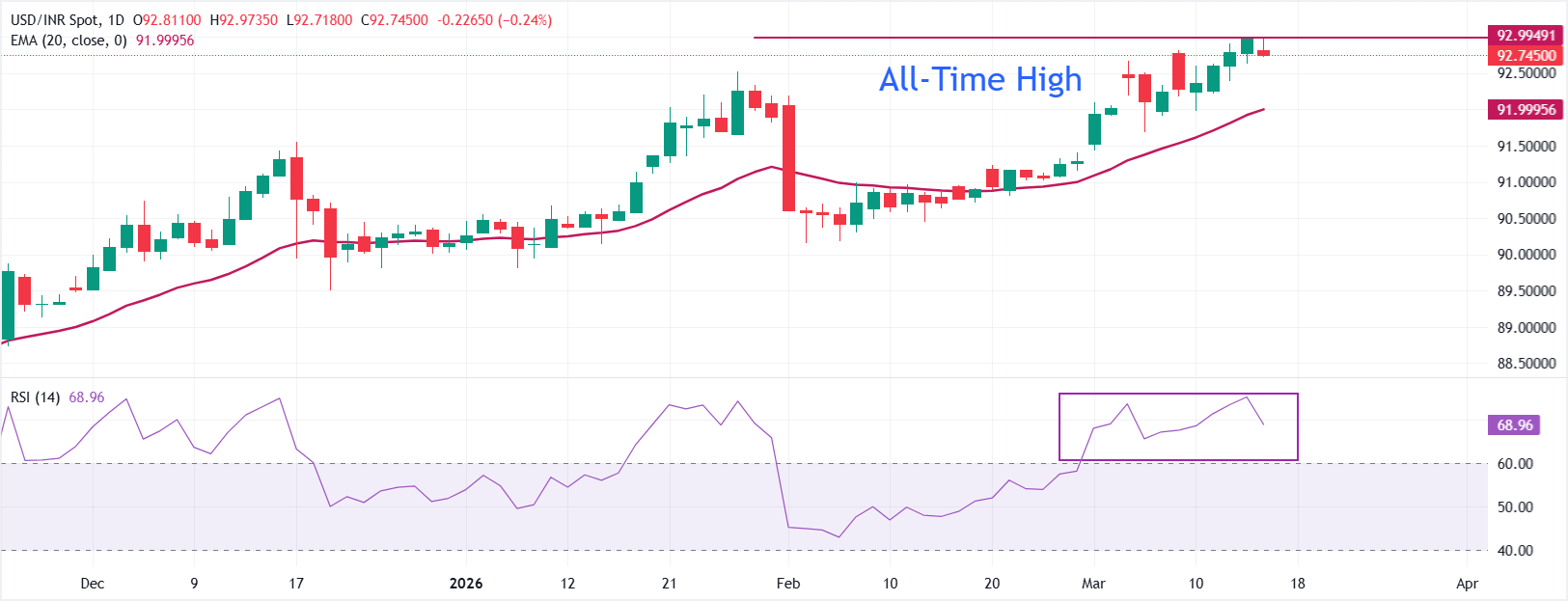
USD/INR drops to near 92.80 at the start of the week. However, the near-term bias is bullish as price holds above the rising 20-day Exponential Moving Average, which is around 92.00.
The sequence of higher closes from late in the series keeps buyers in control despite a minor pause, while the 14-day Relative Strength Index (RSI) around 70 has cooled slightly from the overbought territory. Overall, the technical backdrop favors further upside while the pair remains above its short-term trend support.
Initial resistance is located at the recent high near 92.97, and a daily close above this level would open the way toward the psychological 93.50 zone next. On the downside, immediate support emerges at the 20-day EMA near 92.00, with a break below this area exposing deeper retracement toward 91.30 as the next notable floor. As long as pullbacks are contained above the 92.00 region, the path of least resistance stays to the upside.
(The technical analysis of this story was written with the help of an AI tool.)
(This story was corrected at 11:15 GMT to say in the first bullet and paragraph that the Indian Rupee snaps four-day losing streak, not winning streak.)
Economic Indicator
Fed Interest Rate Decision
The Federal Reserve (Fed) deliberates on monetary policy and makes a decision on interest rates at eight pre-scheduled meetings per year. It has two mandates: to keep inflation at 2%, and to maintain full employment. Its main tool for achieving this is by setting interest rates – both at which it lends to banks and banks lend to each other. If it decides to hike rates, the US Dollar (USD) tends to strengthen as it attracts more foreign capital inflows. If it cuts rates, it tends to weaken the USD as capital drains out to countries offering higher returns. If rates are left unchanged, attention turns to the tone of the Federal Open Market Committee (FOMC) statement, and whether it is hawkish (expectant of higher future interest rates), or dovish (expectant of lower future rates).
Read more.Next release: Wed Mar 18, 2026 18:00
Frequency: Irregular
Consensus: 3.75%
Previous: 3.75%
Source: Federal Reserve
Author

Sagar Dua
FXStreet
Sagar Dua is associated with the financial markets from his college days. Along with pursuing post-graduation in Commerce in 2014, he started his markets training with chart analysis.