USD/CHF Price Forecast: Bears testing support at previous highs around 0.8315
- USD/CHF corrects lower from four-week highs at 0,8337 to test support in the 0.8310-0.8315 area.
- Market expectations of a Fed rate hike in December are likely to limit US Dollar dips.
- The technical picture shows a mild correction from overbought levels.

The US Dollar (USD) posts moderate losses against the Swiss Franc (CHF) on Thursday, trimming gains after a 1.7% rally over the previous two days pushed momentum indicators into overbought levels on intraday charts. The USD/CHF pair trades at 0.8320 after pulling back from one-month highs near 0.8340, testing support at previous highs between 0.8310 and 0.8315.
Dollar dips, however, are expected to remain shallow, as recent US data, namely the hot consumer inflation figures seen on Tuesday and the strong employment report released last week, have paved the way for the Federal Reserve (Fed) to hike interest rates again in December.
Fed officials have endorsed that view, and some of them might reiterate their stance later on Thursday. Chicago Fed President Austan Goolsbee and San Francisco Fed President Mary Daly have already expressed their concern about the high inflation pressures earlier this week. New York Fed President John Williams, who is also expected to speak later in the day, has already hinted at a further rate hike before year-end. Bearing this in mind, it is difficult to foresee any significant US Dollar reversal.
Technical Analysis: Pulling back from overbought levels
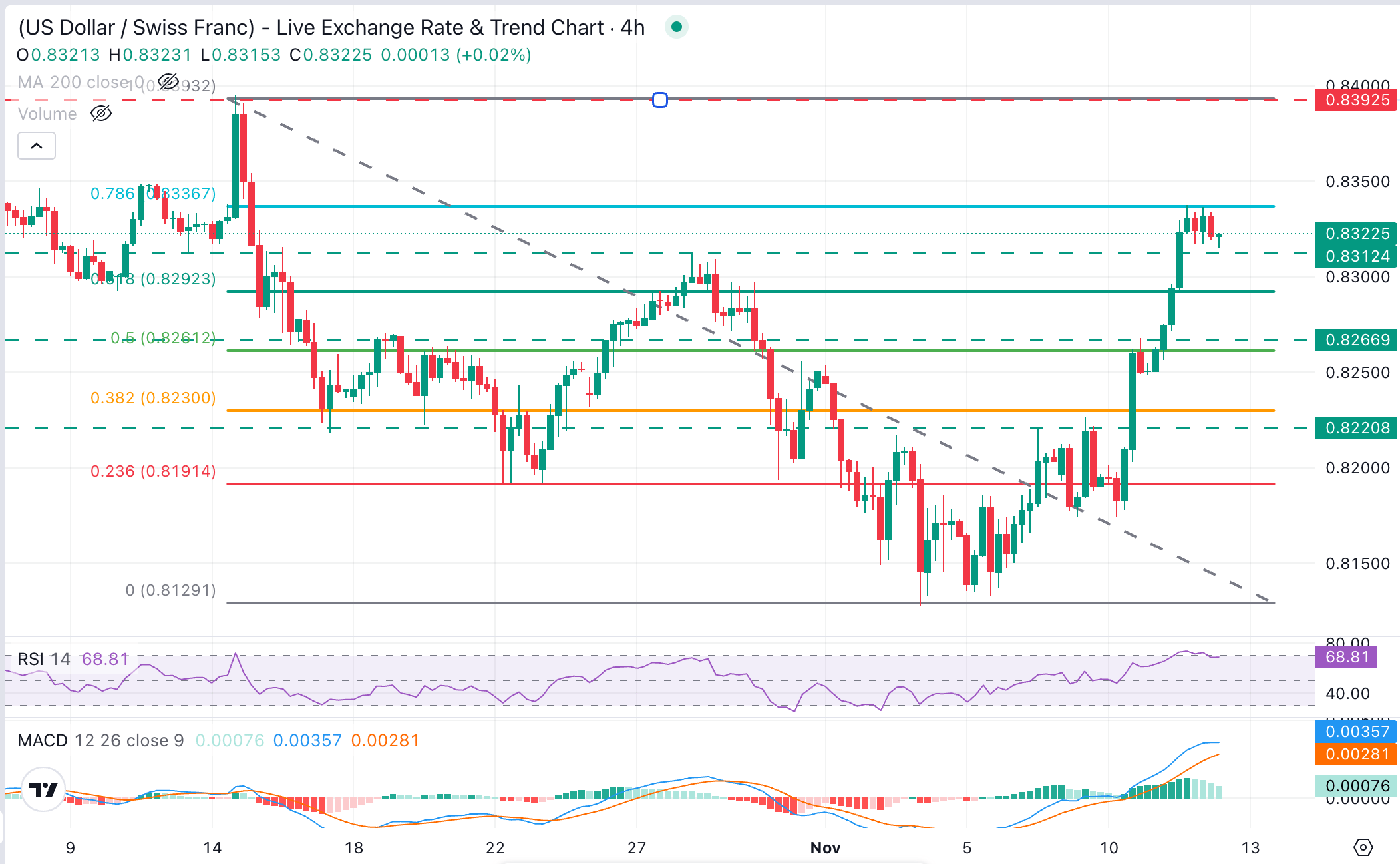
Bulls found resistance at the 78.6% Fibonacci retracement of the October-November rally, and the pair is now correcting lower from oversold levels, with dips likely to find buyers. The USD/CHF is now trading at 0.8322, with the 4-hour Relative Strength Index (14) hovering near 67, still close to overbought territory, and the Moving Average Convergence Divergence (MACD) in positive territory, which suggests that buying pressure is still present even as upside appears to be slowing.
Bears are struggling to push prices below the mentioned support area above 0.8310. Below here, the next relevant target is at the November 10 high, near 0.8270, although it seems a far-away level for today. On the topside, a confirmation above the mentioned Fibonacci retracement of 0.8337 would expose a key resistance at the October 14 high at 0.8395,
(The technical analysis of this story was written with the help of an AI tool. Know more.)
US Dollar Price Today
The table below shows the percentage change of US Dollar (USD) against listed major currencies today. US Dollar was the strongest against the Australian Dollar.
| USD | EUR | GBP | JPY | CAD | AUD | NZD | CHF | |
|---|---|---|---|---|---|---|---|---|
| USD | -0.03% | 0.00% | -0.11% | 0.02% | 0.34% | 0.09% | -0.11% | |
| EUR | 0.03% | 0.04% | -0.07% | 0.04% | 0.38% | 0.10% | -0.09% | |
| GBP | -0.01% | -0.04% | -0.11% | 0.04% | 0.34% | 0.05% | -0.13% | |
| JPY | 0.11% | 0.07% | 0.11% | 0.12% | 0.45% | 0.18% | -0.00% | |
| CAD | -0.02% | -0.04% | -0.04% | -0.12% | 0.33% | 0.06% | -0.13% | |
| AUD | -0.34% | -0.38% | -0.34% | -0.45% | -0.33% | -0.25% | -0.45% | |
| NZD | -0.09% | -0.10% | -0.05% | -0.18% | -0.06% | 0.25% | -0.17% | |
| CHF | 0.11% | 0.09% | 0.13% | 0.00% | 0.13% | 0.45% | 0.17% |
The heat map shows percentage changes of major currencies against each other. The base currency is picked from the left column, while the quote currency is picked from the top row. For example, if you pick the US Dollar from the left column and move along the horizontal line to the Japanese Yen, the percentage change displayed in the box will represent USD (base)/JPY (quote).
Author

Guillermo Alcala
FXStreet
Graduated in Communication Sciences at the Universidad del Pais Vasco and Universiteit van Amsterdam, Guillermo has been working as financial news editor and copywriter in diverse Forex-related firms, like FXStreet and Kantox.