USD/CAD Price Forecast: Trades subduedly near 1.3900 ahead of US-Canada employment data
- USD/CAD ticks lower to near 1.3900 in countdown to the US-Canada labor market data.
- The US and Canada’s Unemployment Rate is expected to have remained steady at 4.3% and 6.9%, respectively.
- Upward-sloping 20-day EMA suggests that the near-term trend is bullish.

The USD/CAD pair trades marginally lower at around 1.3900 during the European trading session on Friday. The Loonie pair is expected to trade with caution in the countdown to the United States (US)-Canada labor market data for May, which will be published at 12:30 GMT.
Investors will pay close attention to the US-Canada employment data to get fresh cues regarding the Federal Reserve (Fed) and the Bank of Canada’s monetary policy outlook.
The US Nonfarm Payrolls (NFP) report is expected to show that the economy created 85K fresh jobs, lower than 115K in April. The Unemployment Rate is seen remaining steady at 4.3%.
Meanwhile, Canada’s job report will likely show that employers hired 10K job-seekers after firing 17.7K workers in April. The Unemployment Rate is seen unchanged at 6.9%.
On the geopolitical front, conflicts between Israel and Lebanon remain continued despite US-brokered ceasefire, a scenario that could boost oil prices.
USD/CAD technical analysis
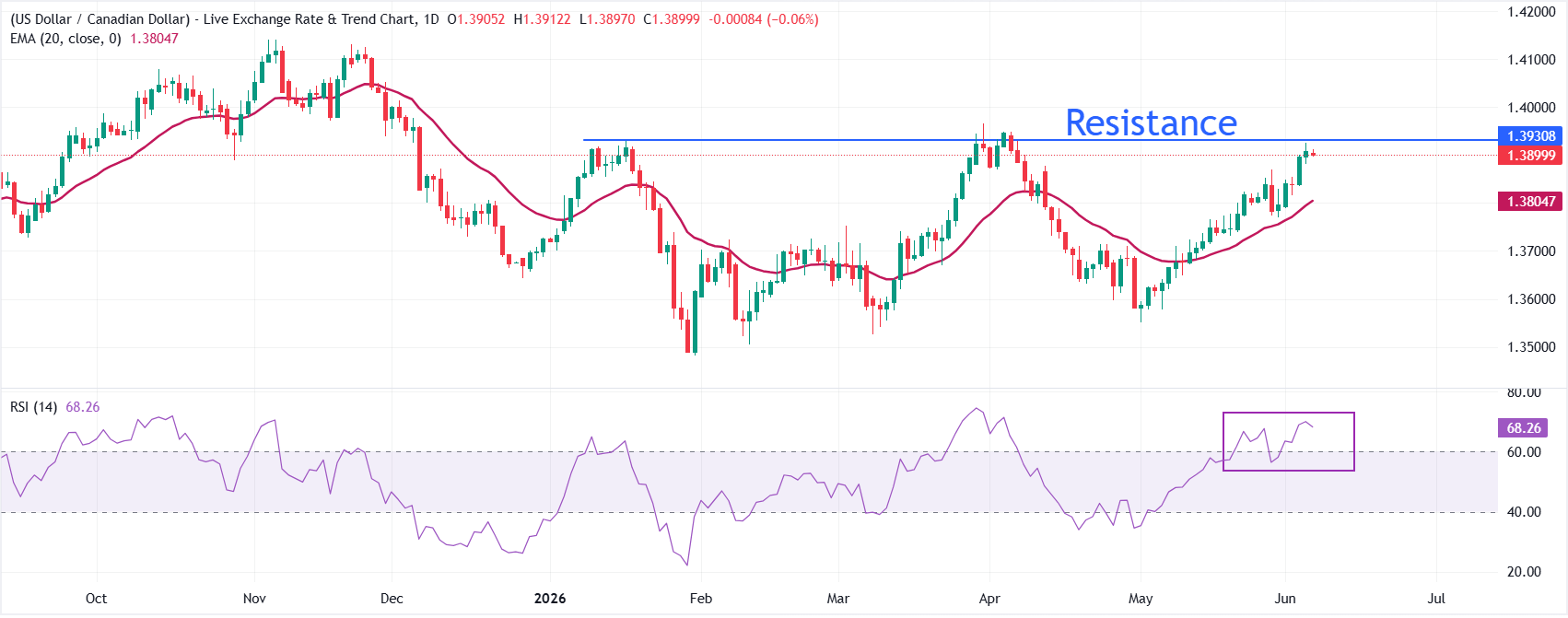
USD/CAD trades marginally lower at around 1.3900 at press time; however, the near-term trend is bullish as it trades above the 20-day Exponential Moving Average (EMA). which is at 1.3805
The RSI(14) hovers around 68, signaling strong but not yet extreme upside momentum that could sustain further gains while leaving room for a brief pause or consolidation phase.
On the topside, the immediate focus is on the March 31 high at 1.3967, which could act as key barrier for the US Dollar bulls. The pair could extend its advance towards 1.4000 if it manages to break above 1.3967. Looking down, the 20-day EMA will be the key support zone.
(The technical analysis of this story was written with the help of an AI tool.)
Employment FAQs
Labor market conditions are a key element to assess the health of an economy and thus a key driver for currency valuation. High employment, or low unemployment, has positive implications for consumer spending and thus economic growth, boosting the value of the local currency. Moreover, a very tight labor market – a situation in which there is a shortage of workers to fill open positions – can also have implications on inflation levels and thus monetary policy as low labor supply and high demand leads to higher wages.
The pace at which salaries are growing in an economy is key for policymakers. High wage growth means that households have more money to spend, usually leading to price increases in consumer goods. In contrast to more volatile sources of inflation such as energy prices, wage growth is seen as a key component of underlying and persisting inflation as salary increases are unlikely to be undone. Central banks around the world pay close attention to wage growth data when deciding on monetary policy.
The weight that each central bank assigns to labor market conditions depends on its objectives. Some central banks explicitly have mandates related to the labor market beyond controlling inflation levels. The US Federal Reserve (Fed), for example, has the dual mandate of promoting maximum employment and stable prices. Meanwhile, the European Central Bank’s (ECB) sole mandate is to keep inflation under control. Still, and despite whatever mandates they have, labor market conditions are an important factor for policymakers given its significance as a gauge of the health of the economy and their direct relationship to inflation.
Author

Sagar Dua
FXStreet
Sagar Dua is associated with the financial markets from his college days. Along with pursuing post-graduation in Commerce in 2014, he started his markets training with chart analysis.

















