USD/CAD Price Forecast: Prepares for fresh rally above 1.3700
- USD/CAD rises to near 1.3695 as the US Dollar trades firmly against its peers.
- US President Trump said on Monday that the ceasefire with Iran is on “life support”.
- Investors await the US CPI data for fresh cues on the Federal Reserve’s (Fed) monetary policy outlook.


The USD/CAD pair trades 0.12% higher to near 1.3695 during the European trading session on Tuesday. The Loonie pair rises as the US Dollar (USD) outperforms its peers amid fears that the war between the United States (US) and Iran could resume due to the absence of a breakthrough in their negotiations.
As of writing, the US Dollar Index (DXY), which tracks the Greenback’s value against six major currencies, trades 0.3% higher to near 98.20.
On Monday, US President Donald Trump said that the counterproposal delivered by Iran against the one-page peace proposal was a “stupid proposal” and lacked Tehran’s decision on pursuing its nuclear ambitions. Trump added, “Ceasefire is on life support.”
Though the Canadian Dollar (CAD) underperforms the US Dollar (USD), the former trades firmly against its other peers as elevated oil prices have improved its appeal. Currencies from economies, such as Canada, which are net oil exporters, tend to outperform in a high oil price environment.
Later in the day, investors will focus on the US Consumer Price Index (CPI) data for April, which will be published at 12:30 GMT.
USD/CAD technical analysis
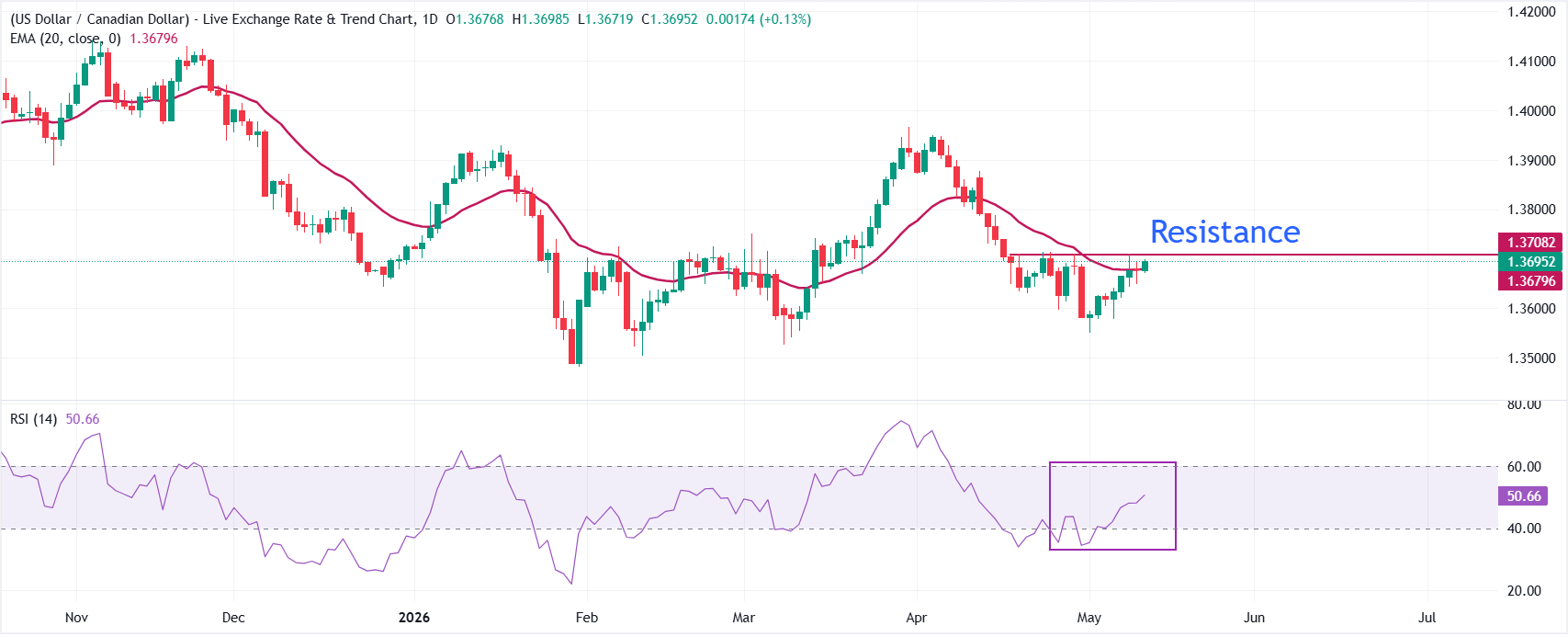
USD/CAD trades higher at around 1.3695 at the press time. The pair holds a slight bullish bias as it trades above the 20-day exponential moving average (EMA) at 1.3680, suggesting that near-term dips remain supported.
The Relative Strength Index (RSI) around 51 hints at neutral-to-firm momentum, indicating that buyers still have a modest edge while the pair consolidates near current levels.
Looking up, the pair could extend its advance towards the April 14 high at 1.3793 if it manages to hold above the April 24 high at 1.3715.
On the downside, the 20-day EMA at 1.3680 is the immediate support; a sustained break beneath that EMA would expose a deeper correction towards the May 7 low of 1.3620.
(The technical analysis of this story was written with the help of an AI tool.)
Canadian Dollar FAQs
The key factors driving the Canadian Dollar (CAD) are the level of interest rates set by the Bank of Canada (BoC), the price of Oil, Canada’s largest export, the health of its economy, inflation and the Trade Balance, which is the difference between the value of Canada’s exports versus its imports. Other factors include market sentiment – whether investors are taking on more risky assets (risk-on) or seeking safe-havens (risk-off) – with risk-on being CAD-positive. As its largest trading partner, the health of the US economy is also a key factor influencing the Canadian Dollar.
The Bank of Canada (BoC) has a significant influence on the Canadian Dollar by setting the level of interest rates that banks can lend to one another. This influences the level of interest rates for everyone. The main goal of the BoC is to maintain inflation at 1-3% by adjusting interest rates up or down. Relatively higher interest rates tend to be positive for the CAD. The Bank of Canada can also use quantitative easing and tightening to influence credit conditions, with the former CAD-negative and the latter CAD-positive.
The price of Oil is a key factor impacting the value of the Canadian Dollar. Petroleum is Canada’s biggest export, so Oil price tends to have an immediate impact on the CAD value. Generally, if Oil price rises CAD also goes up, as aggregate demand for the currency increases. The opposite is the case if the price of Oil falls. Higher Oil prices also tend to result in a greater likelihood of a positive Trade Balance, which is also supportive of the CAD.
While inflation had always traditionally been thought of as a negative factor for a currency since it lowers the value of money, the opposite has actually been the case in modern times with the relaxation of cross-border capital controls. Higher inflation tends to lead central banks to put up interest rates which attracts more capital inflows from global investors seeking a lucrative place to keep their money. This increases demand for the local currency, which in Canada’s case is the Canadian Dollar.
Macroeconomic data releases gauge the health of the economy and can have an impact on the Canadian Dollar. Indicators such as GDP, Manufacturing and Services PMIs, employment, and consumer sentiment surveys can all influence the direction of the CAD. A strong economy is good for the Canadian Dollar. Not only does it attract more foreign investment but it may encourage the Bank of Canada to put up interest rates, leading to a stronger currency. If economic data is weak, however, the CAD is likely to fall.
Author
Sagar Dua
FXStreet
Sagar Dua is associated with the financial markets from his college days. Along with pursuing post-graduation in Commerce in 2014, he started his markets training with chart analysis.