US equity markets are set to finish the week higher yet again

US equity markets are set to finish the week higher yet again. The second half of this week has seen a rotation from the new to the old. Investors have been taking profits on tech stocks following an historic run and a disappointing forecast from Broadcom, and shifting funds into more traditional and defensive sectors. As such, the Dow has outperformed the Nasdaq in the last two trading sessions. Headlines from the conflicts in the Middle East are having decreased market impact. The apparent lack of effective progress in negotiations and continuing military action have however pushed energy markets higher, WTI +6% to around $93 a barrel as reserves continue to be depleted around the world. The USD has also seen some support, as inflation concerns weigh on sentiment, DXY +0.5%. Metals meanwhile remain under pressure, gold down almost 2% on the week.
Elsewhere, while not an index widely available to retail traders, Korea's KOSPI has been firmly on the radar of late given its quite extraordinary moves. The index is down almost 5% today while other indices are relatively quiet. Now heavily weighted towards AI investments through its giant chipmakers, the gauge has becow generating real earnings.me something of a barometer for the AI sector.
And finally Nonfarm payrolls, released tonight, will be as important as ever. Signs of tightening in the US labour market will bring forward expectations of rate hikes. Consensus is at 85k jobs added in May, vs 115k in April.
Keep the kidneys, sell the Bitcoin?
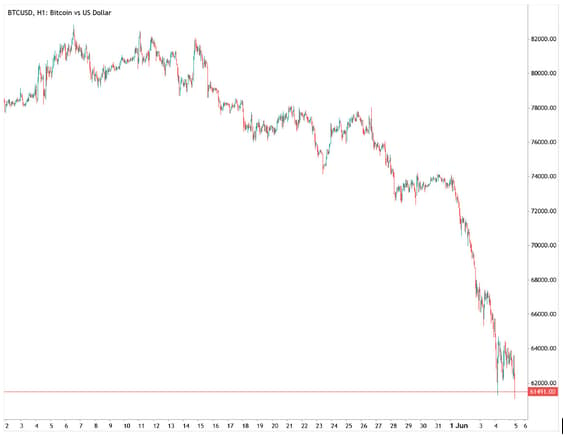
In the midst of a deepening rout in cryptos, Bitcoin is now down over 50% from its high in October 2025, and down around 15% this week alone. Monday saw the disclosure from Michael Saylor's Strategy Inc. that it had sold 32 Bitcoins, the proceeds of which will fund distributions on the company's preferred stock. It was far from a market-moving sized block in isolation, especially relative to the firm's treasury of approx. 844k Bitcoins. But for the world's most prominent crypto bull, who famously advised followers to "sell a kidney if you must, but keep the Bitcoin" as part of his firm never-sell stance, it was a symbolic move nonetheless. A move that has further damaged increasingly fragile sentiment in the space.
Bitcoin ETFs have seen record outflows in the last two weeks, further fueling the slide. On top of these evident and obvious catalysts, should we be asking too if cryptocurrencies have simply become relatively boring of late? When cryptos were flying, there were few persuasive alternatives for investors, a TINA effect of sorts for a certain risk-seeking segment of traders. Now though, along with higher interest rates, there are a number of other compelling options offering the possibility of high returns: e.g. commodity markets that have come alive and their related assets; and of course the inescapable AI sector that is now generating real earnings.
Willing and abel
The highly anticipated first real moves made by incoming Berkshire Hathaway CEO Greb Abel were revealed this week. Two purchases from their record pile of cash were disclosed, and both were distinct departures from the style of his predecessor. The first acquisition, Taylor Morrison Home Corp., was in fact reminiscent of a young Warren Buffett and his long-discarded "cigar-butt strategy". Where Buffett's offsider Munger was a strong proponent for "really wonderful businesses that we could buy at fair prices", their most famous illustration of which was likely Apple in 2016, this purchase was more an example of "so-so companies at very cheap prices".
The second and more headline-grabbing move was a $10 billion investment in Alphabet Inc., as part of an $80 billion placing to fund the Google parent's AI development. Again, with Alphabet trading at 25x earnings, and plunging into still largely untested technology, this was a signal to the market that Abel will be dancing to his own tune rather than mirroring the Oracle. More generally, Google's fundraising program, one of the largest equity deals of all time, was a clear reminder of just how capital-intensive the AI business is at the top end. The race to dominate is turning into an unprecedented spending spree. Alphabet’s shares dipped on the announcement but have sine recovered.
SpaceX
The rocket-ship/AI/internet juggernaut is due to launch on the Nasdaq on 12 June. The impending IPO is significant in varied ways. It stands as a test of several prevailing themes, among others: AI sector exuberance, spending on hyperscale infrastructure, an acceptance of virtually unheard of multiples related to the fruition of possibilities in the distant future, and faith in the vision of a founder notorious for outsized promises. The estimated $500 million of fees generated for the banks involved is noteworthy in itself too. Two other AI giants, Anthropic and OpenAI, will also naturally be taking learnings while they plan for their own IPOs later this year. Last week SpaceX dropped its targeted valuation from $2 trillion to $1.8 trillion. Analysts at Morningstar this week undertook their own appraisal of the behemoth, attributing in conclusion a value of around $780 billion. They cited an overreliance on untested technology, such as orbital data centres, as a key factor in their eyebrow raising statement that "the company has been significantly overvalued". Believers or otherwise, retail traders eagerly await the addition of the stock to their chosen trading platforms.
Next week
May's CPI reading from the US will be closely watched, following last month's biggest jump in the reading in three years, as well as the split FOMC vote. Expectations are for another lift of 0.5%, taking the annual rate up to 4.2%. Anything higher will be a headwind for risk assets and support the USD, and vice versa. China will also release their inflation print on Wednesday, a key determinant in the reignition or otherwise of fiscal stimulus there. Thursday brings an interest rate decision from the ECB. They held steady last month, but a subsequent jump in inflation means that they are now expected to raise rates to curb price rises in the Eurozone. GameStop, Oracle and Adobe will release their quarterly earnings.
Author

Scott Redford
Fintrix Markets
Through his 14 years in the industry, Scott has managed risk for a number of the world's biggest brokers, including IG and Pepperstone.

















