US Dollar Index remains depressed below 95.00, looks to data, Fedspeak
- DXY appears under pressure in the area of recent lows sub-95.00.
- The dollar stays offered in the wake of US inflation figures.
- Weekly Claims, Producer Prices, Fedspeak next in the docket.

The US Dollar Index (DXY), which measures the greenback vs. a bundle of its main rival currencies, remains well on the defensive and drops further south of the 95.00 support.
US Dollar Index weaker post-CPI, looks to upcoming data, Fedspeak
The index loses ground for the third consecutive session on Thursday and accelerates losses below the 95.00 mark, always on the back of the improved sentiment in the risk-linked galaxy and the corrective downside in US yields.
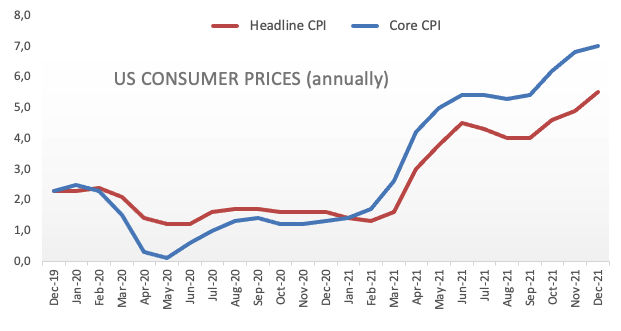
Indeed, the dollar’s selloff gathered steam after US headline inflation rose 7% in the year to December, level last seen back in 1982. Despite the high reading, the results fell in line with market expectations and underpinned the view that the Fed could initiate its normalization as soon as in March.
US yields, in the meantime, give away some gains so far on Thursday, although they remain largely near recent highs.
In the US calendar, the usual Initial Claims are due seconded by December Producer Prices. In addition, FOMC’s L.Brainard will testify before the Senate Banking Committee and Philly Fed P.Harker (2023 voter, hawkish) and Chicago Fed C.Evans (2023 voter, centrist) are due to speak later in the session.
What to look for around USD
The index lost the grip and dropped to new lows in the sub-95.00 area as market participants keep digesting the recent inflation figures amidst higher US yields and prospects of Fed’s tightening in March. On the supportive side for the greenback, Fed-speakers still point to a sooner-than-anticipated lift-off, the persistent elevated inflation, higher yields and the solid performance of the US economy.
Key events in the US this week: Initial Claims, FOMC L.Brainard Testimony, Producer Prices (Thursday) - Retail Sales, Industrial Production, Flash Consumer Sentiment, Business Inventories (Friday).
Eminent issues on the back boiler: Start of the Fed’s tightening cycle. US-China trade conflict under the Biden’s administration. Debt ceiling issue. Potential geopolitical effervescence vs. Russia and China.
US Dollar Index relevant levels
Now, the index is losing 0.25% at 94.74 and a break above 96.46 (weekly top Jan.4) would open the door to 96.90 (weekly high Dec.15) and finally 96.93 (2021 high Nov.24). On the flip side, the next down barrier emerges at 94.64 (100-day SMA) seconded by 93.27 (monthly low Oct.28 2021) and then 93.11 (200-day SMA).
Author

Pablo Piovano
FXStreet
Born and bred in Argentina, Pablo has been carrying on with his passion for FX markets and trading since his first college years.