|

US Dollar Index Price Forecast: Remains near 107.00, lower descending channel boundary

  • The US Dollar Index may find key support near the descending channel’s lower boundary at 106.30.
  • The 14-day RSI is below 50, signaling increasing bearish momentum.
  • The primary resistance appears at the nine-day EMA at 107.47

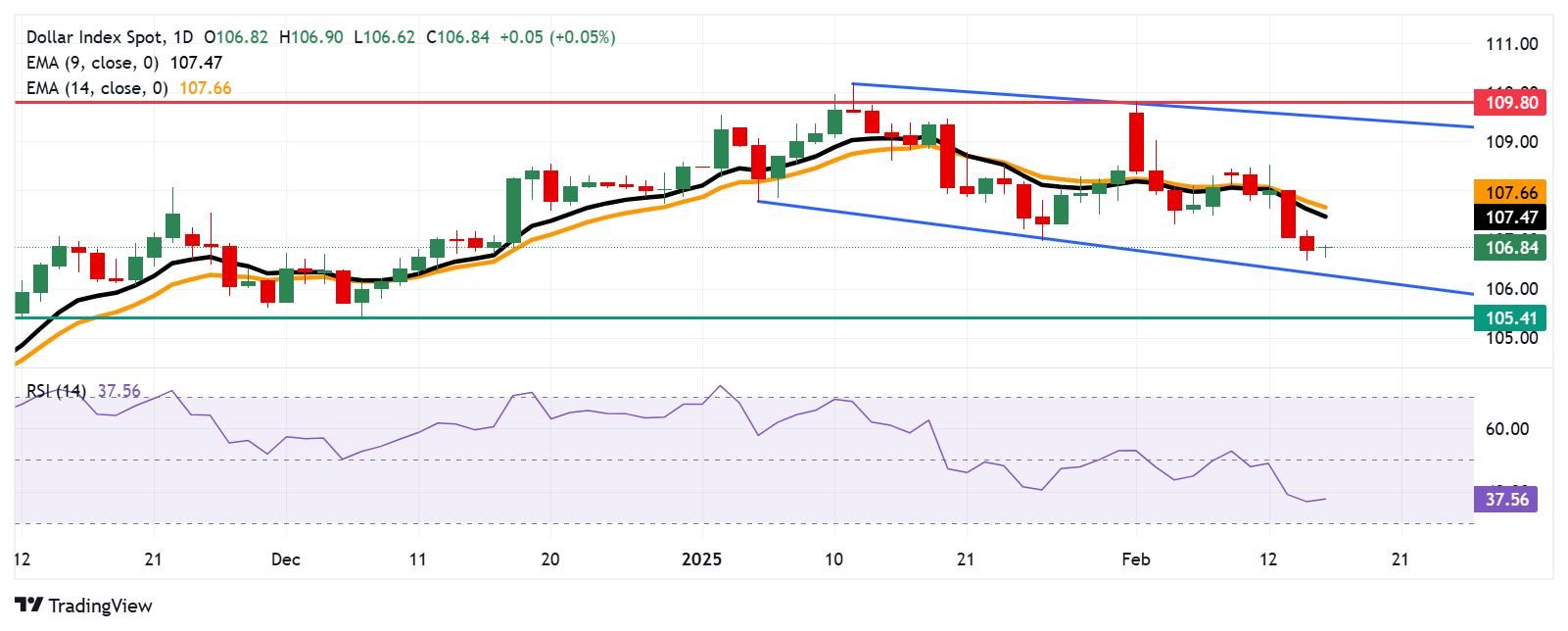
The US Dollar Index (DXY) edges higher after registering losses in the previous two consecutive sessions, trading around 106.90 during the European hours on Monday. A review of the daily chart suggests a prevailing bearish bias as the index consolidates within the descending channel pattern.

However, the 14-day Relative Strength Index (RSI) is positioned below the 50 level, indicating a strengthening bearish momentum. Furthermore, the US Dollar Index remains positioned below the nine- and 14-day Exponential Moving Averages (EMAs), confirming the short-term price momentum is weaker.

On the downside, the DXY could approach the lower boundary of the descending channel at 106.30 level, followed by the psychological level of 106.00. A break below this level could reinforce the bearish bias and put downward pressure on the index to test the three-month low at 105.41, which was recorded on December 6.

Regarding resistance, the DXY could find its primary resistance at nine-day EMA at 107.47, followed by 107.66. A decisive break above these levels would improve the short-term price momentum and support the pair to explore the region around the descending channel’s upper boundary at 109.50 level, followed by the five-week high of 109.80, last tested on February 3.

US Dollar Index: Daily Chart
Author

Akhtar Faruqui

Akhtar Faruqui is a Forex Analyst based in New Delhi, India. With a keen eye for market trends and a passion for dissecting complex financial dynamics, he is dedicated to delivering accurate and insightful Forex news and analysis.


More from Akhtar Faruqui
Share:

Editor's Picks

GBP/USD stays below 1.3400 after soft UK CPI data

GBP/USD struggles to gain traction and stays below 1.3400 in the second half of the day on Wednesday. The UK annual Consumer Price Index (CPI) inflation cooled to 2.6% in June against the market forecast of 2.7%, making it difficult for the British Pound gather recovery momentum. Meanwhile, investors keep a close eye on headlines coming out of the Middle East.

EUR/USD stabilizes near 1.1400 as markets focus on geopolitics

EUR/USD trades in a narrow channel at around 1.1400 on Wednesday. In the absence of high-impact data releases, escalating geopolitical tensions in the Middle East caps the pair's upside. On Thursday, the European Central Bank (ECB) will announce monetary policy decisions.

Gold extends rally as Middle East concerns intensify

Gold extends gains for the fourth consecutive day, standing comfortably above $4,100, unfazed by the risk-off market amid rising tensions in Iran and higher Oil prices. The pair has rallied nearly 2.5% so far this week and is on track for its best weekly performance in more than three months.

XRP consolidates as inflows and volume climb
Ripple (XRP) retains a slightly bullish outlook on Wednesday despite logging a minor correction from the supply range near $1.15. The remittance token is down 0.5% on the day, reflecting a broader cryptocurrency market drawdown, primarily driven by persistent geopolitical tensions between the United States (US) and Iran in the Middle East.
US – Fed preview: A divided hold
The first month after Kevin Warsh's debut at the FOMC's June meeting has brought mixed signals on the inflation front. On one hand, the re-escalation of the war in Iran has lifted energy prices higher again. Yet on the other hand, Warsh's hawkish comments have already lifted real rates, supported broad USD and tightened financial conditions while realized inflation surprised to the downside in June.
US Dollar mid-year outlook: Exceptional currency, exceptional risks?
The US Dollar enters the second half of 2026 in a markedly different position from a year ago. The King currency has recovered, reflecting persistent US inflation, changing expectations for Fed policy, geopolitical tensions and renewed demand for defensive assets.