US Dollar does not move away in easy Monday
- The US Dollar is flat to marginally gaining against most major peers.
- All eyes are on the US inflation print for July being released on Wednesday.
- The US Dollar index resides near a key level, and a substantial move could be seen later this week.

The US Dollar (USD) has a soft opening this week, with no real outliers on the quote board on Monday. Traders are taking a clean sheet and have deemed last week’s events as water under the bridge. All eyes will be on the US Consumer Price Index (CPI) for July, which is scheduled for Wednesday.
On the economic data front, it is a calm start to the week, with the US Treasury heading back to markets to auction some shorter-term bills. As such, it is nothing special, though with yields having moved quite a lot last week, traders and markets will be cautious if the bond market hits that snapping point when prices could collapse again. Besides the US CPI, the US Retail Sales data for July scheduled for Thursday will be the last important data point this week.
Daily digest market movers: Sit on your hands
- Although the week has started very calmly, the US Dollar is stronger by 0.5% against the Korean Won (KRW) and the Japanese Yen (JPY) in early European trading.
- Bloomberg reports that in a column on Friday, the People’s Bank of China (PBoC) reported that the PBoC will keep a close eye on the potential rate cuts from the US Federal Reserve (Fed) and will act accordingly to keep the Yuan (CNY) stable against the US Dollar (USD). That could mean substantial devaluations for the CNY once the US Dollar devalues on the back of interest rate cuts from the Fed in order to catch up on the move.
- At 15:30 GMT, the US Treasury will allocate a 3-month and a 6-month bill.
- The US Monthly Budget Statement for July is expected at 18:00 GMT. Expectations are for a deficit of $254.3 billion, coming from a $66 billion deficit.
- Equity markets are going for a calm start to the week. Most major indices are in the green by less than 0.5%.
- The CME Fedwatch Tool shows a 53.5% chance of a 25 basis points (bps) interest rate cut by the Fed in September against a 46.5% chance for a 50 bps. Another 25 bps cut (if September is a 25 bps cut) is expected in November by 42.1%, while a 48.0% chance for a 50 bps cut and 9.9% for a triple rate cut are being pencilled in for that meeting.
- The US 10-year benchmark rate trades at 3.93% after popping above 4.00% briefly on Thursday.
US Dollar Index Technical Analysis: Calmness before the storm
The US Dollar Index (DXY) is still trading at that key level since last week, when itwas unable to close above it and continue its recovery. Everything will now depend on the inflation report on Wednesday to move the needle forward. Either the report is disinflationary, and the US Dollar eases further, or there is a pickup in inflation and September starts to look doubtful for an initial interest rate cut.
Still, the first level to recover, which gains importance every day, is 103.18, a level held on August 2 though snapped on August 5 in the Asian hours. Once the DXY closes above that level, next up is 104.00, which was the support from June. If the DXY can return above that level, the 200-day Simple Moving Average (SMA) at 104.15 is the next resistance to look out for.
On the downside, the oversold condition in the Relative Strength Index (RSI) indicator has eased in the daily chart and holds room again for a small leg lower. Support nearby is the March 8 low at 102.35. Once through there, pressure will start to build on 102.00 as a big psychological figure before testing 101.90, which was a pivotal level in December 2023 and January 2024.
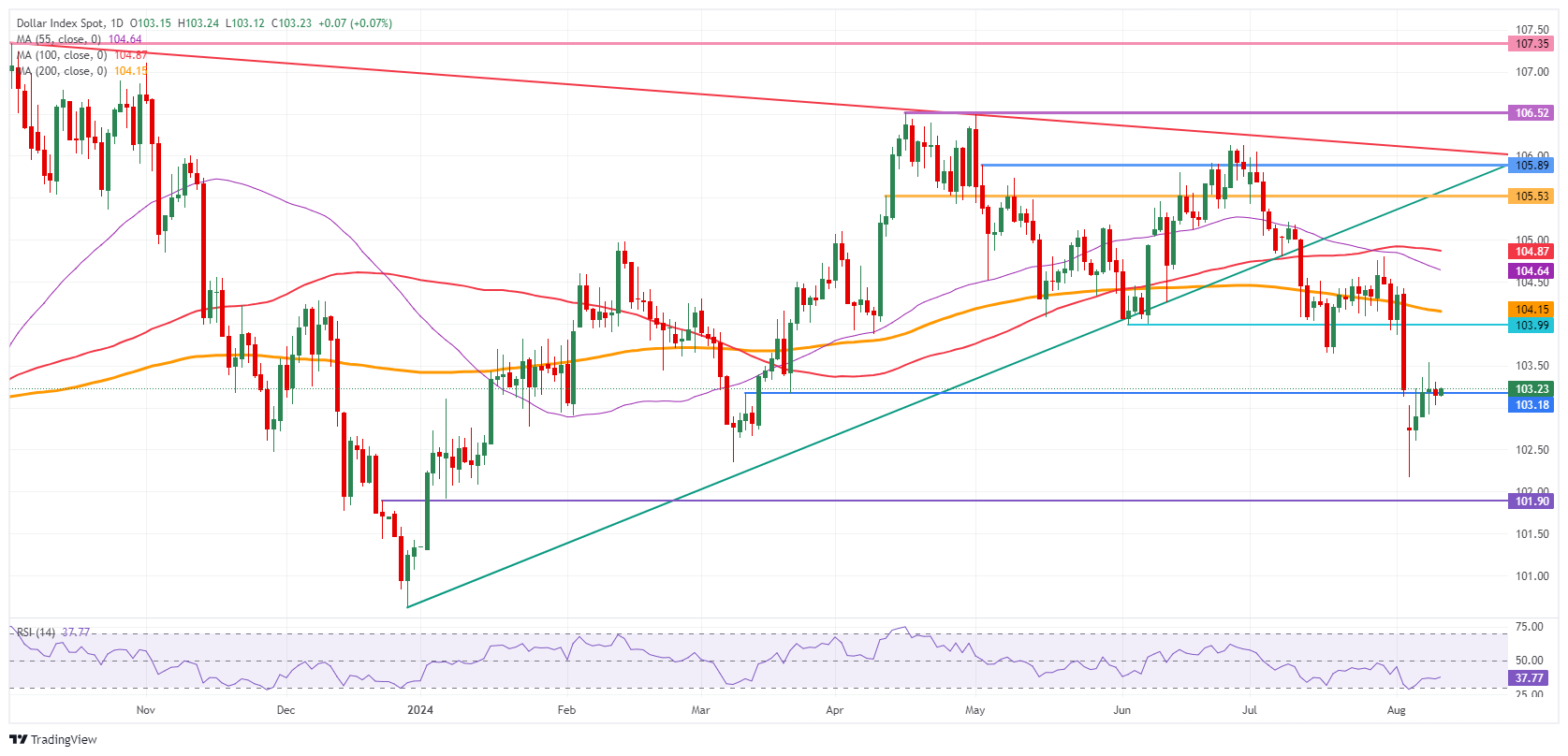
US Dollar Index: Daily Chart
ECB FAQs
The European Central Bank (ECB) in Frankfurt, Germany, is the reserve bank for the Eurozone. The ECB sets interest rates and manages monetary policy for the region. The ECB primary mandate is to maintain price stability, which means keeping inflation at around 2%. Its primary tool for achieving this is by raising or lowering interest rates. Relatively high interest rates will usually result in a stronger Euro and vice versa. The ECB Governing Council makes monetary policy decisions at meetings held eight times a year. Decisions are made by heads of the Eurozone national banks and six permanent members, including the President of the ECB, Christine Lagarde.
In extreme situations, the European Central Bank can enact a policy tool called Quantitative Easing. QE is the process by which the ECB prints Euros and uses them to buy assets – usually government or corporate bonds – from banks and other financial institutions. QE usually results in a weaker Euro. QE is a last resort when simply lowering interest rates is unlikely to achieve the objective of price stability. The ECB used it during the Great Financial Crisis in 2009-11, in 2015 when inflation remained stubbornly low, as well as during the covid pandemic.
Quantitative tightening (QT) is the reverse of QE. It is undertaken after QE when an economic recovery is underway and inflation starts rising. Whilst in QE the European Central Bank (ECB) purchases government and corporate bonds from financial institutions to provide them with liquidity, in QT the ECB stops buying more bonds, and stops reinvesting the principal maturing on the bonds it already holds. It is usually positive (or bullish) for the Euro.
Author

Filip Lagaart
FXStreet
Filip Lagaart is a former sales/trader with over 15 years of financial markets expertise under its belt.

















