TSM (Taiwan Semiconductor): $700 Within the grand super cycle

Strategic Importance Taiwan Semiconductor Manufacturing Company (TSMC), traded under the ticker TSM, holds one of the most critical positions in the global technology industry. While companies like NVIDIA, Apple, and AMD design chips, TSMC manufactures the advanced semiconductors that power their products. This makes TSMC not just a chipmaker, but a core infrastructure provider for AI, cloud computing, smartphones, high‑performance computing, automotive electronics, and more.
Business Model TSMC operates as a pure‑play foundry, focusing on producing chips designed by other companies. This model allows tech giants to concentrate on architecture and product development without building their own fabrication plants. Manufacturing leading‑edge chips is capital‑intensive and technically complex, and only a handful of companies worldwide can do it at scale. TSMC has established itself as the leader by consistently delivering advanced processes, strong yields, and reliable execution.
Competitive Advantage TSMC’s edge lies in its technological leadership. As chips shrink, transistor density rises, making manufacturing exponentially harder. TSMC has repeatedly transitioned customers to newer nodes while maintaining viable yields — a critical capability for AI and HPC processors. Its moat is reinforced by:
- Decades of technical expertise.
- Long‑term relationships with top chip designers.
- Heavy capital investment in advanced nodes.
- Scale advantages across R&D and procurement.
- A robust ecosystem of partners.
- High switching costs for customers.
AI as a Growth Driver Artificial intelligence is now one of TSMC’s most powerful growth engines. AI data centers require GPUs, custom accelerators, CPUs, networking chips, and advanced memory — nearly all dependent on TSMC’s leading‑edge manufacturing. Regardless of which chip designer dominates, TSMC benefits as the “picks and shovels” provider to the AI boom.
Advanced Packaging Beyond transistor scaling, advanced packaging has become essential for performance. By integrating multiple components into a single system, packaging improves speed, efficiency, and energy use. TSMC’s investment here adds another competitive advantage and revenue stream, positioning it at the center of next‑gen computing architecture.
Financial Strength & CapEx TSMC’s model requires massive capital expenditures to stay at the frontier. While this can pressure free cash flow, it builds capacity for future growth. Investors must watch whether spending aligns with sustainable demand. Historically, TSMC has balanced margins, pricing power, and customer relationships to fund innovation while maintaining profitability.
Geographic Diversification TSMC is expanding outside Taiwan — into the U.S., Japan, and other regions — to reduce supply‑chain risk and strengthen government ties. However, overseas fabs are more expensive, requiring careful balance between diversification and efficiency.
Risks Despite its dominance, TSMC faces:
- Geopolitical uncertainty around Taiwan.
- Cyclical demand in semiconductors.
- Customer concentration risk.
- Rising competition from Samsung and Intel.
- Manufacturing cost pressures and yield risks.
- Export restrictions and trade tensions.
Valuation & Outlook TSMC should be valued not just as a cyclical chipmaker but as a high‑quality infrastructure leader in AI and advanced computing. Still, valuation must be weighed against earnings growth, CapEx, free cash flow, and geopolitical risk.
Long‑term fundamental outlook
The long‑term outlook for TSMC remains closely tied to the relentless expansion of global computing demand. Artificial intelligence, cloud infrastructure, advanced smartphones, autonomous vehicles, robotics, industrial automation, and connected devices will all require increasingly powerful semiconductors.
TSMC is uniquely positioned to capture this growth. Its scale, engineering expertise, manufacturing reliability, and deep relationships with leading chip designers provide a durable competitive advantage. These strengths ensure that TSMC remains at the center of next‑generation computing architecture.
That said, risks cannot be ignored. Geopolitical uncertainty surrounding Taiwan, the cyclical nature of semiconductors, high capital expenditures, and intensifying competition from rivals like Samsung and Intel must remain central to any investment analysis.
Nevertheless, TSMC represents one of the clearest ways to gain exposure to the physical infrastructure behind artificial intelligence. As long as demand for computing power and advanced processors continues to rise, TSMC is likely to remain one of the most strategically important companies in the global technology ecosystem.
From a fundamental perspective, TSMC stands out as a high‑quality semiconductor leader with direct exposure to AI and high‑performance computing. The key question now is whether the technical structure supports further upside or signals a larger correction before the next major opportunity.
Elliott Wave technical outlook
Bullish Base Case (Wave (III)) TSMC is currently trading within a powerful wave (III) advance. This structure suggests the stock could reach the $700 area within the next few years, depending on the broader path of global indices. Analysts expect world indices to enter one of the strongest accelerations ever seen, which could create a “nest” formation in TSM and fuel further upside momentum.
Less Bullish Scenario In a more conservative view, TSM is completing wave ((5)) of the current cycle. Once this wave ends, the stock may enter wave (IV) before resuming higher in wave (V). This path still supports upside, but with corrective pauses along the way.
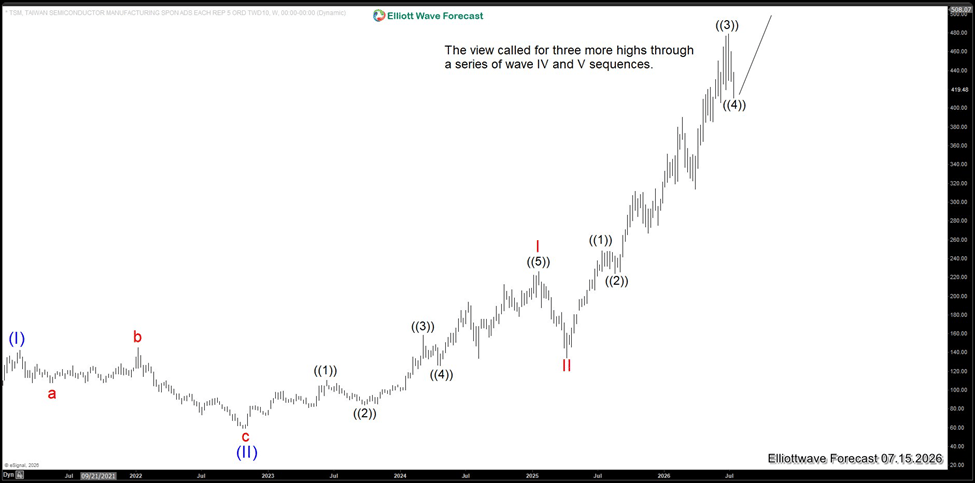
More Bullish Scenario An alternative, highly bullish view sees TSM advancing toward the $550–$600 area in the near term, while forming a quadruple nest since March 27, 2026. This structure could trigger the biggest acceleration into wave (3), supported by strength in global indices, Tesla, Copper, and other markets. Though aggressive, this scenario remains realistic and highlights the potential for explosive upside.
Author

Elliott Wave Forecast Team
ElliottWave-Forecast.com