Transocean’s stock is a strong buy, given the recent news

In my view, Transocean (RIG) is one of the most undervalued companies in the offshore space and the oil industry in general. To support my bullish thesis, I'll make a few assumptions: a bright future for offshore drilling, relatively stable economic conditions, and sustainably high oil prices.
Transocean has recently announced several strong contracts, including those with Equinor (EQNR), and, most importantly, it is actively deleveraging its balance sheet. Despite the recent oil price spike caused by the unprecedented situation in the Middle East, Transocean’s stock is not appreciating as much as other oil majors’.
New contracts
According to Welligence Energy Analytics, Transocean’s contract backlog will increase significantly thanks to its merger with Valaris (VAL). Thanks to this merger, Transocean would become by far the largest company in the offshore drilling industry, also in terms of its backlog. However, the company’s merger with Valaris is not complete yet. But still, Transocean has been announcing new contracts before Valaris’ backlog has officially become Transocean’s.
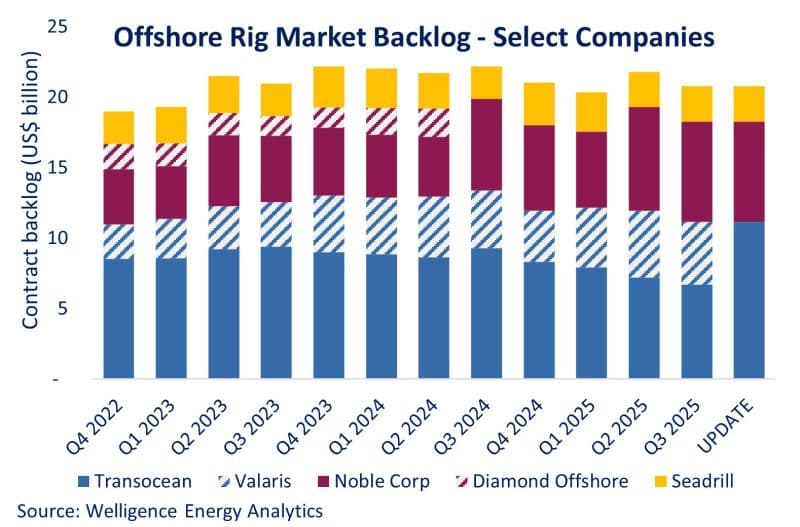
Here is a summary of the recently announced contracts.
In short, Transocean’s newly announced Gulf of Mexico contracts are worth $550 million. One was a $325 million, 700-day agreement for Deepwater Proteus at a day rate of about $464,000, and another was a $225 million, 450-day contract for Deepwater Conqueror at a day rate of around $500,000. Recent North Sea announcements also totaled $1.1 billion, including a contract with Norske Shell worth $62 million for 120 days of work at a day rate of about $517,000. The previously announced Equinor contract was formally confirmed and added $1 billion in backlog.
The recently announced contracts fit in well with Transocean management’s cash flow projections. Moreover, these new commitments prove the tight supply of ultra-deepwater drillships in the offshore industry. True, to keep the demand for offshore drilling services high, it is necessary for oil prices to stay high for a long time. However, nowadays energy security seems to be a serious concern, given the situation in the Middle East. It would be even easier for Transocean to take advantage of this thanks to the company’s acquisition of Valaris, announced in February 2026. Apart from the acquired backlog, RIG would also strengthen its fleet, which will make it easier for the company to sign even more new contracts. I will go into more detail about the Valaris deal later in this article.
Transocean’s deleveraging
The diagram below, borrowed from Moram Capital, shows Transocean’s net debt/EBITDA ratio history. The company’s earnings before interest, taxes, depreciation, and amortization are rising, thus increasing its free cash flows, while Transocean’s debt is falling.
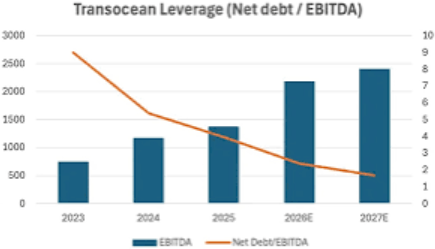
Source: Moram Capital
Transocean’s improving financial health has prompted credit rating agencies, namely S&P Global and Moody’s, to increase its credit rating.
S&P Global increased its credit rating from CCC+ to B-. Although it is still below investment grade, the agency recognizes Transocean’s improving financial discipline. Also, according to Moody’s, “debt reduction supports upgrade to B2; pending acquisition of Valaris will enhance scale.” This means that rising backlog and sales revenues would also improve the offshore driller’s financial profile.
Moreover, earlier this month the offshore driller fully retired the 8.00% “Aquila Notes”. The outstanding principal totaled $165 million, while the company decreased its interest expenses by approximately $22 million. This is just the most recent example of Transocean’s deleveraging. As you could see from the information above, the offshore driller’s management is improving Transocean’s balance sheet while also decreasing its interest expenses.
Valaris deal
The Valaris deal is pending approval. Both Transocean and Valaris are to vote on November 24. All the formal authorizations from national governments of countries the company operates in have already been received. It is expected that in the first half of December this year, Valaris will stop existing.
Transocean’s acquisition of Valaris will make Transocean the leading player in the market, reshaping the offshore drilling industry’s structure. As I have mentioned above, the offshore market for deepwater and ultra-deepwater drillships is very tight. The deal will consolidate ownership of the offshore drilling fleet. As a result, the combined company will become a clear player in the offshore drilling industry. According to Investing.com, Transocean-Valaris's market share will total 39.7%, ahead of key rivals like Noble (24.1%), Seadrill (8.6%), and Stena (8.6%). The combined company would control all of the active 8th-generation drillship fleet, a substantial share of global seventh-generation drillships, 9 semisubmersibles, and 31 jackups received from Valaris. Obviously, the integration with Valaris would mean even more market power for Transocean.
The transaction also leads to positive balance sheet implications because Valaris is almost free of debt. That is why Transocean’s financial profile would materially improve, which would further improve the company’s credit rating and ameliorate its borrowing conditions. As Yahoo Finance reported, the company expects its leverage ratio to decline to about 1.5 times within 2 years after the acquisition closes.
Upside factors
Among the upside factors is the prolonged oil deficit due to the political situation in the Middle East. But it has to be long-term. Despite the oil price surge, oil majors seem to be cautious about massively committing capital to offshore drilling projects right now. For now, they seem to be focusing on maximizing their cash flows and shareholder returns. However, if oil prices stay high for a long time, then it would make even more sense to sign new contracts with offshore drillers like Transocean. Thanks to the Valaris deal, Transocean’s fleet would increase, thus allowing the company to take advantage of the situation, which would obviously improve its financial fundamentals further. The company is actively deleveraging. If this trend continues, the offshore driller would finally end its survival mode in which it has operated since 2014-2015, when the US shale oil drillers substantially raised their output.
Downside risks
The main risk I personally see is that of a recession. It could be provoked by central banks' monetary tightening. Oil companies, especially the indebted ones like Transocean, are at significant risk. Because offshore drilling projects require long-term commitments, the industry’s business activity level does not fall immediately after there is an oil price correction. Despite that, Transocean’s stock is highly volatile. This means that investors might experience paper losses, at least in the short term.
Then, the situation in the Middle East may stabilize, which would be bearish for oil and therefore Transocean’s shares. However, right now it seems that the war between the Houthis and Saudi Arabia is here to stay. Also, it seems to me that the conflict between Iran and Israel will stay unresolved for a long time. If I am right, then oil prices will be higher in the long term, which is obviously bullish for Transocean.
Conclusion
In my view, Transocean’s stock has excellent growth potential thanks to the pending Valaris deal, its deleveraging story, new contract announcements, and the geopolitical situation in the Middle East. Although I am aware of the company’s relatively high debt and the stock’s volatility, I think these factors could significantly increase investors’ profit potential if the offshore industry recovers.
Author

Anna Sokolidou
Independent Analyst
A research analyst, a freelance finance writer and an economics teacher looking for interesting investment opportunities. I have been investing for years. I am mostly interested in writing about commodities, precious metals and large corporations.