The softest US inflation print in six years buys British Pound Sterling about four hours
- GBP/USD trades just beneath the 1.3400 handle, surrendering the whole of a CPI spike that stalled ahead of 1.3450.
- US inflation fell 0.4% MoM in June, the largest monthly decline since April 2020, and the Fed Chair still refused to declare victory.
- The 200-day EMA caps the recovery for a second straight week while Thursday's UK growth data threatens the Sterling side of the ledger.

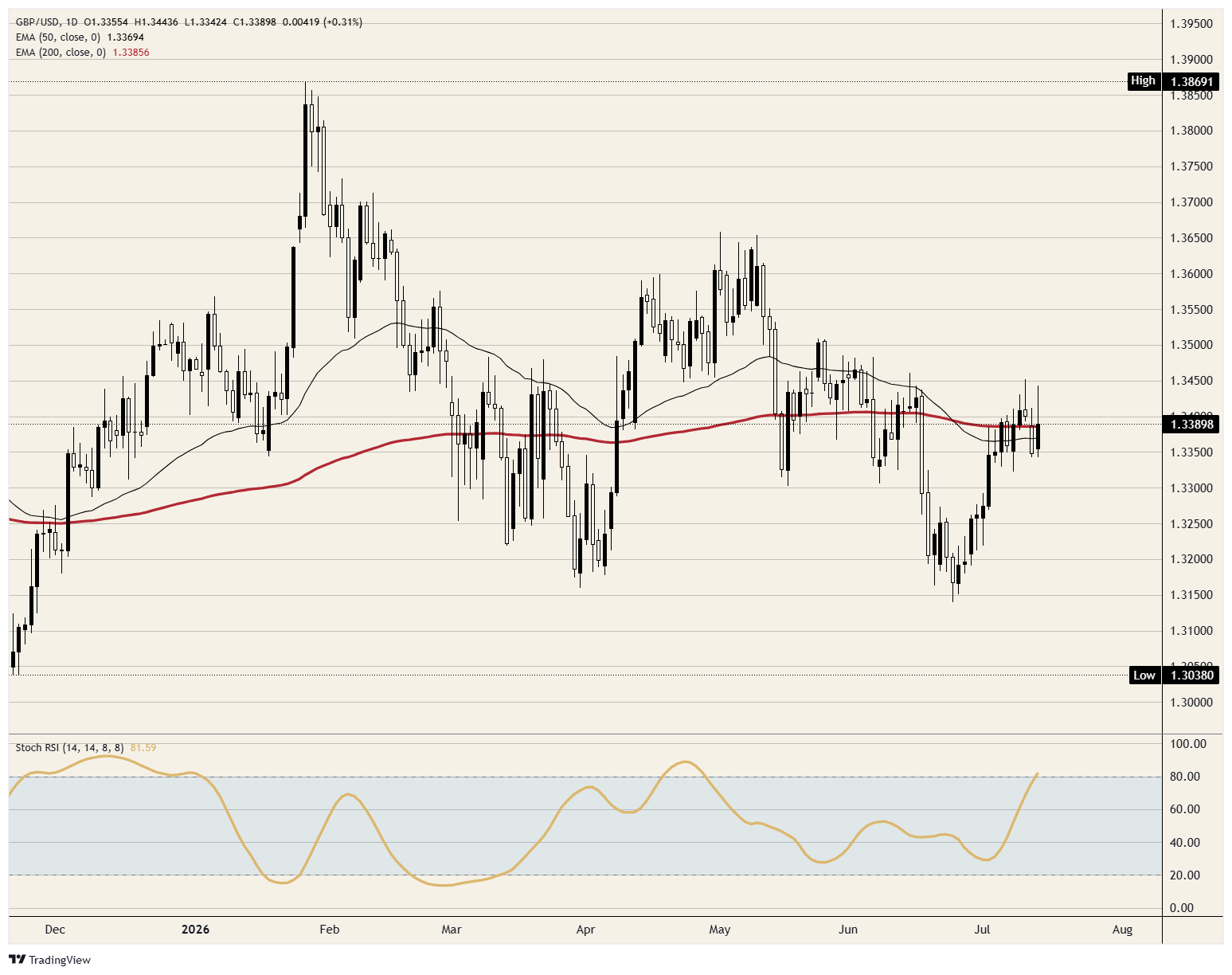
Cable trades just beneath the 1.3400 handle late in Tuesday's session, pinned under a 200-day Exponential Moving Average (EMA) that sits a few pips shy of the figure and has capped every recovery attempt for two weeks. The softest US inflation report in six years landed at 12:30 GMT; the pair spiked to within a few pips of 1.3450 and has since handed the entire move back.
Tuesday's rejection carries more weight than one headline normally earns: the bounce from early July's trough near 1.3150 has run directly into the falling 200-day average, the daily Stochastic Relative Strength Index is stretched above 80, and Sterling must now explain why the best inflation news the Dollar could hand it was worth roughly four hours of gains.
A deflation print bought by a ceasefire that no longer exists
June's Consumer Price Index (CPI) fell 0.4% on the month, the largest monthly decline since April 2020, dragging the annual rate to 3.5% from May's 4.2%. The core measure printed flat against a 0.2% consensus and eased to 2.6% YoY. The engine was energy: gasoline slid 9.7% in June after the ceasefire signed last month knocked roughly a quarter off Crude Oil.
The catch, and the reason the move faded, is that the report is already a period piece. Washington and Tehran are trading strikes again, the Strait of Hormuz sits effectively shut behind a reimposed blockade, and Crude Oil has clawed back roughly 10% in July. Tightening bets that a weak 57K payrolls print washed out at the start of the month are being rebuilt while the strait stays dark.
The Fed Chair reached the same verdict across both of Tuesday's testimony slots (12:30 and 14:00 GMT), telling lawmakers that one good report proves nothing and recommitting to the 2% target. A sitting Fed Governor had already spent Monday promising to vote for an immediate hike if core misbehaved.
Rate futures took the hint without abandoning the plot: hold odds for this month's meeting jumped toward 86%, yet pricing still assigns roughly seven-in-ten odds to at least one hike by year-end and nothing to a cut. That mix pulled the Dollar off its lows and the Pound off its highs through the New York afternoon.
Sterling's home front offers no rescue
The Bank of England is running its own version of the same movie. Bank Rate has held at 3.75% since December; June's decision split 7-2, with two members demanding an immediate move to 4.00%. The Governor has spent the summer calling cuts off the table while July's 13% energy price cap increase works through household bills, and the Bank itself projects inflation, 2.8% now, back above 3.5% by year-end.
Tuesday evening layers politics on top: the Governor is using the Mansion House address (20:00 GMT) to press the incoming Burnham government on growth and fiscal discipline, a reminder that the Labour handover remains a background risk for Sterling rather than a resolved story. A currency this sensitive to risk appetite, with the Strait of Hormuz on every front page, does not get to rally durably on someone else's soft inflation data.
The rest of the week gets a vote
Wednesday's Producer Price Index (12:30 GMT) is the quiet threat: the core measure is seen accelerating to 5.2% YoY from 4.9%, which would tell Fed officials that pipeline pressure never received the ceasefire memo. The Fed Chair returns for a second day of testimony at 14:00 GMT, the Beige Book follows at 18:00 GMT, and the Bank of England's chief economist takes a turn at 10:30 GMT.
Thursday hands the microphone to the Pound briefly, with May's Gross Domestic Product print landing at 06:00 GMT against consensus of 0.1% growth after a 0.1% contraction; industrial and manufacturing production are forecast to shrink. US Retail Sales follow at 12:30 GMT, seen slowing to 0.2% MoM from 0.9% with the ex-autos reading at -0.1%. A limp UK number set against US demand that is cooling rather than cracking is the mix that has kept the pair beneath the 200-day EMA all month.
Friday caps the week with July's preliminary Michigan consumer sentiment at 14:00 GMT, forecast at 51 from 49.5, alongside the survey's one-year and five-year inflation-expectation reads. Fed speakers have made a habit of citing those series when arguing that a shut Hormuz can still un-anchor household price psychology, so a hot expectations number would complete the CPI unwind.
Technical levels
Resistance: The 200-day EMA a few pips beneath 1.3400 is the immediate ceiling, with Tuesday's rejection zone ahead of 1.3450 stacked behind it; the pair has no business discussing 1.3500 without a fresh catalyst.
Support: The 1.3350 region is first, where the intraday base and the 50-day EMA converge; below that sits 1.3300, with early July's trough near 1.3150 the last line of defence.
Bias: Lower. A pair that cannot clear its 200-day EMA on the best US inflation news since 2020, with the daily oscillator stretched above 80, is a pair waiting to be sold; the path of least resistance runs to 1.3350 and then 1.3300 unless buyers force a daily close above the average and through 1.3450.
GBP/USD daily chart
Pound Sterling FAQs
The Pound Sterling (GBP) is the oldest currency in the world (886 AD) and the official currency of the United Kingdom. It is the fourth most traded unit for foreign exchange (FX) in the world, accounting for 12% of all transactions, averaging $630 billion a day, according to 2022 data. Its key trading pairs are GBP/USD, also known as ‘Cable’, which accounts for 11% of FX, GBP/JPY, or the ‘Dragon’ as it is known by traders (3%), and EUR/GBP (2%). The Pound Sterling is issued by the Bank of England (BoE).
The single most important factor influencing the value of the Pound Sterling is monetary policy decided by the Bank of England. The BoE bases its decisions on whether it has achieved its primary goal of “price stability” – a steady inflation rate of around 2%. Its primary tool for achieving this is the adjustment of interest rates. When inflation is too high, the BoE will try to rein it in by raising interest rates, making it more expensive for people and businesses to access credit. This is generally positive for GBP, as higher interest rates make the UK a more attractive place for global investors to park their money. When inflation falls too low it is a sign economic growth is slowing. In this scenario, the BoE will consider lowering interest rates to cheapen credit so businesses will borrow more to invest in growth-generating projects.
Data releases gauge the health of the economy and can impact the value of the Pound Sterling. Indicators such as GDP, Manufacturing and Services PMIs, and employment can all influence the direction of the GBP. A strong economy is good for Sterling. Not only does it attract more foreign investment but it may encourage the BoE to put up interest rates, which will directly strengthen GBP. Otherwise, if economic data is weak, the Pound Sterling is likely to fall.
Another significant data release for the Pound Sterling is the Trade Balance. This indicator measures the difference between what a country earns from its exports and what it spends on imports over a given period. If a country produces highly sought-after exports, its currency will benefit purely from the extra demand created from foreign buyers seeking to purchase these goods. Therefore, a positive net Trade Balance strengthens a currency and vice versa for a negative balance.
Author

Joshua Gibson
FXStreet
Joshua joins the FXStreet team as an Economics and Finance double major from Vancouver Island University with twelve years' experience as an independent trader focusing on technical analysis.