The Japanese Yen slips on a Tokyo holiday
- USD/JPY closes near 158.60, its highest close since September 24, as Crude Oil climbs.
- Speculators held 62.3K net long Yen futures contracts in the week to October 6.
- US CPI forecast at 3.7% YoY on Wednesday, up from 3.4% in August.

Brent climbed above $107 a barrel on Monday with Japan shut for the Health and Sports Day holiday and the US government bond market shut for Columbus Day. USD/JPY closed near 158.60, its highest close since September 24, and its low for the day came within minutes of Brent's. Tokyo reopens on Tuesday with Japan's finance minister in Bangkok for the International Monetary Fund (IMF) meetings and US inflation figures due on Wednesday.
Both bond markets were shut and the Yen moved with Brent
Japan buys nearly all of its Crude Oil abroad at prices set in Dollars, so every rise in Brent means selling more Yen. USD/JPY made its low near 158.00 as Brent fell below $103 at the weekly open on US President Trump's claim of a Russia-Ukraine energy ceasefire. Its high, just above 158.50, came with Brent back near $107 after Russia kept hitting Ukraine's energy sites and Iran's Revolutionary Guards claimed a third supertanker hit in the Strait of Hormuz.
The 10-year Treasury yield stayed at Friday's 5.24% and Japan's 10-year near 3.0%, because neither bond market was open. The overnight gap is wider, with the Fed at 3.75%-4.00% against the Bank of Japan's (BoJ) 1.25%, so borrowing Yen to hold Dollars pays more than 2.5 points a year. USD/JPY still made its highest close of October on a day the rate gap couldn't change.
Speculators are betting on a stronger Yen as the pair climbs toward 160.00
Speculators held 62.3K more futures contracts betting on a stronger Yen than on a weaker one as of October 6, according to the Commodity Futures Trading Commission (CFTC). That's about ¥779 billion, and they added 6.9K contracts that week, betting that Japan buys Yen again. The Finance Ministry spent ¥15.4 trillion from July 30 to late August, the most it has ever spent on the Yen in a month, and the buying started with USD/JPY near 164.00.
Vice Finance Minister for International Affairs Mimura said on September 28 that he wasn't satisfied with or reassured by the Yen's moves, and Finance Minister Katayama and US Treasury Secretary Bessent are both in Bangkok for the IMF and G20 meetings. The speculators' trade needs Tokyo to act, and on Monday Tokyo had the day off.
A BoJ member who voted against September's hike now backs hikes in stages
The other route to a stronger Yen is the BoJ. Board member Sato was one of two members who voted against the September 18 hike to 1.25%. In interviews published on October 6 and 7, she said she supports raising rates in stages and that Crude Oil prices tilt the risk to prices higher.
Japanese household spending fell for a ninth straight month in August, the weak consumption Sato cited when she voted no. Reports citing people familiar with the BoJ's thinking point to a pause on October 30 and a hike in December.
Prime Minister Takaichi is asking parliament to cut the consumption tax on food from 8% to 1% for two years from April 2027, and says she won't sell bonds to cover it. The cut would cost an estimated ¥10 trillion over two years, and Japanese yields pushed up by borrowing worries can weigh on the Yen rather than lift it.
Wednesday's US inflation forecast is 3.7%, or 2.5% without food and energy
US Consumer Price Index (CPI) figures on Wednesday at 12:30 GMT are forecast at 0.6% MoM and 3.7% YoY for September, and at 0.2% and 2.5% once food and energy are stripped out. The energy part of that gap is the cost that lifted USD/JPY on Monday, and December Fed hike odds are above 80%, against under 20% for October 28.
Fed Governor Waller, who said on October 8 that more hikes are likely needed but the pace can be flexible, speaks on Tuesday at 07:45 GMT. US producer prices, forecast up 5.4% YoY, and retail sales are due on Thursday at 12:30 GMT.
BoJ board member Koeda speaks on Thursday at 01:30 GMT. Fed Chair Warsh speaks last, at 03:30 GMT on Friday in a fireside chat at the IMF meetings, the day before the Fed stops speaking publicly ahead of its October 27-28 meeting.
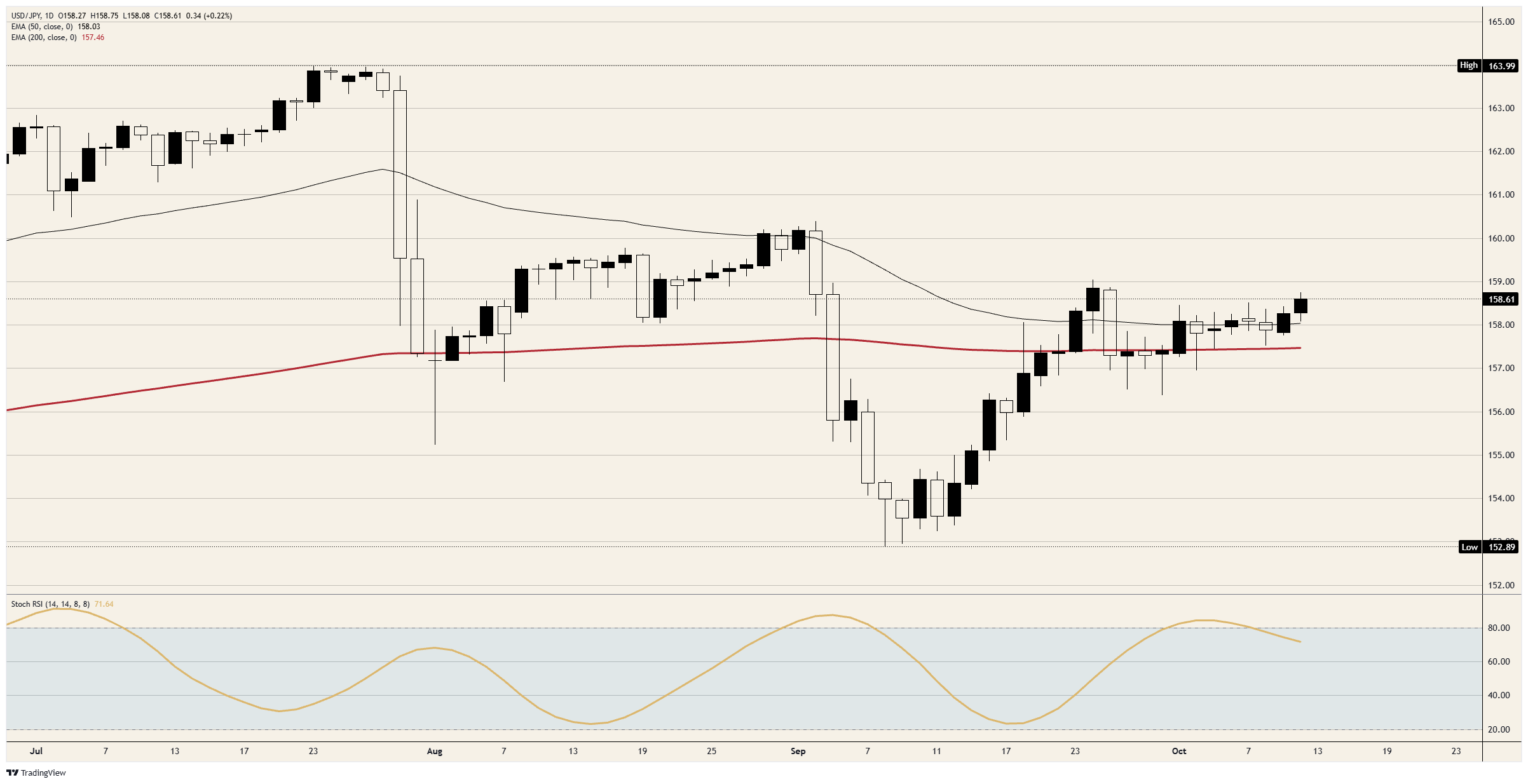
Levels between the 50-day average and 160.00
Resistance: Monday's high just above 158.50 is the highest since September 24, when the rally stopped just above 159.00. 160.00 is where the early-September drop started, the last time USD/JPY traded above it.
Support: Monday's low near 158.00 held at the 50-day Exponential Moving Average (EMA), also near 158.00. 157.50 has been under every daily close since October 1.
Bias: The lean stays long while 158.00 holds on a closing basis, aiming at 159.00 and then 160.00. The daily Stochastic Relative Strength Index (Stoch RSI) has turned down from near 85 to near 72 while price made its high, so momentum isn't confirming the move. A daily close below 157.50 ends the long.
USD/JPY daily chart
Japanese Yen FAQs
The Japanese Yen (JPY) is one of the world’s most traded currencies. Its value is broadly determined by the performance of the Japanese economy, but more specifically by the Bank of Japan’s policy, the differential between Japanese and US bond yields, or risk sentiment among traders, among other factors.
One of the Bank of Japan’s mandates is currency control, so its moves are key for the Yen. The BoJ has directly intervened in currency markets sometimes, generally to lower the value of the Yen, although it refrains from doing it often due to political concerns of its main trading partners. The BoJ ultra-loose monetary policy between 2013 and 2024 caused the Yen to depreciate against its main currency peers due to an increasing policy divergence between the Bank of Japan and other main central banks. More recently, the gradually unwinding of this ultra-loose policy has given some support to the Yen.
Over the last decade, the BoJ’s stance of sticking to ultra-loose monetary policy has led to a widening policy divergence with other central banks, particularly with the US Federal Reserve. This supported a widening of the differential between the 10-year US and Japanese bonds, which favored the US Dollar against the Japanese Yen. The BoJ decision in 2024 to gradually abandon the ultra-loose policy, coupled with interest-rate cuts in other major central banks, is narrowing this differential.
The Japanese Yen is often seen as a safe-haven investment. This means that in times of market stress, investors are more likely to put their money in the Japanese currency due to its supposed reliability and stability. Turbulent times are likely to strengthen the Yen’s value against other currencies seen as more risky to invest in.
Author

Joshua Gibson
FXStreet
Joshua joins the FXStreet team as an Economics and Finance double major from Vancouver Island University with twelve years' experience as an independent trader focusing on technical analysis.

















